
射电望远镜制造

Search documents
河北力量助SKA-Mid首获干涉条纹
Xin Lang Cai Jing· 2026-01-17 22:51
Core Insights - The SKA-Mid telescope has successfully achieved its first interferometric fringes, marking a significant milestone in its capability for collaborative observations [1][2] - The Square Kilometer Array (SKA) is a global project involving multiple countries, aiming to create the world's largest radio telescope with a total receiving area of approximately 1 square kilometer [1] - The successful combination of signals from multiple antennas allows for enhanced observational capabilities, with the recent achievement involving a radio galaxy located about 2.6 billion light-years from Earth [1] Group 1 - The SKA-Mid's interferometric observation capability is closely linked to the precision of the antenna structure and pointing accuracy developed by the China Electronics Technology Group Corporation [2] - The project team has conducted technical research on various indicators such as servo, electrical, and electromagnetic compatibility to improve antenna performance [2] - Enhancements in antenna control algorithms have led to improved precision in the servo system and tracking capabilities [2] Group 2 - The SKA-Mid is currently in an orderly construction phase, with plans for high-quality product delivery and steady progress in assembly and debugging [2] - The project team is actively engaged in system integration testing and validation with international partners at multiple sites [2] - The achievement of this milestone is seen as a significant technical challenge, demonstrating the ability of the SKA-Mid to function as a cohesive scientific observation instrument [2]
到南非看这个国际大科学工程,没想到负责人用中文说“谢谢”
Bei Jing Ri Bao Ke Hu Duan· 2025-10-01 07:13
Core Viewpoint - The Square Kilometre Array (SKA) is a significant international scientific project that has attracted global attention, particularly due to China's deep involvement in its construction and operation [1][3]. Group 1: Project Overview - The SKA is the world's largest integrated aperture radio telescope, funded by multiple countries, consisting of low-frequency arrays in Australia and mid-frequency arrays in South Africa and eight southern African countries [3]. - The project is named after its total receiving area of approximately one square kilometer [3]. Group 2: China's Contribution - China has made substantial contributions to the SKA, including the design and manufacture of 64 mid-frequency antennas, with several already installed and others in transit [5][7]. - The mid-frequency antennas are critical components of the SKA, with their structure being designed and constructed by a Chinese team, led by the China Electronics Technology Group Corporation [5][7]. - The antennas' main reflector consists of 66 independent panels, each adjusted with sub-millimeter precision to ensure smoothness and specific curvature, which is essential for collecting radio waves from space [5][7]. Group 3: International Collaboration - The SKA project exemplifies international collaboration, bringing together scientists and engineers from various countries to achieve common scientific goals [7][9]. - The SKA regional science center plays a crucial role in data aggregation from both South Africa and Australia, allowing global access to astronomical data [7][9]. Group 4: Acknowledgments and Future Prospects - South African officials expressed gratitude towards China for its core support in advancing the country's science, technology, and innovation systems [9]. - The project is expected to lead to further advancements in understanding the universe, with more Chinese-designed and manufactured antennas anticipated to be established in the Karoo region [9].

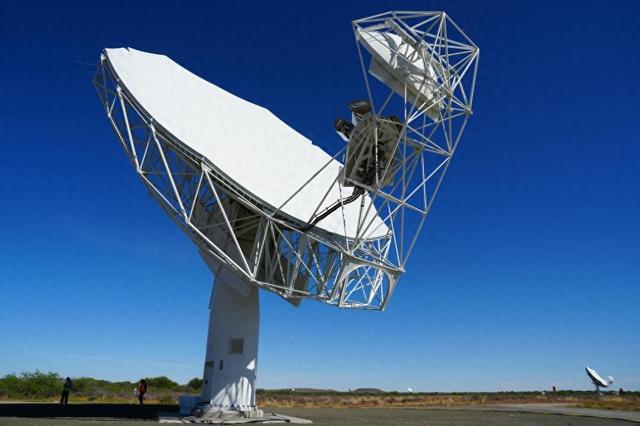
记者手记|国际大科学工程中的中国贡献——实地探访平方公里阵列射电望远镜南非台址
Xin Hua She· 2025-09-30 10:37
Core Insights - The article highlights China's significant contributions to the international scientific project, the Square Kilometre Array (SKA), which is the world's largest radio telescope project, involving multiple countries [1][2]. Group 1: Project Overview - The SKA consists of two parts: a low-frequency array in Australia and a mid-frequency array in South Africa and eight other southern African countries, named for its total receiving area of approximately one square kilometer [1]. - The MeerKAT radio telescope, a precursor to the SKA, features 64 hexagonal dishes, each with a diameter of 13.5 meters, located in the Karoo region of South Africa [1]. Group 2: China's Contributions - China has provided 64 mid-frequency antennas for the SKA, with three already installed and one undergoing testing, showcasing its role as a primary contractor for the antenna structure [2]. - The mid-frequency antennas are critical components of the SKA, with their main reflector made up of 66 individual panels, each requiring sub-millimeter precision adjustments to ensure optimal performance [2][3]. Group 3: Knowledge Transfer and Collaboration - China has also contributed to the development of the servo control system for the antennas, enhancing their pointing accuracy, which is essential for achieving the scientific goals of the SKA [3]. - The SKA regional science center, where data from both South Africa and Australia is aggregated, involves collaboration among astronomers, computer scientists, and engineers, with China playing a key role [3]. Group 4: International Cooperation - The SKA project fosters international collaboration, bringing together countries from both the Global North and South, with a shared goal of understanding the universe [3][4]. - South African officials expressed gratitude for China's support in advancing the country's scientific and technological capabilities [4].