文学研究

Search documents
“和而不同”的现代作家“合论”
Xin Lang Cai Jing· 2026-02-06 00:22
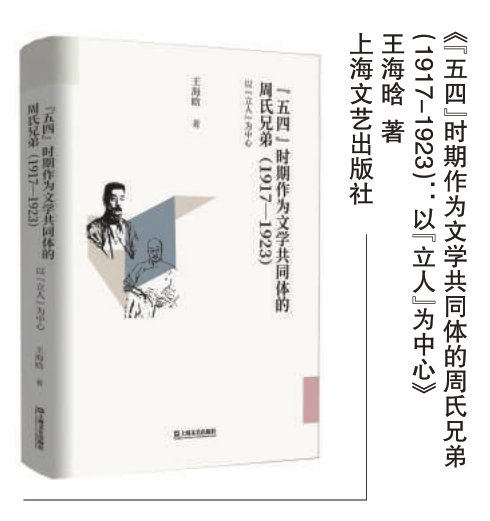
Group 1 - The article discusses the traditional practice of "combined criticism" in Chinese literary criticism, tracing its evolution from the Wei-Jin period to the Tang-Song era, highlighting how it shapes aesthetic judgments and contributes to literary history [2] - The work of young scholar Wang Haihan redefines the relationship between Lu Xun and Zhou Zuoren, presenting them as a "literary community" during the May Fourth Movement, focusing on their shared cultural practices rather than their differences [3][4] - The author emphasizes a methodology of "harmony in difference," arguing that the commonality of the "Li Ren" concept among Lu Xun and Zhou Zuoren serves as a foundation for their literary practices, which can be analyzed through their collaborative efforts in the journal "New Youth" [4][5] Group 2 - The book traces the establishment and collaborative division of labor within the Zhou brothers' literary community during the May Fourth period, examining how the "Li Ren" concept evolved into a cultural project reflected in their stylistic choices and rhetorical strategies [5][6] - The author critiques mainstream literary interpretations that focus solely on content or form, advocating for a return to the artists' perspectives and their conscious stylistic practices, which address social and ideological issues [6] - The methodology employed in the book opens new avenues for studying the Zhou brothers and the historical context of May Fourth literature, while also acknowledging the potential risks of hindsight in historical narratives [8]

“首届中外文学理论发展与中国自主知识体系构建学术论坛”纪要
Xin Lang Cai Jing· 2025-06-11 03:21
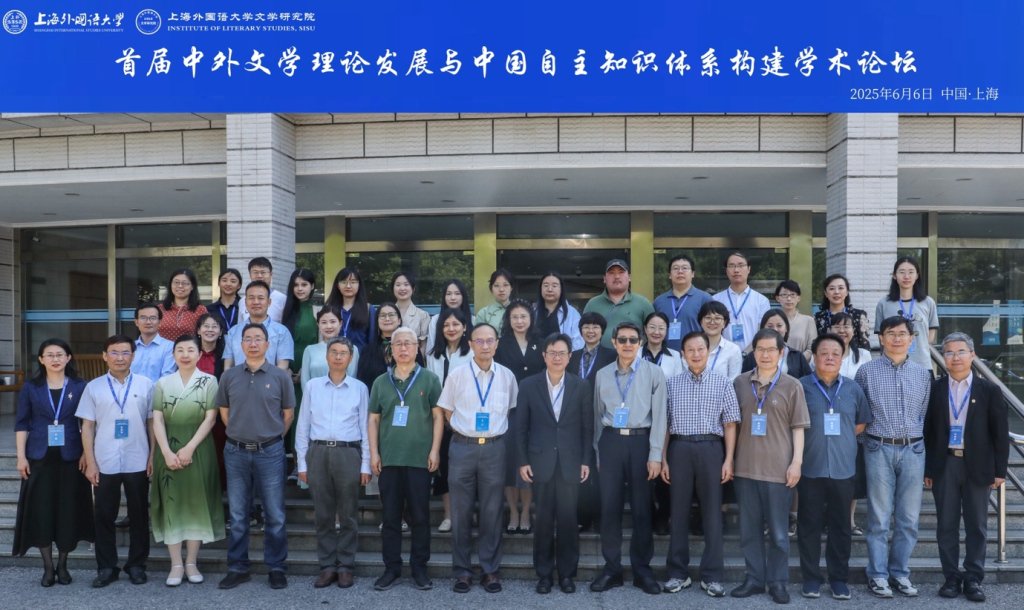
Core Viewpoint - The forum aims to promote the construction of a Chinese autonomous knowledge system in the context of global knowledge restructuring and the integration of Eastern and Western thoughts [3][6][45]. Group 1: Forum Overview - The "First Academic Forum on the Development of Chinese and Foreign Literary Theory and the Construction of China's Autonomous Knowledge System" was held on June 6, 2025, at Shanghai International Studies University [3]. - The forum was organized by the School of Literature at Shanghai International Studies University, with support from various academic teams and editorial departments [3][4]. Group 2: Key Participants - Notable participants included professors from various universities, such as Chen Zhongyi from the Chinese Academy of Social Sciences and Nie Zhenzhao from Guangdong University of Foreign Studies, who engaged in discussions on significant topics [4][6]. - The opening ceremony featured speeches from university leaders, emphasizing the importance of constructing an autonomous knowledge system [6][45]. Group 3: Thematic Discussions - Discussions focused on the need for a Chinese autonomous knowledge system that responds to contemporary challenges, particularly in the context of AI and the fourth industrial revolution [8][11]. - The concept of "Dao and Qi" was highlighted as a critical philosophical framework for integrating humanistic values with technological advancements [8][11]. Group 4: Challenges and Strategies - The forum addressed the challenges posed by Western-centric narratives and emphasized the importance of rewriting civilization history to establish a more balanced understanding of cultural exchanges [13][16]. - Strategies for constructing an autonomous knowledge system included promoting cultural confidence and integrating diverse linguistic and cultural perspectives [16][20]. Group 5: Future Directions - The need for a dynamic and open knowledge system that evolves with societal changes was emphasized, advocating for a system that is not rigid but adaptable [16][29]. - The forum concluded with a call for more engagement from younger scholars to expand the theoretical boundaries of Chinese literature research [45][49].