煤制乙二醇

Search documents
能耗双标杆新规下乙二醇的转型与供需格局重塑
Zhong Guo Neng Yuan Wang· 2025-12-24 09:28
Group 1 - The National Development and Reform Commission, along with other ministries, has issued a notice to promote the coal industry from low-end to high-end and to upgrade coal products from primary fuels to high-value products, with the release of the "Key Areas for Clean and Efficient Utilization of Coal Benchmark Levels and Baseline Levels (2025 Edition)" [1] - The 2025 edition includes indicators for coal consumption in coal-fired power generation and coal-to-natural gas, updating technical indicators based on national standards and policies from the past three years [1] - By the end of 2025, China's total ethylene glycol production capacity is projected to reach 29.865 million tons, a year-on-year increase of 3.93%, with coal-to-ethylene glycol capacity accounting for 993,000 tons per year, representing 33% of the total [1] Group 2 - There are approximately 26 coal-to-ethylene glycol enterprises in China, including major players like Henan Coal Industry, Yangquan Coal Group, and Yulin Chemical, with core production areas in Inner Mongolia, Shaanxi, Shanxi, and Xinjiang [2] - These regions benefit from low-cost raw coal and resource advantages, accounting for over 60% of the national production capacity, while provinces like Shandong, Jiangsu, and Zhejiang, despite lacking coal resources, have some coal-to-ethylene glycol facilities to meet local demand [2] - The main consumption markets for coal-to-ethylene glycol are concentrated in East China and South China, with specific companies supplying various regional markets [2] Group 3 - The coal-to-ethylene glycol industry in China shows significant differentiation in energy consumption control and efficiency standards, with leading companies achieving breakthroughs in energy consumption through process optimization and catalyst upgrades [3] - These top companies utilize direct synthesis gas methods or improved oxalic ester methods, achieving a coal conversion rate of over 80% and a by-product recovery rate of 95% [3] - Currently, most coal-to-ethylene glycol enterprises have energy consumption levels concentrated in the range of 2.9 to 3.2 tons [3] Group 4 - Approximately 75% of enterprises in the coal-to-ethylene glycol industry can stably meet advanced energy efficiency limits and strict environmental control requirements [4] - However, a significant proportion of enterprises, about 25%, do not meet the standards, primarily due to the use of outdated fixed-bed gasification technology and smaller overall plant sizes [4] - There are currently nine long-term shutdown plants, with some production capacities already being eliminated [4]


2025年中国煤制乙二醇行业PEST分析、产业链图谱、发展现状、竞争格局及发展趋势:聚酯消费占比最大,超80%[图]
Chan Ye Xin Xi Wang· 2025-08-20 01:41
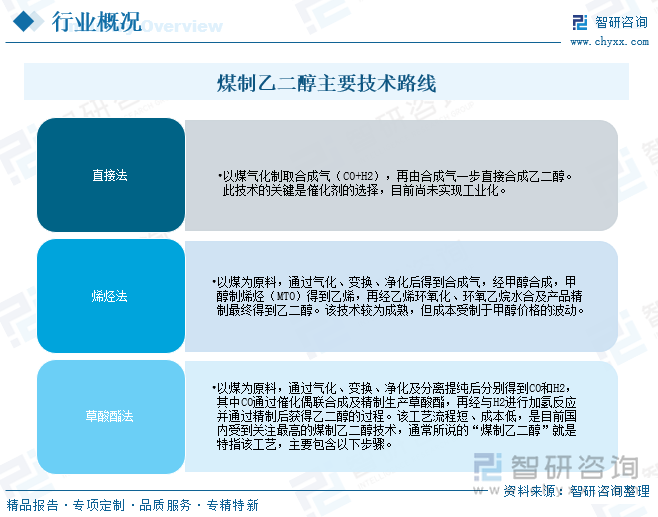
Core Viewpoint - The coal-to-ethylene glycol (EG) industry in China is experiencing continuous expansion and fluctuating growth, driven by the country's abundant coal resources and increasing market demand, with production expected to rise significantly by 2024 [1][12]. Overview - The coal-to-EG process utilizes coal as a primary raw material to produce ethylene glycol, which is widely used in various applications such as polyester fibers and antifreeze [2][4]. Development Background - China's energy structure, characterized by abundant coal but limited oil and gas, has led the government to promote coal-to-EG to reduce reliance on imported oil and ensure energy security, while also facing stricter environmental regulations under the "dual carbon" strategy [4]. Industry Chain 1. Industry Chain Structure - The coal-to-EG industry includes upstream suppliers of coal, oxygen, water, catalysts, and production equipment, with the downstream market primarily consisting of ethylene glycol applications [6]. 2. Upstream - Coal is the main raw material for coal-to-EG production, with China's coal output projected to reach 4.759 billion tons in 2024, a year-on-year increase of 2.17%, ensuring a stable supply for the industry [8]. 3. Downstream - Polyester is the largest consumer market for coal-to-EG, accounting for over 80% of consumption, with an annual growth rate of 7.09% in production capacity from 2016 to 2024 [10]. Current Development Status - The production of coal-to-EG in China is expected to increase from 1 million tons in 2016 to 3.988 million tons in 2024, with market size growing from 4.367 billion yuan to 15.365 billion yuan during the same period [12]. Competitive Landscape 1. Overall Landscape - The coal-to-EG enterprises are primarily located in resource-rich regions such as Inner Mongolia, Shanxi, Shaanxi, and Xinjiang, with 17 companies accounting for 66.4% of the total production capacity in 2024 [14]. 2. Representative Enterprises Analysis - **Shanxi Coal Group Yulin Chemical Co., Ltd.**: Established in December 2017, it operates a significant coal-to-EG project with a capacity of 1.8 million tons per year [16]. - **Xinjiang Tianye Co., Ltd.**: Focuses on a diversified green economy, with projected revenues of 11.16 billion yuan and a gross profit of 1.256 billion yuan in 2024 [18]. Development Trends - Future coal-to-EG enterprises are expected to increase investment in technology R&D, improve catalyst performance, and adopt advanced environmental technologies to achieve green transformation and comply with stricter regulations [20].