畜牧机器人

Search documents
2026年中国农业畜牧业机器人解决方案行业政策、产业链、市场规模及结构、市场集中度及发展趋势研判:市场集中度高,技术普及将呈现显著地域性分化[图]
Chan Ye Xin Xi Wang· 2026-01-16 01:27
Core Viewpoint - The agricultural and livestock robotics solutions aim to enhance efficiency, precision, and consistency in modern agricultural production and livestock management through smart automation systems. The market for these solutions is experiencing significant growth, becoming a crucial part of global smart agriculture development [1][2]. Market Size and Growth - The global agricultural and livestock robotics solutions market is projected to grow from $7.6 billion in 2020 to $15.7 billion by 2025, with agricultural robotics solutions accounting for approximately $8.9 billion (56.69%) and livestock robotics solutions for $6.8 billion (43.31%) [2][3]. - By 2026, the market size is expected to reach $18.4 billion, with agricultural robotics solutions estimated at $10.6 billion (57.61%) and livestock robotics solutions at $7.8 billion (42.39%) [1][4]. Industry Definition and Types - Agricultural and livestock robotics solutions are defined as smart automation systems that integrate advanced technologies such as GNSS positioning, LiDAR, computer vision, and automation control to enhance crop planting and livestock management efficiency [2][3]. Current Industry Status - The industry is witnessing a trend of increasing adoption of smart robotics in various agricultural applications, including automated planting, harvesting systems, and data collection in both agriculture and aquaculture [1][2]. Industry Chain - The upstream of the agricultural and livestock robotics solutions industry includes suppliers of raw materials and core components such as metals, chips, sensors, and servomotors, while the midstream consists of the robotics solutions themselves. The downstream applications are focused on large-scale agricultural planting, livestock farms, and government-led smart pasture projects [4][5]. Policy Environment - The Chinese government has implemented a series of policies to accelerate the development of agricultural and livestock robotics solutions, recognizing their critical role in modernizing agriculture and supporting rural revitalization [6][7]. Competitive Landscape - The market for agricultural robot automatic steering systems is characterized by high concentration, with a CR5 of 77.6% and a CR1 of 30.6% in 2024, indicating an oligopolistic competition structure [7][8]. Company Spotlight - Fengjiang Intelligent Technology Co., Ltd. is a key player in the agricultural robotics solutions market, focusing on providing intelligent and digital solutions across various agricultural processes. In the first half of 2025, the company reported revenues of 358 million yuan, with 263 million yuan (73.29%) coming from agricultural and livestock solutions [9]. Industry Development Trends - The agricultural and livestock robotics solutions sector is transitioning from technological breakthroughs to commercial implementation, with expectations of deep integration of AIoT and edge computing technologies in the next five years, leading to significant regional variations in technology adoption [10].


研判2025!中国畜牧机器人行业发展背景、市场现状及布局企业分析:“农业强国”战略背景下,行业发展前景广阔[图]
Chan Ye Xin Xi Wang· 2025-07-09 01:20
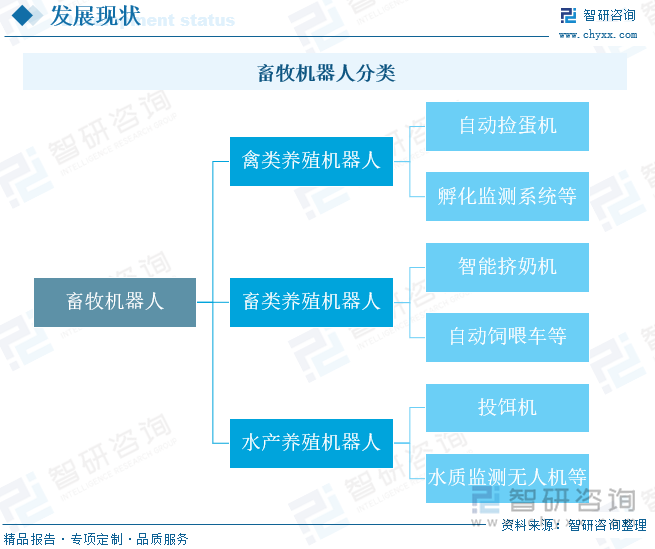
Core Viewpoint - The livestock robotics industry is experiencing significant growth driven by technological advancements and policy support, with the market expected to reach 1.87 billion yuan in 2024, a 20% increase year-on-year, and projected to exceed 2.2 billion yuan by 2025 [1][16]. Industry Overview - Livestock robots integrate sensor technology, artificial intelligence, automation control systems, and the Internet of Things to enhance efficiency, reduce labor costs, and achieve sustainable production in livestock farming [2][4]. - The main functions of livestock robots include environmental monitoring, feeding management, milking operations, disease warning, cleaning and disinfection, and data collection [2][4]. Market Structure - Feeding robots account for approximately 35% of the market, followed by milking robots at 25%, inspection robots at 20%, and cleaning robots at 15%, with other types making up less than 5% [18][19]. Development Stages - The development of livestock robots in China can be categorized into three stages: 1. **Emergence Phase (2000-2015)**: Introduction of European milking robots, with high costs and limited applicability [4]. 2. **Growth Phase (2016-2020)**: Acceleration of domestic alternatives due to policy support and capital influx, with costs decreasing by about 50% [4]. 3. **Explosive Phase (2021 onwards)**: Deep integration of AI and 5G technologies, leading to increased penetration of smart livestock equipment across various scales of farming [4]. Factors Driving Development - The large scale of livestock farming in China provides a vast market for livestock robots, with significant increases in livestock numbers and production volumes [8][11]. - Labor shortages in rural areas due to aging populations and declining workforce numbers are driving the demand for automation and mechanization in livestock farming [11]. - Continuous policy support aimed at modernizing the livestock sector is fostering the growth of the livestock robotics industry [13][15]. Industry Players - Key companies in the livestock robotics sector include Muyuan Foods, New Hope, Wens Foodstuff, and Lihua Technology, among others [2][24]. - Emerging companies such as Beijing Guoke Chengtai Agricultural Equipment and Hefei Lasset Robot Technology are also contributing to the innovation in this field [2][24]. Future Trends - The development of livestock robots is expected to lead to higher levels of automation and intelligence in livestock farming, enhancing economic benefits and sustainability [25]. - Future innovations will focus on improving efficiency, environmental sustainability, and animal welfare, further advancing agricultural technology in China [25].