
智能农业

Search documents
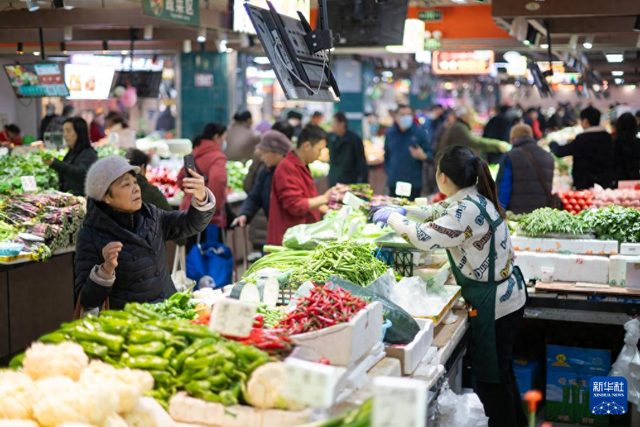
中外网友“大对账”,对到了菜市场
Xin Lang Cai Jing· 2026-02-14 06:12
Core Viewpoint - The article highlights the stark contrast in fruit and vegetable availability between China and several Western countries, emphasizing China's successful agricultural policies and practices that ensure year-round supply of diverse produce [3][10]. Group 1: Agricultural Policies and Achievements - China's "vegetable basket" project, initiated in 1988, has significantly improved the supply of vegetables, meat, and dairy, leading to increased farmer incomes and a stable supply chain [6][7]. - In 2023, the average per capita vegetable consumption in China reached 588 kilograms, with vegetable cultivation area consistently exceeding 300 million mu, maintaining the world's largest scale [3][10]. - China is the world's largest producer and consumer of fruits, with a total fruit production of 335 million tons and consumption of 328 million tons in 2024, far exceeding the global average per capita fruit consumption [3][10]. Group 2: Technological Advancements and Infrastructure - The use of advanced technology in agricultural practices, such as smart systems for monitoring soil conditions and automated irrigation, has transformed traditional greenhouses into intelligent "cloud greenhouses" [9]. - The establishment of a comprehensive cold chain logistics system facilitates the efficient transportation of produce across regions, ensuring fresh vegetables reach consumers quickly [9][10]. - China's focus on seed breeding has led to a domestic seed market share exceeding 91%, contributing to the diversity and quality of produce available [9][10]. Group 3: Global Context and Comparisons - In contrast to China's agricultural success, several Western countries face challenges such as adverse weather conditions and rising energy costs, leading to reduced vegetable production and supply shortages [3][6]. - Reports from the UK, South Korea, and Australia indicate significant vegetable shortages due to various factors, highlighting the effectiveness of China's agricultural policies in maintaining a stable supply [3][6].

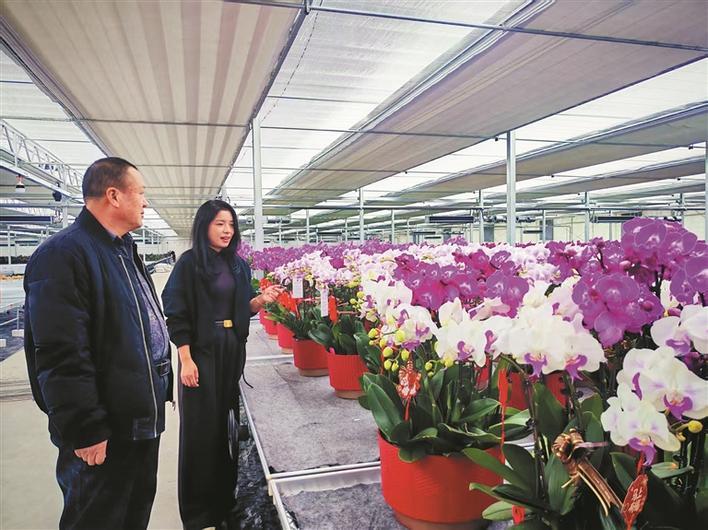
“鲜花小镇”迎客忙
Xin Lang Cai Jing· 2026-02-10 20:03
Core Insights - The flower market is experiencing a peak sales season as the Spring Festival approaches, with various flowers like orchids and tulips being showcased at the Bingtuan International Flower Industry Park [2][3] - The park has implemented advanced technology for flower cultivation, including smart temperature control and integrated water and fertilizer systems, ensuring optimal growth conditions year-round [3][4] - The project aims to create a "Flower Town" that combines tourism, education, and agricultural experiences, with a total investment of 500 million yuan and plans for further expansion [4][5] Industry Overview - The Bingtuan International Flower Industry Park has prepared over 60,000 high-quality flowers to meet the demand for the New Year flower market, utilizing efficient logistics to supply various regions [4] - The park's advanced technology not only reduces labor costs but also enhances the stability of flower quality and extends their blooming period, resulting in superior products for the market [3][4] - The project is expected to create over 400 jobs upon full completion, contributing to local employment and economic growth [4][5]
越南永隆省大力发展绿色、循环农业
Shang Wu Bu Wang Zhan· 2026-02-02 16:01
Core Insights - The article discusses the efforts of Vinh Long Province in Vietnam to promote agricultural modernization through technology and digital transformation, aiming for sustainable and green development in agriculture [1][2] Group 1: Technological and Digital Transformation - Vinh Long Province is implementing the 57th Resolution of the Central Committee of the Communist Party regarding technological innovation and digital transformation in agriculture [1] - The province aims for 15%-20% of agricultural production area to utilize high-tech by 2030, creating smart production areas and traceability systems throughout the value chain [1] - Advanced technologies such as variety improvement, biotechnology, mechanization, automation, and smart management are increasingly applied, reducing costs and enhancing resource efficiency [1] Group 2: Agricultural Development and Sustainability - The province is focusing on green agriculture and circular economy development, emphasizing reduced chemical fertilizer use and increased application of organic fertilizers and bioproducts [2] - Vinh Long's main agricultural products are rice and coconuts, with over 9,200 households registered in the "1 Million Hectares of Quality Low-Carbon Rice Sustainable Development Plan," aiming for at least 50,000 hectares by 2030 [2] - The coconut industry targets an area of approximately 132,000 hectares by 2030, with 50% being organic coconuts, leveraging the carbon credit potential of coconut trees [2]
个旧金秋三生农业科技有限公司成立,注册资本500万人民币
Sou Hu Cai Jing· 2026-01-19 17:05
Core Viewpoint - A new company, Gejiu Golden Autumn San Sheng Agricultural Technology Co., Ltd., has been established with a registered capital of 5 million RMB, focusing on various agricultural and technology services [1] Company Summary - The legal representative of the company is Ding Guijun [1] - The company is jointly owned by Yunnan Golden Autumn San Sheng Agricultural Technology Co., Ltd. (63% stake), Yunnan Beirui Agricultural Development Co., Ltd. (27% stake), and Niu Yong (10% stake) [1] - The company is registered in Gejiu City, Yunnan Province, and its business scope includes agricultural research, technology services, and various agricultural production and sales activities [1] Industry Summary - The company operates in the scientific research and technical service industry, specifically in technology promotion and application services [1] - Its business activities encompass a wide range of services, including agricultural production management, supply chain management, and internet sales [1] - The company is also involved in the sale and processing of agricultural products, as well as the development of artificial intelligence applications and smart agricultural management [1]
2026年中国农业畜牧业机器人解决方案行业政策、产业链、市场规模及结构、市场集中度及发展趋势研判:市场集中度高,技术普及将呈现显著地域性分化[图]
Chan Ye Xin Xi Wang· 2026-01-16 01:27
Core Viewpoint - The agricultural and livestock robotics solutions aim to enhance efficiency, precision, and consistency in modern agricultural production and livestock management through smart automation systems. The market for these solutions is experiencing significant growth, becoming a crucial part of global smart agriculture development [1][2]. Market Size and Growth - The global agricultural and livestock robotics solutions market is projected to grow from $7.6 billion in 2020 to $15.7 billion by 2025, with agricultural robotics solutions accounting for approximately $8.9 billion (56.69%) and livestock robotics solutions for $6.8 billion (43.31%) [2][3]. - By 2026, the market size is expected to reach $18.4 billion, with agricultural robotics solutions estimated at $10.6 billion (57.61%) and livestock robotics solutions at $7.8 billion (42.39%) [1][4]. Industry Definition and Types - Agricultural and livestock robotics solutions are defined as smart automation systems that integrate advanced technologies such as GNSS positioning, LiDAR, computer vision, and automation control to enhance crop planting and livestock management efficiency [2][3]. Current Industry Status - The industry is witnessing a trend of increasing adoption of smart robotics in various agricultural applications, including automated planting, harvesting systems, and data collection in both agriculture and aquaculture [1][2]. Industry Chain - The upstream of the agricultural and livestock robotics solutions industry includes suppliers of raw materials and core components such as metals, chips, sensors, and servomotors, while the midstream consists of the robotics solutions themselves. The downstream applications are focused on large-scale agricultural planting, livestock farms, and government-led smart pasture projects [4][5]. Policy Environment - The Chinese government has implemented a series of policies to accelerate the development of agricultural and livestock robotics solutions, recognizing their critical role in modernizing agriculture and supporting rural revitalization [6][7]. Competitive Landscape - The market for agricultural robot automatic steering systems is characterized by high concentration, with a CR5 of 77.6% and a CR1 of 30.6% in 2024, indicating an oligopolistic competition structure [7][8]. Company Spotlight - Fengjiang Intelligent Technology Co., Ltd. is a key player in the agricultural robotics solutions market, focusing on providing intelligent and digital solutions across various agricultural processes. In the first half of 2025, the company reported revenues of 358 million yuan, with 263 million yuan (73.29%) coming from agricultural and livestock solutions [9]. Industry Development Trends - The agricultural and livestock robotics solutions sector is transitioning from technological breakthroughs to commercial implementation, with expectations of deep integration of AIoT and edge computing technologies in the next five years, leading to significant regional variations in technology adoption [10].


2026中东海湾食品展全球首发:AI、机器人与生物科技引爆食品行业
Zhong Guo Shi Pin Wang· 2026-01-14 09:45
Group 1 - The Gulfood 2026 will take place from January 26 to 30, 2026, in Dubai, featuring over 8,500 international exhibitors and participants from 195 countries, covering twelve core sectors of the food industry [1] - The event will focus on food technology innovation, emerging AI trends, digital upgrades, and sustainable solutions, positioning itself as a driving force for the future growth of the food and beverage industry [4][9] - AI is becoming a significant technological force in the food industry, enhancing efficiency from "farm to table" through demand forecasting, waste reduction, and data-driven production decisions [7][8] Group 2 - The AI-driven food technology market is projected to reach approximately $27.73 billion by 2029, while the alternative protein market is expected to grow to $185.49 billion by 2029 [8] - Innovations in cultivated meat and precision fermentation dairy products are accelerating commercialization, offering both sustainability and market profitability [8] - The 3D food printing market is anticipated to reach $425.7 million by 2034, driven by increasing personalized nutrition demands [8] Group 3 - The World Economic Forum estimates that innovations around food and agricultural sustainability could unlock approximately $2.3 trillion in new commercial value by 2030 [9] - Gulfood 2026 will serve as a premier international platform for showcasing food technology innovations, enabling companies to capture new opportunities and enhance competitiveness [9][10] - The event is not just a food exhibition but a strategic international event aimed at upgrading the global food industry and shaping the market landscape for the next decade [9]

超达装备:公司于2025年8月成立了子公司江苏超达智能科技有限公司
Zheng Quan Ri Bao Wang· 2025-12-23 13:45
Group 1 - The core viewpoint of the article highlights that the company, ChaoDa Equipment, is actively exploring the integration of industrial technology into agriculture through its subsidiary, Jiangsu ChaoDa Intelligent Technology Co., Ltd., established in August 2025 [1] - The subsidiary's core business is currently in the trial production and promotion phase, indicating the company's commitment to advancing smart agriculture [1]

新农人兴农
Xin Lang Cai Jing· 2025-12-19 22:32
Core Insights - The article highlights the transformation of agricultural practices in Yifengdian Town, where local farmers leverage digital tools and live streaming to enhance vegetable sales and agricultural knowledge sharing [1][2][3]. Group 1: Digital Transformation in Agriculture - Wang Guangfeng, a village party secretary, utilizes live streaming to sell over 25 million pounds of vegetables annually, significantly increasing village collective income by over 800,000 yuan [1]. - Zhu Dianyue, a planting expert, has created over 3,000 agricultural science videos, helping more than 2,000 farmers solve planting issues through "cloud consultations" [2]. - The town has nearly 60,000 acres of vegetable planting area and 26 seed companies, with annual seed sales exceeding 800 million yuan [2]. Group 2: Smart Agricultural Practices - The introduction of smart greenhouses allows real-time monitoring and control of key growth factors, improving seedling emergence rates from 70% to over 95% [2]. - Automation in farming is exemplified by the use of a tractor equipped with a Beidou navigation system, which enhances operational efficiency and accuracy in planting [3]. - The "Jiang Dajie" brand, led by Jiang Bo, has achieved annual vegetable sales exceeding 10,000 tons, with exports to countries like South Korea, Malaysia, and Singapore [3].
视频丨从“会种地”到“慧种地” 看十亿亩农田“版本升级”
Yang Shi Xin Wen Ke Hu Duan· 2025-12-13 12:19
Core Viewpoint - The article discusses the modernization and upgrading of agricultural practices in China, highlighting the integration of technology and infrastructure improvements to enhance productivity and resilience against climate challenges. Group 1: Technological Advancements - Farmers are adopting advanced equipment such as precision seeders, harvesters, and drones to improve efficiency and productivity [1][8] - Digital production methods are being implemented, leading to higher yields and better management of agricultural activities [3][6] - The use of data platforms allows farmers to monitor their fields in real-time, significantly improving oversight and decision-making [6] Group 2: Infrastructure Improvements - China plans to build and renovate 80 million acres of high-standard farmland this year, enhancing facilities and ecological conditions to ensure stable and high yields [13] - The construction of irrigation and drainage systems, such as interconnected ditches, is crucial for managing water resources effectively during droughts and floods [19][21] - The modernization of large and medium-sized irrigation areas and water conservancy projects is a focus to strengthen food security [23] Group 3: Agricultural Data and AI Integration - Remote sensing satellites and AI models are being utilized to monitor crop growth and optimize agricultural practices, contributing to increased yields and reduced pest issues [27][29][31] - The contribution rate of agricultural technology progress in China has reached 63.2%, with over 75% mechanization in farming operations [33] Group 4: Policy and Financial Support - The government is providing over 2,000 yuan per acre for high-standard farmland, with a focus on tailored solutions for different regions [36] - More than 1.1 million social service organizations are assisting farmers with various agricultural tasks, ensuring that smallholders can access advanced technologies [36][38] Group 5: Future Goals - Over 100 million acres of high-standard farmland have been established, with a target of 135 million acres by 2030 and complete upgrades of permanent basic farmland by 2035 [38]
东华软件等成立新公司,含智能农业管理业务
3 6 Ke· 2025-12-05 06:47
Group 1 - Donghua Software (Tacheng) Co., Ltd. has been established with a registered capital of 50 million RMB [1] - The legal representative of the new company is Cui Yulu [1] - The business scope includes intelligent control system integration, smart agriculture management, big data services, and data processing services [1] Group 2 - The company is jointly held by Donghua Software Co., Ltd. and other shareholders [1]
