科研实验设备

Search documents
把太空中的重力环境“搬”到地球
Ren Min Ri Bao· 2025-11-03 03:16
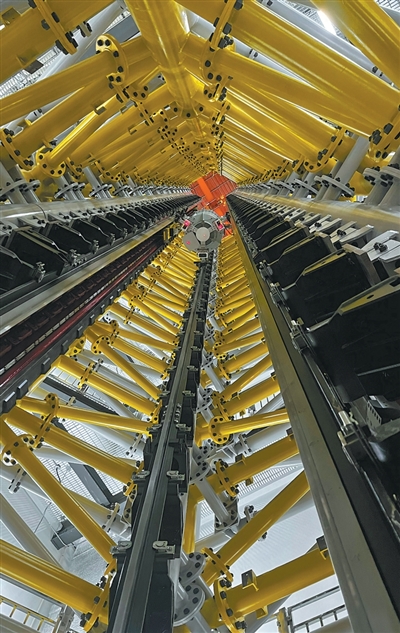
Core Viewpoint - The launch of Asia's first electromagnetic catapult microgravity experimental device by the Chinese Academy of Sciences provides a new platform for scientific experiments in microgravity environments, which can reveal phenomena that differ significantly from those under normal gravity conditions [2][4]. Group 1: Device Functionality and Design - The electromagnetic catapult device simulates microgravity by rapidly launching an experimental capsule, allowing for a brief period of microgravity during ascent and descent, with effective microgravity time reaching up to 4 seconds [2][4]. - The tower housing the device is approximately 44 meters tall, with a steel structure of about 40 meters, featuring a triangular guide rail and two visible red linear motors that provide the electromagnetic propulsion [2][4]. Group 2: Experimental Efficiency and Capabilities - Compared to traditional microgravity devices, the electromagnetic catapult offers significant advantages in simulation precision, experimental efficiency, payload strength requirements, and cost [4]. - The device can initiate a second experiment within 10 minutes, whereas traditional drop tower devices can only conduct two to three experiments in a day [4]. Group 3: Research and Future Applications - Since its trial operation began in July 2023, the device has completed over 300 microgravity experiments across six categories, including fluid physics and combustion science [4]. - Plans are in place to conduct over 1,000 additional experiments simulating microgravity, lunar gravity, and Martian gravity, supporting major scientific projects and providing technical support for manned spaceflight and deep space exploration [4].

把太空中的重力环境“搬”到地球(探一线)
Ren Min Ri Bao· 2025-10-31 22:32
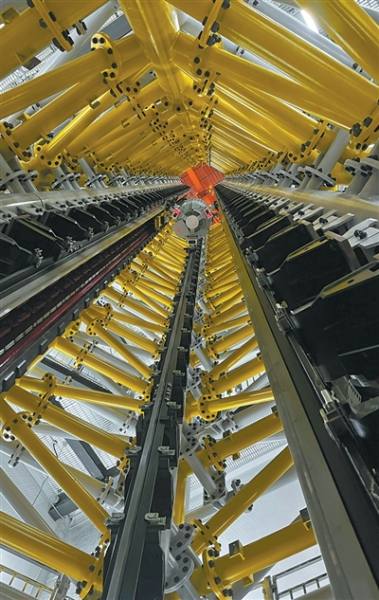
Core Viewpoint - The launch of Asia's first electromagnetic catapult microgravity experimental device by the Chinese Academy of Sciences provides a new platform for scientific experiments in microgravity environments, which can reveal phenomena that differ significantly from those under normal gravity conditions [1][3]. Group 1: Device Overview - The electromagnetic catapult microgravity experimental device simulates microgravity conditions on the ground, allowing for various scientific experiments [1]. - The device features a tower approximately 44 meters high, with a steel structure of about 40 meters, and utilizes linear motors to provide electromagnetic propulsion for the experimental cabin [1][2]. - The device can achieve effective microgravity time of up to 4 seconds during its operation, and it can also simulate low-gravity environments like those on the Moon and Mars [1][3]. Group 2: Experimental Efficiency - Compared to traditional microgravity devices, the electromagnetic catapult offers significant advantages in simulation precision, experimental efficiency, payload strength requirements, and cost [3]. - Traditional drop tower devices can only conduct two to three experiments per day, while the new device can initiate a second experiment within 10 minutes [3]. Group 3: Research and Future Plans - Since its trial operation began in July 2023, the device has completed over 300 microgravity experiments across six categories, including fluid physics and combustion science [3]. - The company plans to conduct over 1,000 additional experiments related to microgravity, lunar gravity, and Martian gravity, providing essential support for major projects in manned spaceflight and deep space exploration [3].