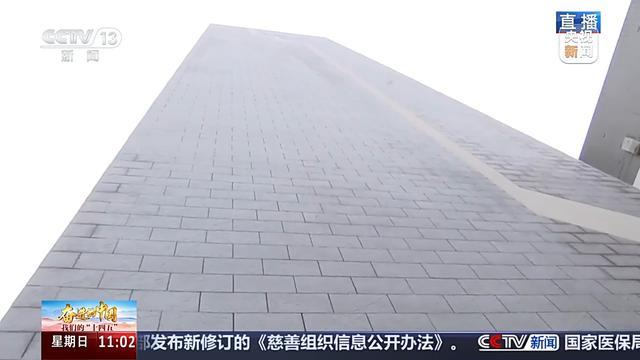
电磁弹射微重力实验装置

Search documents
把太空中的重力环境“搬”到地球
Ren Min Ri Bao· 2025-11-03 03:16
Core Viewpoint - The launch of Asia's first electromagnetic catapult microgravity experimental device by the Chinese Academy of Sciences provides a new platform for scientific experiments in microgravity environments, which can reveal phenomena that differ significantly from those under normal gravity conditions [2][4]. Group 1: Device Functionality and Design - The electromagnetic catapult device simulates microgravity by rapidly launching an experimental capsule, allowing for a brief period of microgravity during ascent and descent, with effective microgravity time reaching up to 4 seconds [2][4]. - The tower housing the device is approximately 44 meters tall, with a steel structure of about 40 meters, featuring a triangular guide rail and two visible red linear motors that provide the electromagnetic propulsion [2][4]. Group 2: Experimental Efficiency and Capabilities - Compared to traditional microgravity devices, the electromagnetic catapult offers significant advantages in simulation precision, experimental efficiency, payload strength requirements, and cost [4]. - The device can initiate a second experiment within 10 minutes, whereas traditional drop tower devices can only conduct two to three experiments in a day [4]. Group 3: Research and Future Applications - Since its trial operation began in July 2023, the device has completed over 300 microgravity experiments across six categories, including fluid physics and combustion science [4]. - Plans are in place to conduct over 1,000 additional experiments simulating microgravity, lunar gravity, and Martian gravity, supporting major scientific projects and providing technical support for manned spaceflight and deep space exploration [4].

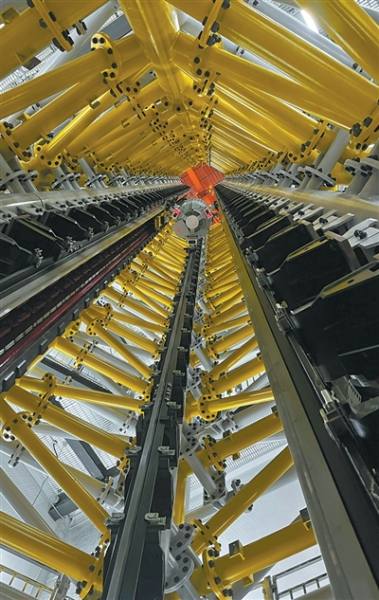
把太空中的重力环境“搬”到地球(探一线)
Ren Min Ri Bao· 2025-10-31 22:32
Core Viewpoint - The launch of Asia's first electromagnetic catapult microgravity experimental device by the Chinese Academy of Sciences provides a new platform for scientific experiments in microgravity environments, which can reveal phenomena that differ significantly from those under normal gravity conditions [1][3]. Group 1: Device Overview - The electromagnetic catapult microgravity experimental device simulates microgravity conditions on the ground, allowing for various scientific experiments [1]. - The device features a tower approximately 44 meters high, with a steel structure of about 40 meters, and utilizes linear motors to provide electromagnetic propulsion for the experimental cabin [1][2]. - The device can achieve effective microgravity time of up to 4 seconds during its operation, and it can also simulate low-gravity environments like those on the Moon and Mars [1][3]. Group 2: Experimental Efficiency - Compared to traditional microgravity devices, the electromagnetic catapult offers significant advantages in simulation precision, experimental efficiency, payload strength requirements, and cost [3]. - Traditional drop tower devices can only conduct two to three experiments per day, while the new device can initiate a second experiment within 10 minutes [3]. Group 3: Research and Future Plans - Since its trial operation began in July 2023, the device has completed over 300 microgravity experiments across six categories, including fluid physics and combustion science [3]. - The company plans to conduct over 1,000 additional experiments related to microgravity, lunar gravity, and Martian gravity, providing essential support for major projects in manned spaceflight and deep space exploration [3].
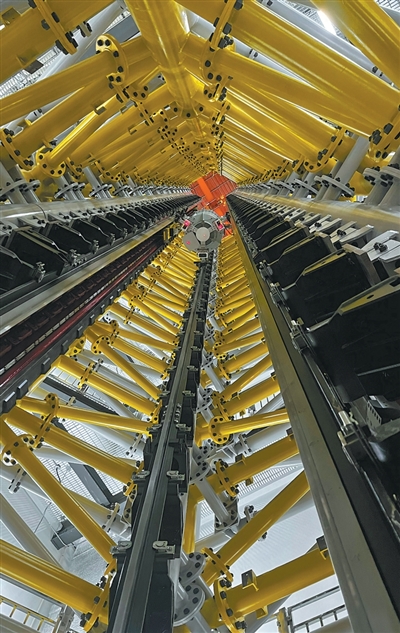
亚洲首个电磁弹射微重力实验装置启动新一轮科学实验 把太空中的重力环境“搬”到地球(探一线)
Ren Min Ri Bao· 2025-10-31 22:04
Core Viewpoint - The launch of Asia's first electromagnetic catapult microgravity experimental device by the Chinese Academy of Sciences marks a significant advancement in simulating microgravity environments for scientific research, providing new pathways to explore phenomena that differ from those observed under normal gravity conditions [1][2]. Group 1: Device Overview - The electromagnetic catapult microgravity experimental device simulates microgravity conditions on Earth, allowing for various scientific experiments across different disciplines [1]. - The device operates by rapidly launching an experimental capsule, creating a brief microgravity environment for approximately 4 seconds during ascent and descent [1][2]. - The structure includes a 44-meter tall tower with a 40-meter steel body, featuring triangular guide rails and linear motors that provide electromagnetic propulsion [1]. Group 2: Experimental Efficiency - Compared to traditional microgravity devices, the electromagnetic catapult offers significant advantages in precision, efficiency, payload strength requirements, and cost [2]. - Traditional drop tower devices can conduct only 2-3 experiments per day, while the new device can initiate a second experiment within 10 minutes [2]. - Since its trial operation began in July 2023, the device has completed over 300 microgravity experiments across six categories, including fluid physics and combustion science [2]. Group 3: Future Applications - The device is set to support over 1,000 planned experiments simulating microgravity, lunar gravity, and Martian gravity, contributing to major scientific projects and providing technical support for manned spaceflight and deep space exploration [2].
“前沿科技+重大工程”喜讯不断 “硬核”实力彰显中国力量
Yang Shi Wang· 2025-10-13 06:04
Group 1: Hydropower Development - The Yebatan Hydropower Station has officially begun water storage, marking the start of the commissioning phase for its first units [1] - Located on the Jinsha River, the station is a key component of China's "14th Five-Year Plan" for clean energy development, with a total installed capacity of 2.24 million kilowatts and a maximum dam height of 217 meters [1] - The station is expected to generate an average annual output of over 10.2 billion kilowatt-hours, saving nearly 4 million tons of standard coal and reducing carbon dioxide emissions by approximately 7.37 million tons annually [3] Group 2: Electromagnetic Launch System - The first electromagnetic launch microgravity experimental device in Asia has commenced a new round of scientific experiments, focusing on life sciences [4] - Since its operation in 2023, the device has completed over 300 experiments across six categories, providing valuable data for advanced research [6] - The device is designed to simulate lunar microgravity conditions and plans to build a facility capable of achieving 20 seconds of microgravity time at a depth of 800 meters [7] Group 3: Deep Space Observation - Recent advancements in deep space observation have been made with the "Event Horizon Telescope," which consists of six radio telescopes connected in a network across China [8] - This network has an effective aperture equivalent to the size of China's land area, allowing for high clarity and precision in observations [8] - The telescope network has recently detected new changes in black holes, enhancing navigation capabilities for spacecraft in deep space exploration [10]

首次、领跑、跨越!上周末 大国重器捷报频传
Yang Shi Xin Wen· 2025-10-13 01:12
Group 1: Nuclear Energy Development - The "Hualong One" Unit 2 at the world's largest nuclear power base in Fujian has commenced its first nuclear fuel loading, marking a significant milestone in nuclear power engineering [1] - The "Hualong One" technology is currently the most widely used third-generation nuclear power technology globally, with Unit 1 already in commercial operation and Unit 2 expected to start generating power in Q4 of this year [1] - Once operational, Unit 2 is projected to provide over 10 billion kilowatt-hours of clean electricity annually [1] Group 2: Space and Scientific Research - China has conducted its first ground-based microgravity experiment using a mouse, facilitated by the electromagnetic catapult microgravity experimental device developed by the Chinese Academy of Sciences [3][4] - The electromagnetic catapult structure weighs over 300 tons and provides effective microgravity time of up to 4 seconds during experiments, contributing valuable data for material and combustion science [4] - The FAST telescope has discovered 1,152 pulsars, significantly surpassing the total number discovered by other international telescopes during the same period, marking a leap in China's radio astronomy research [5][7] Group 3: Meteorological Advancements - China has established a comprehensive meteorological observation system consisting of 9 Fengyun satellites, 842 weather radars, and over 90,000 ground observation stations, achieving a global leading level with its self-developed Beidou sounding system [8] - The integration of 35 commercial meteorological small satellites into operational meteorological services enhances the observational capabilities of Fengyun satellites [8] Group 4: Aerospace Achievements - The successful launch of the Gravity-1 remote-controlled rocket from Taiyuan Satellite Launch Center marks the second flight of this rocket, which has been upgraded for improved reliability and can carry over 400 kilograms of satellites [9] - The Gravity-1 rocket is designed to meet the demands for large-scale low-orbit satellite constellation launches in the future [9] Group 5: Overall Technological Progress - The series of advancements in various fields reflects the vibrant and robust technological innovation capabilities of China in the new era, with expectations for more progress and achievements [10]
“超级跳楼机” 探访亚洲首台电磁弹射微重力实验装置
Huan Qiu Wang Zi Xun· 2025-10-12 11:47
Core Viewpoint - The article highlights the introduction of Asia's first electromagnetic catapult microgravity experimental device, which utilizes the same electromagnetic launch technology as the Fujian aircraft carrier, enabling ground-based microgravity scientific experiments without the need for flight [3]. Group 1 - The device is referred to as a "super elevator," allowing for the execution of microgravity experiments on the ground [3]. - The technology is significant for advancing scientific research capabilities in the region [3].
国之重器硬核4秒!第一视角看电磁弹射
Huan Qiu Wang Zi Xun· 2025-10-12 08:33
Core Insights - The first microgravity experiment on mice conducted on the ground in China marks a significant advancement in life sciences research [4] - The electromagnetic catapult microgravity experimental device has completed over 300 scientific experiments since its operation began in 2023, providing valuable data for material and combustion sciences [2] Group 1: Experimental Device Specifications - The electromagnetic catapult microgravity experimental device is a steel structure weighing over 300 tons and standing approximately 44 meters tall, equivalent to 15 stories [2] - The device can provide effective microgravity for up to 4 seconds, with 2 seconds of microgravity during both ascent and descent phases [2] - The device's efficiency allows for a significant reduction in impact force during experiments, lowering it to 5g compared to over 20g in traditional drop tower setups [8] Group 2: Biological Research Applications - The recent experiment involved six drug-injected mice, focusing on research to overcome the blood-brain barrier for targeted drug development in human tumors [4] - This experiment is crucial for advancing the development of targeted therapies in oncology [4] Group 3: Future Developments - Plans are underway to simulate lunar microgravity conditions on the ground later this year, with a new facility being designed to reach a depth of 800 meters and achieve microgravity durations of up to 20 seconds [8] - This initiative aims to support China's manned spaceflight and deep space exploration efforts [8]
第一视角看电磁弹射 带你近距离感受国之重器震撼4秒
Huan Qiu Wang Zi Xun· 2025-10-12 06:24
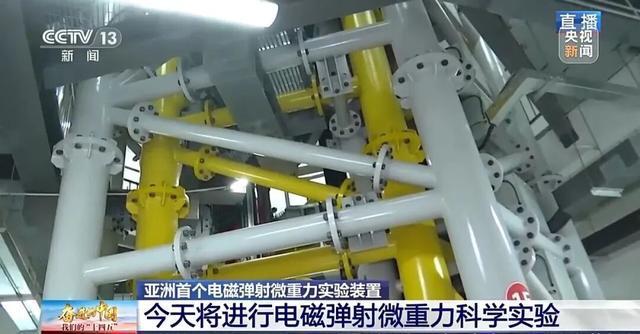
Core Viewpoint - The Asian first electromagnetic catapult microgravity experimental device has commenced a new round of scientific experiments, focusing on life sciences [1][3]. Group 1: Experimental Device Overview - The electromagnetic catapult microgravity experimental device is approximately 44 meters tall, equivalent to a 15-story building, providing effective microgravity time of up to 4 seconds [3]. - The entire structure weighs over 300 tons and is secured by more than 40,000 bolts, ensuring precision and ease of future adjustments [5]. - The experimental chamber has a diameter of 1.2 meters and a height of 2 meters, resembling a large elevator [5]. Group 2: Scientific Experiments - The current experiment involves six drug-injected mice, aiming to study the effects of microgravity on targeted drug delivery across the blood-brain barrier, marking the first such experiment conducted on the ground in China [8]. - The electromagnetic catapult operates on the same principle as those used on aircraft carriers, but in a vertical direction, accelerating the experimental chamber to a speed of 20 meters per second [10]. Group 3: Advantages of the Electromagnetic Device - Compared to traditional drop tower experiments, the electromagnetic device significantly reduces impact forces from over 20g to about 5g, enhancing safety and efficiency [11]. - The electromagnetic system allows for more frequent experiments, with traditional setups limited to three experiments per day, while the new system primarily incurs electrical energy costs, reducing overall experimental expenses [11]. Group 4: Future Developments - Plans are underway to simulate lunar microgravity conditions on the ground later this year, along with the construction of a new facility capable of achieving 20 seconds of microgravity at a depth of 800 meters [12].