计算机仿真

Search documents
【行业深度】洞察2025:中国计算机仿真行业竞争格局及市场份额(附市场集中度、企业竞争力评价等)
Qian Zhan Wang· 2026-02-24 07:13
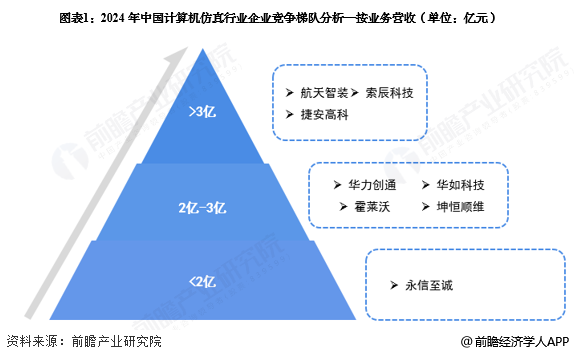
Core Insights - The Chinese computer simulation industry is characterized by a competitive landscape with a low market concentration, indicating a high level of competition among numerous small enterprises [10]. Group 1: Industry Overview - The leading companies in the Chinese computer simulation industry include Aerospace Intelligent Equipment and Suochen Technology, with revenues exceeding 300 million yuan [2]. - Companies like Huali Chuangtong and Huaru Technology have revenues between 200 million and 300 million yuan, while firms such as Yongxin Zhicheng have revenues below 200 million yuan [2]. Group 2: Regional Distribution - The majority of computer simulation companies in China are concentrated in the southeastern coastal regions, particularly in Guangdong and Jiangsu, with over 2,000 companies in Guangdong and nearly 1,500 in Jiangsu as of November 29, 2025 [3]. Group 3: Competitive Landscape - In 2022, Jingwei Hengrun reported the highest revenue among the top 10 listed companies in the computer simulation sector, followed by Kangtuo Infrared with a revenue of 1.35 billion yuan [9]. - The industry is marked by a large number of small-scale enterprises primarily engaged in agency and system integration, leading to a very low concentration ratio (CR8) of only 0.87% [10]. Group 4: Technological Competition - As of November 29, 2025, Jingwei Hengrun leads in patent numbers with 858 invention patents and 794 authorized inventions, followed by Huali Chuangtong with 77 invention patents and 92 authorized inventions [14]. Group 5: Competitive Dynamics - The competitive environment in the computer simulation industry is intense due to a high number of existing competitors and low market concentration. Supplier bargaining power is weak, while consumer bargaining power is also low due to low product differentiation [17]. - The threat of new entrants is present as many multinational companies are entering the Chinese market through wholly-owned or joint ventures, or by seeking local agents [17].




2025年计算机仿真行业企业经营分析 相关业务营收较为稳定【组图】
Qian Zhan Wang· 2026-02-06 04:09
Core Insights - The report highlights the growth and performance of the computer simulation industry in China, particularly focusing on the automotive sector and the financial results of key listed companies in 2025 [1][9]. Group 1: Market Size and Revenue - The global automotive computer simulation market and the Chinese automotive computer simulation market are significant, with major listed companies showing revenue growth in the first half of 2025 [1]. - Aerospace Intelligent Equipment reported the highest revenue among listed companies at 696 million yuan in 2025 [1]. Group 2: Business Revenue Stability - Most companies in the Chinese computer simulation industry, except for Huaru Technology, have stable revenue from their simulation business, with Aerospace Intelligent Equipment projected to generate 571 million yuan in 2024, the highest among listed firms [2]. Group 3: Profitability Metrics - There is a notable disparity in gross profit margins among leading companies in the computer simulation industry, with Suochen Technology achieving the highest margin at 71.77% in 2024, while Huaru Technology reported its first loss in recent years [4]. Group 4: Regional Business Distribution - The majority of companies in the computer simulation industry have a strong domestic presence, with revenue from domestic operations typically exceeding 80% [5].
【全网最全】2025年计算机仿真行业上市公司全方位对比(附业务布局汇总、业绩对比、业务规划等)
Qian Zhan Wang· 2026-02-02 03:09
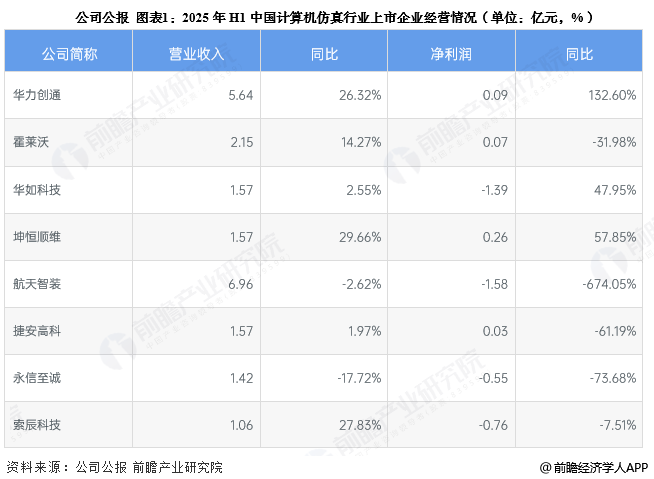
Industry Overview - The computer simulation industry in China has a limited number of listed companies, but the industry chain is extensive, with key players in the midstream segment including Huazhi Chuantong, Holiwo, and Huaru Technology [1] - The industry is expected to grow, with significant revenue contributions from various companies, particularly in the fields of military simulation, training, and digital transformation [16] Key Companies and Their Performance - Listed companies in the computer simulation sector include Huazhi Chuantong (5.64 billion), Holiwo (2.15 billion), Huaru Technology (1.57 billion), and others, with varying revenue performances [5][14] - The largest revenue-generating company in the sector is Langxin Information, with 1206.69 billion, followed by TCL Technology at 1359.43 billion [4] Business Focus and Strategies - Huazhi Chuantong aims to solidify its foundation in simulation testing and radar signal processing, focusing on domestic alternatives in the aerospace industry [16] - Holiwo is working to achieve international standards in simulation functionality and precision, while also integrating AI technology into its software [16] - Huaru Technology is leveraging military models for intelligent decision-making and virtual training applications [16] Market Dynamics - The computer simulation industry is characterized by a high concentration of business activities, with many companies having over 90% of their business focused on simulation [12] - The geographical distribution of representative companies is concentrated in regions like Beijing, Jiangsu, and Shanghai, with Beijing having the most significant number of companies [6] Revenue and Financial Metrics - The revenue from computer simulation business for major companies is generally below 3 billion, with notable exceptions like Aerospace Zhizhuang and Jiean Gaoke, which have higher revenues [14] - The gross profit margins for companies in the sector vary, with Jiean Gaoke achieving a margin of 1.84% [14] Future Outlook - The industry is expected to continue evolving with advancements in technology and increased demand for simulation solutions across various sectors, including defense and telecommunications [16] - Companies are focusing on enhancing their product offerings and expanding their market reach through strategic partnerships and technological innovations [16]
2025年全球计算机仿真行业发展趋势分析 市场覆盖地域不断扩散【组图】
Qian Zhan Wang· 2026-01-16 08:56
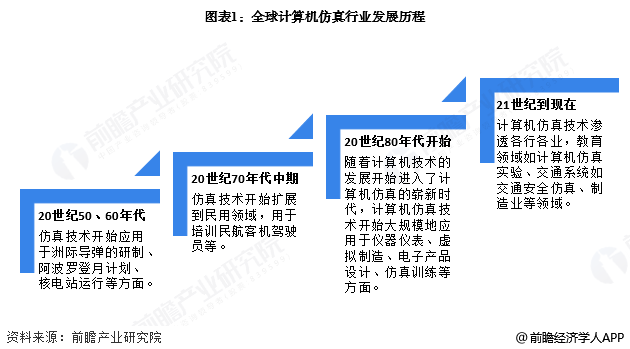
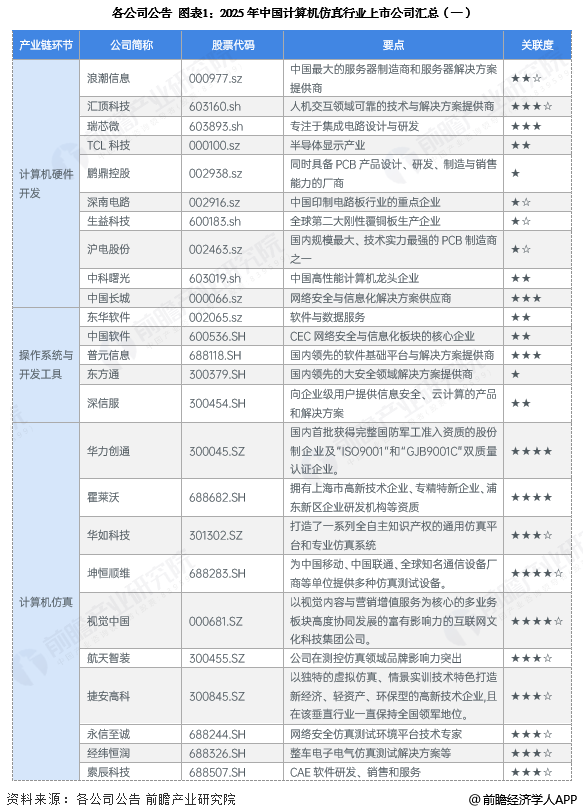
Core Insights - The global computer simulation industry market size reached $300 billion, growing from $182.5 billion in 2018, with a projected growth trend from 2019 to 2024 [3][11] - Computer simulation technology has penetrated various industries, initially starting in military applications and expanding into civil sectors such as aviation, education, and manufacturing [1][11] Industry Overview - Major listed companies in the computer simulation industry include Huali Chuangtong (300045.SZ), Holowell (688682.SH), and others [1] - The industry has seen significant growth due to advancements in internet and information technology, with a forecasted market size of approximately $300 billion by 2024 [3] Application and Development Trends - Computer simulation technology is widely applied across defense, industrial, and various human production and life aspects, including aerospace, electronics, and energy sectors [11][13] - The application range is continuously extending, with emerging markets in developing countries like China and India expected to accelerate growth [9][13] - The technology has evolved from theoretical research to practical applications in production, driving demand and enhancing simulation capabilities [11][13] - Cloud-native architectures are transforming the market by providing "simulation as a service," improving accessibility and efficiency [13]