计算机仿真产品

Search documents
【行业深度】洞察2025:中国计算机仿真行业竞争格局及市场份额(附市场集中度、企业竞争力评价等)
Qian Zhan Wang· 2026-02-24 07:13
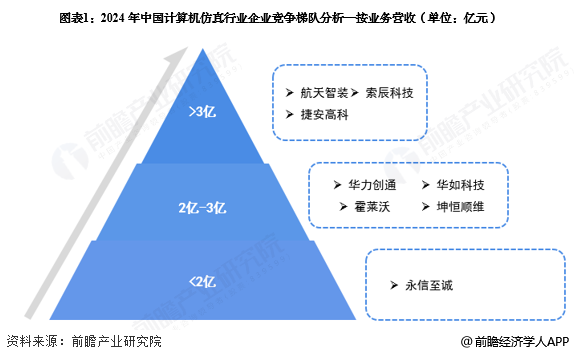
Core Insights - The Chinese computer simulation industry is characterized by a competitive landscape with a low market concentration, indicating a high level of competition among numerous small enterprises [10]. Group 1: Industry Overview - The leading companies in the Chinese computer simulation industry include Aerospace Intelligent Equipment and Suochen Technology, with revenues exceeding 300 million yuan [2]. - Companies like Huali Chuangtong and Huaru Technology have revenues between 200 million and 300 million yuan, while firms such as Yongxin Zhicheng have revenues below 200 million yuan [2]. Group 2: Regional Distribution - The majority of computer simulation companies in China are concentrated in the southeastern coastal regions, particularly in Guangdong and Jiangsu, with over 2,000 companies in Guangdong and nearly 1,500 in Jiangsu as of November 29, 2025 [3]. Group 3: Competitive Landscape - In 2022, Jingwei Hengrun reported the highest revenue among the top 10 listed companies in the computer simulation sector, followed by Kangtuo Infrared with a revenue of 1.35 billion yuan [9]. - The industry is marked by a large number of small-scale enterprises primarily engaged in agency and system integration, leading to a very low concentration ratio (CR8) of only 0.87% [10]. Group 4: Technological Competition - As of November 29, 2025, Jingwei Hengrun leads in patent numbers with 858 invention patents and 794 authorized inventions, followed by Huali Chuangtong with 77 invention patents and 92 authorized inventions [14]. Group 5: Competitive Dynamics - The competitive environment in the computer simulation industry is intense due to a high number of existing competitors and low market concentration. Supplier bargaining power is weak, while consumer bargaining power is also low due to low product differentiation [17]. - The threat of new entrants is present as many multinational companies are entering the Chinese market through wholly-owned or joint ventures, or by seeking local agents [17].