钢丝制品

Search documents
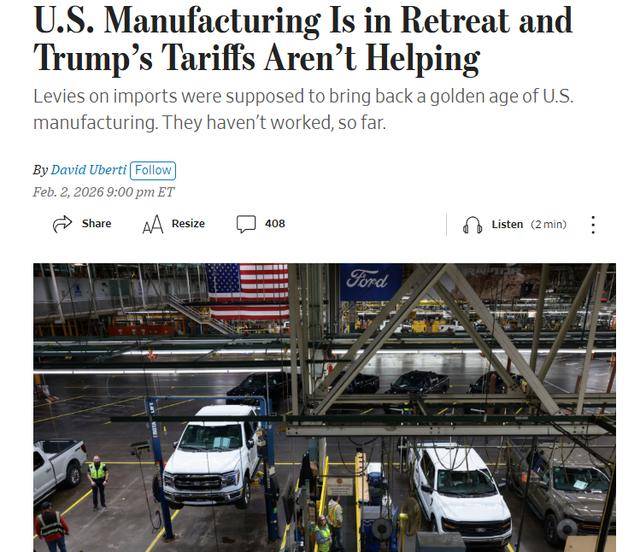
美国制造业“黄金时代”未现,反而持续走弱
Sou Hu Cai Jing· 2026-02-03 12:37
Core Viewpoint - The article highlights that despite the U.S. government's commitment to revitalize manufacturing through tariffs and industrial policies, the manufacturing sector continues to weaken, failing to achieve the promised "golden age of American manufacturing" [1] Group 1: Employment and Manufacturing Activity - U.S. manufacturing jobs have decreased for eight consecutive months since the announcement of the "liberation day" tariff policy, with over 200,000 jobs lost in 2023, marking the lowest employment level since the end of the COVID-19 pandemic [4] - The manufacturing index from the Institute for Supply Management (ISM) has remained in contraction territory for 26 months, indicating persistent weakness in manufacturing activity [4] - Analysts believe that the brief uptick in new orders and production data in January 2023 is insufficient to reverse the overall downward trend in the manufacturing sector [4] Group 2: Investment and Policy Uncertainty - The uncertainty surrounding the "stop-and-go" tariff policies is dampening investment willingness among businesses, with recent threats from the U.S. President to impose new tariffs on Europe, Canada, and South Korea exacerbating the risk of policy changes [5] - Business executives describe the past year as a "wasted investment period" due to the unpredictability of tariff policies [5] Group 3: Industry-Specific Challenges - Insteel Industries, a wire products company, reports that it has not benefited from the tariff policies, facing domestic raw material shortages due to increased steel tariffs, which have risen to 50% [6] - A manufacturer operating 23 factories globally notes that tariffs have raised the costs of steel and aluminum, limiting the ability to invest in new areas such as data centers and electrical equipment [8] - The CEO of Skyline, a furniture manufacturer, points out that high interest rates and weak consumer demand are also negatively impacting manufacturing demand, with tariffs on wood and textiles from Vietnam increasing costs and destabilizing supply chains [8]