
铁路信号系统

Search documents
趋势研判!2025年中国铁路信号系统行业发展历程、产业链、市场规模、重点企业及未来趋势:铁路网络持续完善,带动铁路信号系统规模达248.1亿元[图]
Chan Ye Xin Xi Wang· 2025-12-27 02:22
Core Insights - The railway signaling system is a crucial component of rail transport, ensuring safe and efficient operations, with significant government support and investment in China [1][10] - The market size of China's railway signaling system industry is projected to grow from 10.71 billion yuan in 2017 to 24.81 billion yuan in 2024, with a compound annual growth rate (CAGR) of 12.75% [1][11] - The industry is evolving towards greater safety, efficiency, and intelligence, driven by advancements in communication and information technology [1][10] Industry Overview - The railway signaling system is essential for automated train control and real-time monitoring, comprising various devices such as interlocking systems, block systems, and train control systems [1][9] - The system's core functions include ensuring safety, improving transport efficiency, and enhancing working conditions [1][9] Industry Development Background - China's economic growth has provided a solid financial foundation for railway construction, with fixed asset investment in railways reaching 850.6 billion yuan in 2024, a year-on-year increase of 11.26% [8] - The demand for intercity and suburban railway construction continues to grow, creating vast market opportunities for the railway signaling system industry [8] Industry Chain - The upstream of the railway signaling system industry includes raw materials and components such as steel, aluminum, plastics, and electronic components [8] - The midstream involves system integration and equipment manufacturing, while the downstream includes railway construction units and transportation enterprises [8] Market Dynamics - The industry is characterized by a competitive landscape with domestic companies like China Railway Signal Co., Ltd. leading the market, while international firms like Siemens and Alstom maintain competitiveness in high-standard projects [11][12] - The market is driven by technological advancements, ecological cooperation, and accelerated domestic substitution [11] Future Trends - The future of the railway signaling system will focus on intelligence, integrating artificial intelligence, big data, and the Internet of Things for dynamic analysis and optimization [14] - Standardization efforts will aim to create a unified technical standard for railway signaling systems, facilitating interoperability and reducing lifecycle costs [15] - Safety and reliability will evolve towards resilient systems with proactive fault tolerance and real-time simulation capabilities [15]



2026-2032年铁路信号系统行业细分市场调研及投资可行性分析报告
Xin Lang Cai Jing· 2025-12-08 12:26
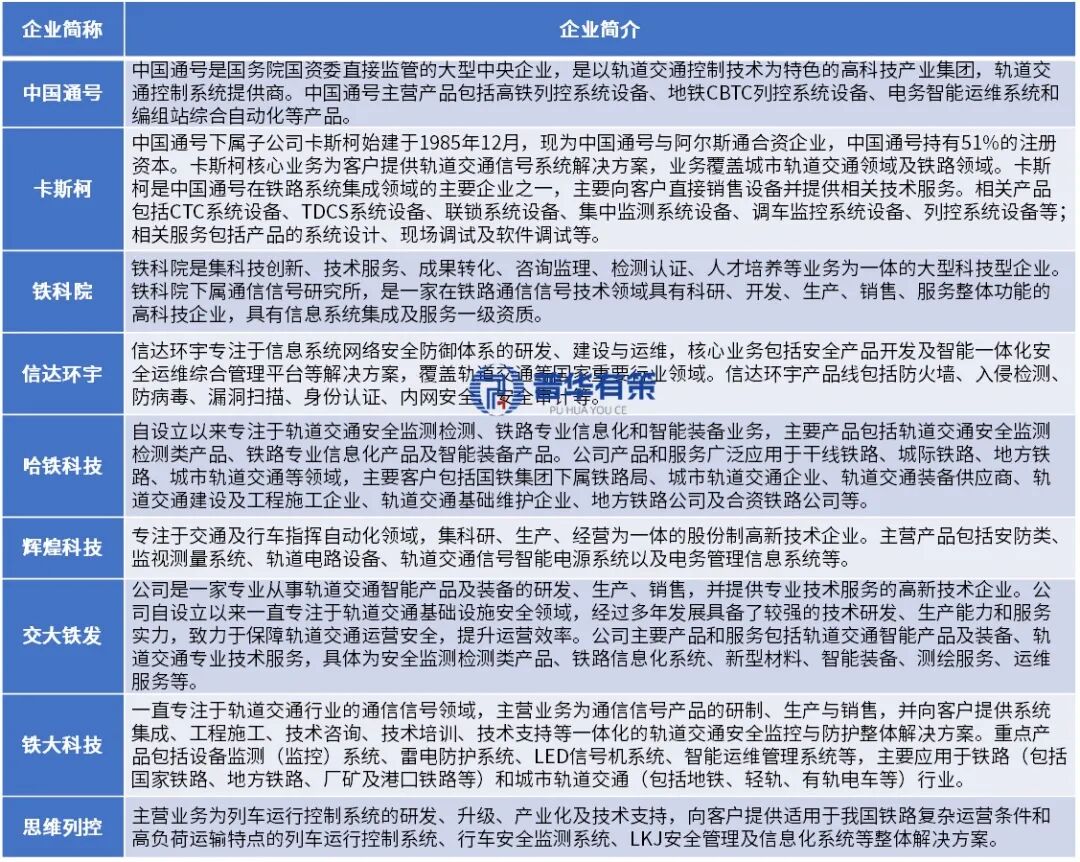
Industry Overview - The railway signal system is a core component of the railway transportation system, ensuring safe, orderly, and efficient train operations through key devices such as dispatching, blocking, train control, and interlocking [1][20] - The system includes various components like signal devices, interlocking equipment, blocking devices, train dispatching systems (TDCS), centralized dispatching systems (CTC), locomotive signals, train operation monitoring devices (LKJ), and train control systems [1][20] Development Environment Analysis - Government policies provide strong support for the industry's development, emphasizing the importance of signal and communication facilities and encouraging core technology research and development [2][21] - Economic growth and investment in infrastructure, with a projected railway fixed asset investment of approximately 850 billion yuan in 2024, are driving demand for railway signal systems [3][22] Technological Integration - New technologies such as 5G, IoT, big data, AI, and Beidou navigation are driving the transformation of railway signal systems towards intelligence, networking, and integration [4][23] - The integration of these technologies will enhance real-time communication, predictive maintenance, and operational efficiency [4][23] Industry Trends - The industry is moving towards increased intelligence, with the CTCS-4 level system expected to enable fully autonomous train operations [5][24] - There is a deepening trend of localization and independence in technology, with domestic companies increasing investment in core component R&D [5][25] - The fusion of multiple technologies will create an integrated system combining signal, communication, navigation, and intelligence [5][27] Maintenance and Service Market - The demand for maintenance services is growing, leading to a trend towards market-oriented and intelligent maintenance solutions [5][28] - Companies will leverage smart monitoring systems and big data platforms to provide customized maintenance services [5][28] International Expansion - China's high-speed rail technology is at a world-leading level, and the "going out" strategy is creating significant overseas market opportunities for railway signal systems [5][29] - The industry has already exported systems to Southeast Asia, Africa, and Europe, participating in international railway projects [5][29] Major Companies - Key players in the industry include China Railway Signal & Communication Corp (CRSC), Casco, and others, focusing on various aspects of railway signal systems [5][30] - These companies are involved in the development, production, and provision of services related to railway signal systems, contributing to the industry's growth and technological advancement [5][31]
持续优化营商环境全力做好服务保障 加快塑造开放型经济发展新动能新优势
Xi An Ri Bao· 2025-06-11 02:59
Group 1 - The core message emphasizes the importance of foreign-funded enterprises in driving high-quality development in Xi'an, highlighting the need for a favorable business environment and comprehensive service support [2] - The Xi'an Alstom Yongji Electric Equipment Co., Ltd. is identified as the largest production base for train traction motors globally, showcasing its significance in the local economy [1] - Siemens Signal Ltd., a Sino-German joint venture focused on railway signaling products and systems, is encouraged to enhance technological innovation and product development in collaboration with Xi'an [1] Group 2 - The local government is urged to actively engage with enterprises to understand their needs and effectively utilize policies, platforms, and resources to create a market-oriented, legal, and international business environment [2] - There is a call for increased awareness of openness and efforts to facilitate trade and investment, aiming to attract more foreign investment and improve the level of an open economy [2]