
多技术融合

Search documents
下一个革新爆点是什么,新一代投资人有何画像?这场年度预测给出答案
证券时报· 2025-12-14 03:23
Core Insights - The next innovation explosion is expected to stem from the integration of multiple technologies, particularly the fusion of artificial intelligence with various disciplines and fields [3] - The Shanghai Future Industry Fund has identified ten future industries, including AI and computing, biomedicine and health, energy and environment, robotics and automation, quantum technology, and blockchain [3] - A new generation of investors, termed "AI Native," is emerging, focusing on scientific and technological entrepreneurship, with a shift from relationship-based to AI-driven investment paradigms [9] Group 1: Innovation and Future Industries - The essence of the next "innovation explosion" is the "multi-technology integration," with AI being a key driver alongside interdisciplinary collaboration [3] - The ten identified future industries include: 1. Artificial Intelligence and Computing 2. Biomedicine and Health 3. Energy and Environment 4. Robotics and Automation 5. Quantum Technology 6. Interdisciplinary and Fusion Fields 7. Information and Communication Technology 8. New Materials and Advanced Manufacturing 9. Aerospace and Space Exploration 10. Blockchain and Distributed Technologies [3] Group 2: Future Talent and Organizational Paradigms - The future talent profile is characterized by individuals from the 90s and 00s, who are AI natives, possessing cross-disciplinary skills and a willingness to challenge traditional norms [7] - Future organizations may evolve into "silicon-based" entities where humans act as AI orchestrators, potentially leading to the rise of "one-person unicorn" companies [7] Group 3: Investment Paradigms - The investment landscape is transitioning from a "relationship-based" model to an "AI-driven ecological" model, with a focus on supporting scientific entrepreneurs [9] - The current entrepreneurial wave is led by scientists and specialized PhDs, marking a shift from previous eras dominated by grassroots entrepreneurs [9] - Investors are encouraged to adopt forward-looking strategies, investing in AI Native young entrepreneurs and fostering an AI investment ecosystem [9]


下一个革新爆点是什么,新一代投资人有何画像?这场年度预测给出答案
Zheng Quan Shi Bao Wang· 2025-12-13 11:46
Group 1 - The core theme of the "What's Next 2026" conference is to explore the next wave of disruptive innovations and the characteristics of the new generation of investors, emphasizing the importance of collaboration between state-owned capital platforms and innovators [1][2]. - The Shanghai Future Industry Fund's annual forecast identifies "multi-technology integration" as the next innovation breakthrough, highlighting ten future industries including AI, biomedicine, energy, and quantum technology [2][3]. - A strategic scientist predicts three major innovation breakthroughs: the ultimate fusion of biology and mathematics, controllable nuclear fusion for clean energy, and automation in scientific discovery through AI [3][4]. Group 2 - The annual forecast defines the future talent profile as primarily composed of post-90s and post-00s individuals, characterized by a cross-disciplinary and innovative mindset [5][6]. - Future organizations may evolve into silicon-based entities where humans act as AI orchestrators, potentially leading to the emergence of "one-person unicorn" companies [5][6]. - The venture capital landscape is shifting from a "network-based" model to an "AI-driven ecosystem" model, with a focus on supporting scientists and technology entrepreneurs [6][7].
2026-2032年铁路信号系统行业细分市场调研及投资可行性分析报告
Xin Lang Cai Jing· 2025-12-08 12:26
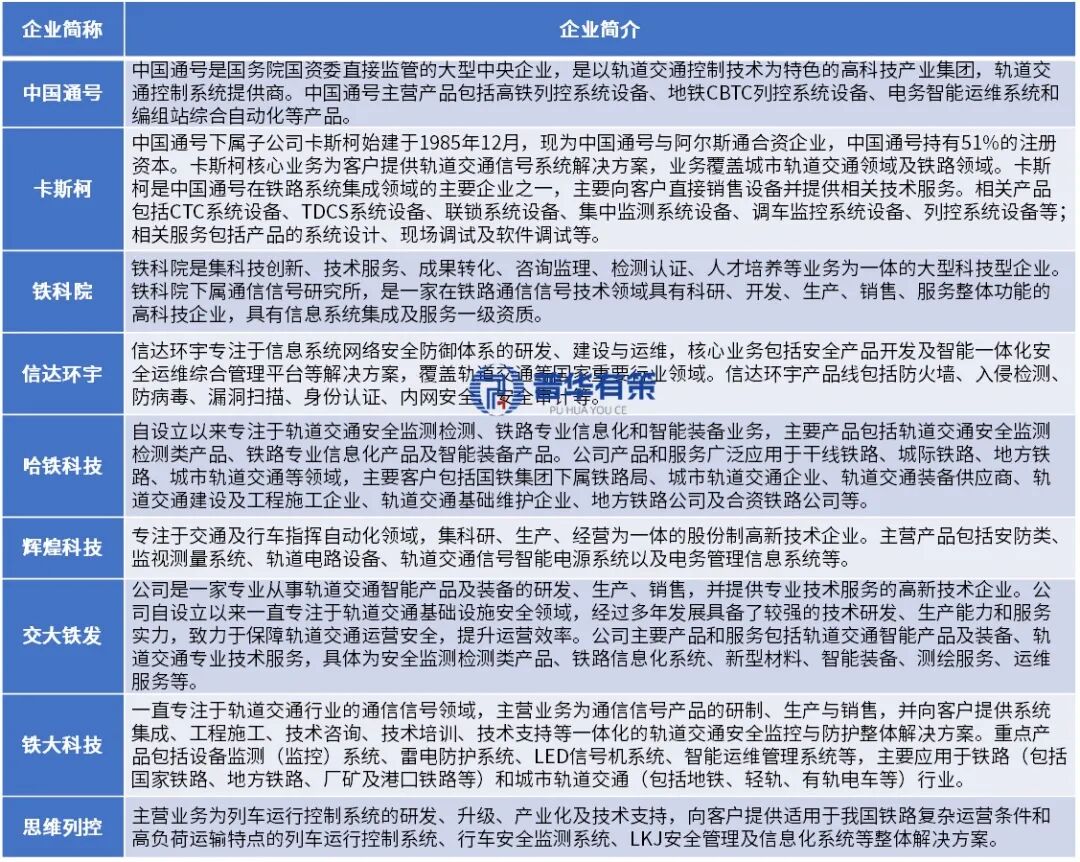
Industry Overview - The railway signal system is a core component of the railway transportation system, ensuring safe, orderly, and efficient train operations through key devices such as dispatching, blocking, train control, and interlocking [1][20] - The system includes various components like signal devices, interlocking equipment, blocking devices, train dispatching systems (TDCS), centralized dispatching systems (CTC), locomotive signals, train operation monitoring devices (LKJ), and train control systems [1][20] Development Environment Analysis - Government policies provide strong support for the industry's development, emphasizing the importance of signal and communication facilities and encouraging core technology research and development [2][21] - Economic growth and investment in infrastructure, with a projected railway fixed asset investment of approximately 850 billion yuan in 2024, are driving demand for railway signal systems [3][22] Technological Integration - New technologies such as 5G, IoT, big data, AI, and Beidou navigation are driving the transformation of railway signal systems towards intelligence, networking, and integration [4][23] - The integration of these technologies will enhance real-time communication, predictive maintenance, and operational efficiency [4][23] Industry Trends - The industry is moving towards increased intelligence, with the CTCS-4 level system expected to enable fully autonomous train operations [5][24] - There is a deepening trend of localization and independence in technology, with domestic companies increasing investment in core component R&D [5][25] - The fusion of multiple technologies will create an integrated system combining signal, communication, navigation, and intelligence [5][27] Maintenance and Service Market - The demand for maintenance services is growing, leading to a trend towards market-oriented and intelligent maintenance solutions [5][28] - Companies will leverage smart monitoring systems and big data platforms to provide customized maintenance services [5][28] International Expansion - China's high-speed rail technology is at a world-leading level, and the "going out" strategy is creating significant overseas market opportunities for railway signal systems [5][29] - The industry has already exported systems to Southeast Asia, Africa, and Europe, participating in international railway projects [5][29] Major Companies - Key players in the industry include China Railway Signal & Communication Corp (CRSC), Casco, and others, focusing on various aspects of railway signal systems [5][30] - These companies are involved in the development, production, and provision of services related to railway signal systems, contributing to the industry's growth and technological advancement [5][31]

关于证券行业构建多技术融合异常交易检测与风险防控的研究
Zhong Zheng Wang· 2025-11-11 11:06
Group 1 - The core issue in the domestic securities industry is the increasing complexity and difficulty in detecting abnormal trading behaviors due to the significant growth in trading products and strategies [1][2] - Traditional monitoring systems are lagging in technical response, primarily relying on second-level data, which fails to capture millisecond-level trading behaviors, leading to monitoring blind spots [2][3] - There are dual risks associated with core risk control modules that depend on foreign technology architectures, which do not meet local regulatory and data security requirements [2][3] Group 2 - The current state of risk control in the securities industry is hindered by a lack of comprehensive domestic hardware and software integration, limiting the effectiveness of risk management systems [3] - Existing systems often rely on traditional machine learning models, lacking the ability to comprehensively identify trading behavior patterns and complex relationships [3] Group 3 - A proposed multi-technology integration framework includes FPGA, distributed technology, large models, and knowledge graphs, which can create a closed-loop risk control mechanism from data collection to prevention [4][5] - FPGA technology allows for low-latency data collection, enabling real-time capture of market microstructure changes and reducing warning delays to milliseconds [4] - Distributed technology addresses the explosive growth of order data during trading peaks through parallel computing, enhancing real-time data processing capabilities [6] Group 4 - The integration of large models and knowledge graphs enhances the ability to model and analyze trading behaviors, improving the accuracy of abnormal trading detection [7] - A fully domestic risk control system is proposed, covering all critical components from hardware to algorithms, to ensure security and reduce external dependencies [8] Group 5 - Challenges in implementing multi-technology integration include difficulties in adapting different technological systems and the lack of standardized solutions for domestic FPGA chips [9][10] - There is a significant shortage of composite talents who possess knowledge in finance, information technology, AI algorithms, and hardware engineering, which hampers the development and operation of risk control systems [10] Group 6 - Recommendations for enhancing the application of advanced technologies in abnormal trading risk control include establishing a collaborative innovation platform, improving domestic industrial chain support policies, and fostering composite talent development [11][12][14] - Pilot demonstrations and ecosystem cultivation are suggested to validate the application of integrated risk control systems in securities firms, promoting technology sharing and collaboration [15]
低空经济之通导监系统
2025-04-15 14:30
Summary of Conference Call Notes Industry Overview - The discussion revolves around the low-altitude economy, focusing on communication, navigation, and surveillance systems for efficient management of low-altitude flights [1] Key Technologies and Their Characteristics Radar - Coverage range: 50 to 300 kilometers - Positioning accuracy: 10 to 100 meters - High real-time capability and all-weather operation - Suitable for aviation control and military early warning - High maintenance costs and interference issues [2] ADS-B (Automatic Dependent Surveillance–Broadcast) - Coverage range: 200 to 300 kilometers - Positioning accuracy: 10 to 30 meters - High data accuracy and low cost - Compatible with global civil aviation standards, mainly used in civil aviation monitoring and airport traffic management [2] 5G Technology - Coverage range depends on base station density - Positioning accuracy: 1 meter - High real-time capability and low latency - Supports massive device connectivity and AI analysis - Limitations in remote areas due to base station dependency [3] Beidou Satellite System - Positioning accuracy: 1 to 5 meters (higher with enhanced services) - Global coverage and strong anti-jamming capabilities - Suitable for drone navigation and maritime search and rescue - Accuracy affected by obstructions like buildings and weather [4] Electro-Optical and Infrared Technology - Coverage range: 1 to 10 kilometers - High precision and real-time capability - Suitable for security, anti-drone operations, and nighttime monitoring [5] Trends and Future Developments - Integration of communication and radar functions in 5G base stations is a key trend, enhancing low-altitude monitoring capabilities [10] - The development of a multi-layered perception and defense network for low-altitude management is underway, with various technologies being combined for better coverage and efficiency [12][13] - The market is seeing a push towards the commercialization of radar systems for various applications, including public safety and low-altitude monitoring [14] Company Initiatives - The company has developed various low-altitude monitoring radar systems and solutions, aiming to create a comprehensive low-altitude management system [12] - New products targeting low-altitude threats have been introduced, including K-band dual-polarization active phased array radars [14] Important Notes - The conference call content is intended for internal use only and should not be shared externally [15]