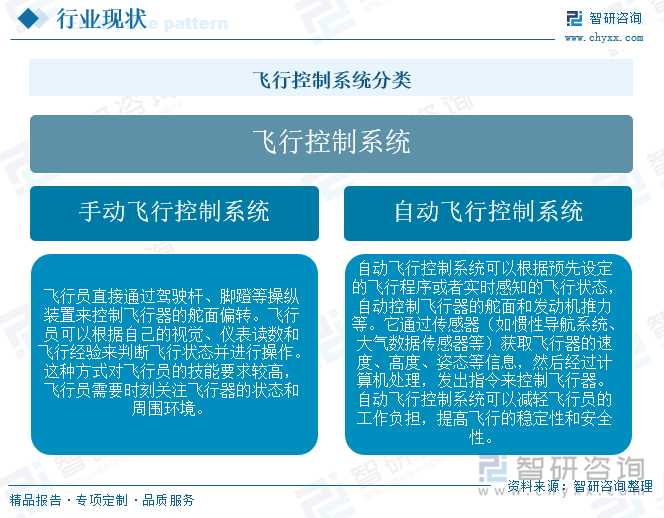
飞行控制系统

Search documents
研判2025!中国飞行控制系统行业产业链、市场规模及发展趋势分析:技术革新驱动市场扩张,无人机与eVTOL引领增长新趋势[图]
Chan Ye Xin Xi Wang· 2025-06-05 01:36
Core Insights - The Chinese flight control system industry is undergoing a critical phase of technological innovation and market expansion, with a projected market size of 2.79 billion yuan in 2024, reflecting a year-on-year growth of 7.31% [1][12] - The growth is primarily driven by the explosive development of the drone market and the rise of emerging fields such as eVTOL (electric vertical takeoff and landing aircraft) [1][12] - Technological advancements include deep learning algorithms for automatic flight attitude adjustment and obstacle avoidance, as well as modular designs for easier upgrades and maintenance [1][12] Industry Overview - Flight control systems are complex systems used to control the flight attitude, trajectory, and parameters of aircraft or other flying vehicles, adjusting aerodynamic control surfaces and engine thrust based on pilot commands or pre-set programs [2][4] Industry Development History - The industry has evolved through four main stages: 1. Initial exploration (late 1970s to 1980s) focusing on active control technology and fly-by-wire systems [4] 2. Technological accumulation and engineering phase (1990s to early 2000s) with the maturation of fly-by-wire systems [4] 3. Rapid development and industrialization (early 2000s to 2010) with the rise of drones and the integration of AI algorithms [4] 4. Intelligent and autonomous innovation phase (2010 to present) with deep integration of AI and big data technologies [5][6] Industry Chain - The upstream of the flight control system industry includes materials (aluminum alloys, titanium alloys, etc.), composite materials, and core components (chips, gyroscopes, etc.) [8] - The midstream involves the production and manufacturing of flight control systems, while the downstream includes applications in both drone and manned aircraft sectors [8] Market Size - The flight control system market in China is expected to continue its growth trajectory, driven by the booming drone market and the emergence of eVTOL [12] - The eVTOL industry is projected to reach a market size of 3.2 billion yuan in 2024, with a staggering year-on-year growth of 226.53% [10][12] Key Companies - The industry features a diverse competitive landscape with state-owned enterprises leading in military and large civil aircraft sectors, such as AVIC and CASC [14] - DJI holds over 70% of the global market share in consumer drones, leveraging its proprietary flight control algorithms for precise operation in complex environments [14][16] - Chengdu Zongheng focuses on industrial-grade drones, achieving centimeter-level positioning accuracy in its flight control systems [14][18] Industry Development Trends 1. **Technological Innovation and Intelligent Development** - The industry is accelerating towards intelligent and autonomous systems, integrating AI, big data, and cloud computing for enhanced decision-making and environmental perception [20] - Breakthroughs in hardware, such as high-performance processors and advanced communication technologies, will further improve the reliability and real-time capabilities of flight control systems [20] 2. **Market Demand and Industry Integration** - The demand for flight control systems is driven by the widespread application of drones in logistics, agriculture, and security, as well as the commercialization of eVTOL [21][22] - Industry integration will see flight control systems merging with automotive electronics and smart manufacturing, fostering cross-industry innovation [22] 3. **Policy Environment and Standardization** - The Chinese government has implemented supportive policies for the aviation industry, encouraging R&D investment and technological innovation [23] - The establishment of unified technical standards and testing certification systems will enhance the international competitiveness of Chinese flight control system products [23]