Alliance Marketing

Search documents
Anker、PatPat都在做的合作伙伴营销,究竟进化到了哪一步?
3 6 Ke· 2026-01-07 09:00
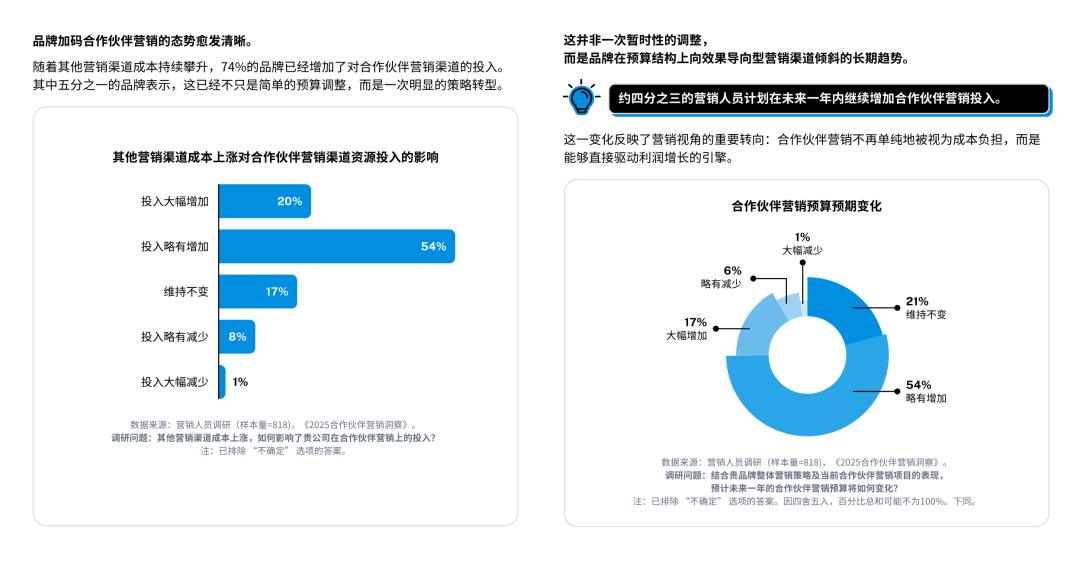
Core Insights - The traditional growth logic for overseas expansion, heavily reliant on advertising as the primary lever, is being fundamentally challenged as companies face diminishing returns on their marketing budgets and strategies [2][4] - Consumer behavior has shifted towards seeking authentic experiences and evaluations from third-party creators and AI tools, leading to a complex marketing network that requires brands to focus on building trust rather than just optimizing ad spend [2][3] Group 1: Shifts in Marketing Strategy - The consensus around traditional advertising effectiveness is collapsing, with companies questioning user retention and brand awareness in a crowded market [2][4] - The rise of community-driven content and AI search tools has transformed the consumer decision-making process, moving away from direct advertising influence [2][4] - Brands are now prioritizing partnership marketing, which integrates creators and community influencers into their growth strategies, moving away from the outdated rebate-driven models [4][5] Group 2: Evolution of Partnership Marketing - Partnership marketing is evolving from a marginal role to a core strategy, as brands recognize the need to engage with trust nodes that influence consumer decisions [4][6] - The report indicates that 74% of brands have increased their investment in partnership marketing over the past year, driven by the high costs of traditional marketing channels [6][10] - Approximately 38% of brands are allocating 21%-30% of their marketing budgets to partnership channels, with some pioneers investing over 50% [6][10] Group 3: Operational Efficiency and AI Integration - Companies are transitioning from manual management of partnerships to automated systems that enhance efficiency and scalability [13][17] - The integration of AI into partnership management is becoming essential, with 97% of brands adopting AI to streamline workflows and improve decision-making [20][24] - The shift towards a structured partnership ecosystem allows brands to build a sustainable network of trust assets, essential for long-term growth [20][24] Group 4: Competitive Landscape and Future Outlook - The competitive landscape is shifting from individual efforts to a focus on systemic complexity, with leading brands automating their partnership ecosystems [20][23] - Only 3% of brands report no obstacles in localization, highlighting the challenges faced by the majority due to a lack of systematic approaches [23] - By 2026, brands that successfully implement growth operating systems will gain a significant competitive advantage, as traditional methods will no longer suffice in a rapidly evolving market [24]

2025出海联盟营销白皮书
Sou Hu Cai Jing· 2025-05-03 04:21
Overview of the Article - The article discusses the "2025 Outbound Alliance Marketing White Paper," which explores the current state, pain points, strategies, and trends in alliance marketing for outbound brands. It emphasizes the importance of localization and collaboration with partners to enhance brand recognition and sales in foreign markets [1][2]. Group 1: Alliance Marketing Overview - Alliance marketing is gaining attention in the wave of brand globalization, leveraging partnerships to reach consumers through diverse channels, enhancing localization and sales [1][7]. - The global alliance marketing scale has been growing, driven by the rise of independent sites and the decline of traditional advertising, with key application areas including apparel, outdoor sports, and health [1][12]. Group 2: Pain Points in Outbound Brand Marketing - Outbound brands face challenges such as diverse sources of alliance partners and complex channels, leading to difficulties in marketing effectiveness attribution [1][2]. - There is a lack of understanding of alliance marketing and a shortage of professionals, complicating partner relationship management and affecting marketing efficiency [1][2]. Group 3: Strategic Execution of Partner Marketing - Brands need to clarify their marketing strategies and avoid misconceptions, focusing on clear positioning and long-term planning [2]. - The execution process requires finding professional talent, selecting appropriate platforms and channels, and typically takes 3 to 6 months to show results [2]. Group 4: Measurement and Strategy for Long-Tail Value - Different billing strategies should be adopted at various marketing stages, with mature companies requiring higher data granularity [2]. - Brands should focus on optimizing various data points such as AOV and ROAS, while AI can assist in material creation and fraud prevention [2]. Group 5: Future Trends in Partner Marketing - Partner marketing is expected to play a larger role in outbound brands, with influencer marketing becoming more prominent and partner types diversifying [2][12]. - The efficiency of integrated platform management will improve, and AI will play a more significant role in driving industry development [2][12]. Group 6: Growth Drivers of Alliance Marketing - Key drivers for the growth of alliance marketing include the rise of independent sites and the decline of traditional advertising effectiveness [12]. - Over the past three years, there has been a significant increase in the search interest for alliance marketing, with a 300% growth in Google search trends [12]. Group 7: Key Categories for Alliance Marketing - The main categories utilizing alliance marketing include apparel, outdoor sports, and health, with rapid penetration in software applications and toys [14][17]. - The effectiveness of alliance marketing is particularly strong in high-value niche categories, such as electric skateboards, which rely heavily on promotional marketing [16]. Group 8: Emergence and Trends of Partner Marketing - Partner marketing expands the boundaries of alliance marketing by integrating various types of partners, including social media influencers and strategic B2B partners [18]. - This approach enhances brand trust and reduces the barriers for target audiences to learn about new brands, emphasizing the importance of long-tail, collaborative, and performance-driven strategies [18].