Measurement Equipment

Search documents
小鹏、小米联手,一国产仪器公司完成近亿元战略融资
Xin Lang Cai Jing· 2026-02-02 10:51
Group 1 - The recent financing round raised nearly 100 million yuan, led by Xinghang Capital and Shunwei Capital, with continued investment from Xiaomi and participation from several market-oriented institutions [2][3][19] - Weijing 3D Technology Co., Ltd. specializes in high-precision 3D visual measurement solutions, focusing on optical automation and industrial precision detection [2][18] - The company has developed a proprietary technology system around measurement algorithms, system architecture, and industrial software platforms [2][18] Group 2 - Weijing 3D has established a product matrix that includes high-precision blue light surface scanning measurement devices, automated online measurement systems, and handheld laser 3D measurement devices [2][18] - The VisionInspect software platform developed by the company is compatible with its entire range of devices, enhancing industrial detection efficiency and quality consistency [2][18] Group 3 - The successful financing reflects the recognition of Weijing 3D's leading position in optical dimension measurement and its potential for technological innovation and market expansion [3][19] - The AutoScan automated 3D measurement solution has broken the monopoly of foreign brands in the high-end market, improving measurement efficiency and precision [4][20] Group 4 - In the electric vehicle battery detection sector, Weijing 3D's automated measurement solution achieves an industry-leading measurement cycle of 149 seconds for battery box online measurement, covering over 600 critical dimensions [6][22] - The company’s solutions for die-casting parts cover the entire lifecycle from process development to mass production monitoring, significantly shortening product trial cycles [8][24] Group 5 - Weijing 3D's automated measurement solutions for white body detection can perform full-size high-speed scanning of large components, maintaining high measurement precision even in complex workshop conditions [10][26] - The company has achieved large-scale applications in key load-bearing components, providing critical data support for precision control and performance optimization [12][28] Group 6 - The VScan M series handheld 3D scanner, launched in October 2025, features high precision and a large field of view, enabling comprehensive measurement coverage [13][29] - The financing will be used for further R&D, product line expansion, and global market channel development, enhancing the company's competitive edge [16][31]


行业聚焦:全球三维激光扫描仪行业头部生产商市场份额及排名调查
QYResearch· 2026-01-21 05:29
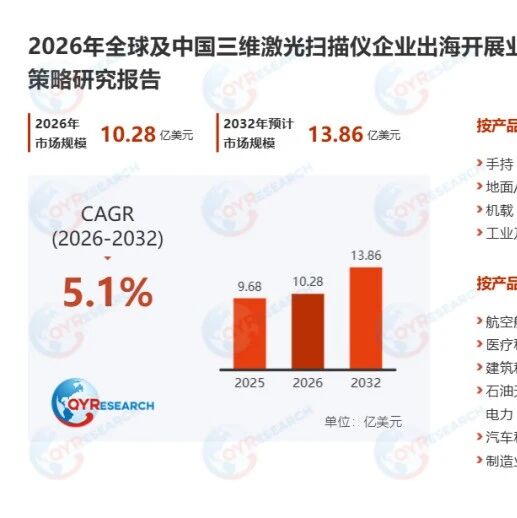
Core Insights - The global 3D laser scanner market is projected to reach $1.39 billion by 2032, with a compound annual growth rate (CAGR) of 5.1% over the coming years [2]. Market Overview - The primary manufacturers of 3D laser scanners include AMETEK (Faro, Creaform), Hexagon (Leica, Zhongguan), Trimble, Topcon, Riegl, Teledyne Optech, Quality Vision International, Maptek, Carl Zeiss, and Kreon Technologies [2]. - By 2025, the top five manufacturers are expected to hold approximately 57.0% of the market share [2]. Product Segmentation - In terms of product type, Terrestrial/Static scanners currently dominate the market, accounting for about 49.1% of the share [6]. - The Automotive and Transportation sector is the largest application area, representing approximately 32.3% of the demand [7]. Key Drivers - The digital transformation in the construction and engineering sectors, particularly the widespread use of Building Information Modeling (BIM), is increasing the demand for precise completion data, making 3D laser scanners essential for creating accurate digital twins [9]. - The manufacturing industry's need for precision and efficiency, especially in aerospace, automotive, and heavy machinery, relies on scanners for quality control and reverse engineering [9]. - The development of autonomous systems and smart infrastructure, including self-driving cars and smart city projects, is driving the demand for laser radar sensors [9]. Major Challenges - High acquisition and operational costs remain the biggest barrier, with advanced ground and mobile laser scanners requiring significant capital investment, often reaching tens of thousands of dollars [10]. - The complexity of data processing and the bottleneck in converting point clouds to BIM models create a labor-intensive gap between data collection and final deliverables, necessitating advancements in AI-driven automation technologies [10].