Optoelectronic Chips

Search documents
2025年全球光电芯片市场现状分析 市场规模逐步攀升【组图】
Qian Zhan Wang· 2025-09-14 04:11
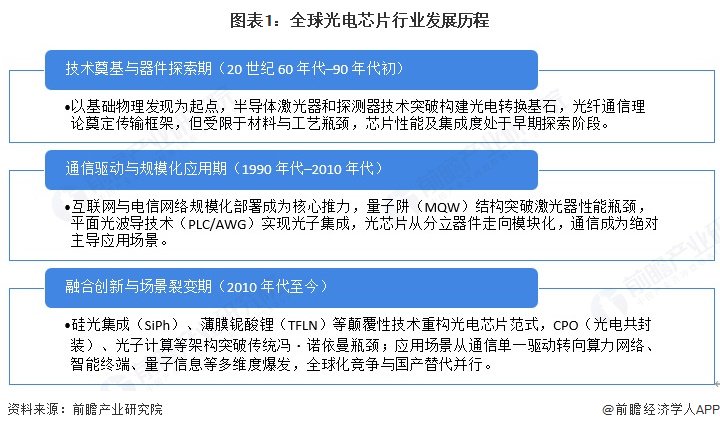
Core Insights - The global optoelectronic chip industry has evolved through three main phases: foundational technology and device exploration (1960s–early 1990s), communication-driven and large-scale application (1990s–2010s), and integrated innovation and scenario transformation (2010s to present) [1] - The global optoelectronic chip market is projected to reach $3.5 billion in 2024, reflecting a year-on-year growth of 25.9% [4] - The industry is currently in a dual-driven phase of technological innovation and market expansion, impacting various sectors from communication networks to consumer electronics and industrial applications [5] Global Market Size - The rapid growth in global data traffic and increasing bandwidth demands across various scenarios are propelling the fast development of high-speed module devices [4] Industry Layout - The global optoelectronic chip industry is characterized by a diverse range of companies with varying core product types and technological advantages, including leaders like II-VI, Huawei HiSilicon, and Broadcom, each with unique market positions and innovations [5][8] - Companies are focusing on advanced technologies such as silicon photonics, quantum computing, and integrated optical devices to enhance performance and reduce costs [7][9] Industry Development Outlook - The global optoelectronic chip market is expected to exceed $10 billion by 2030, driven by advancements in communication technology, AI computing power, and the proliferation of smart devices [12] - Key trends include deep integration of optoelectronics, a shift towards highly integrated and heterogeneous solutions, and a diversification of application scenarios beyond traditional communication [13][15]

2025年中国光电芯片经营主体分析 企业注册数量较少【组图】
Qian Zhan Wang· 2025-09-04 04:28
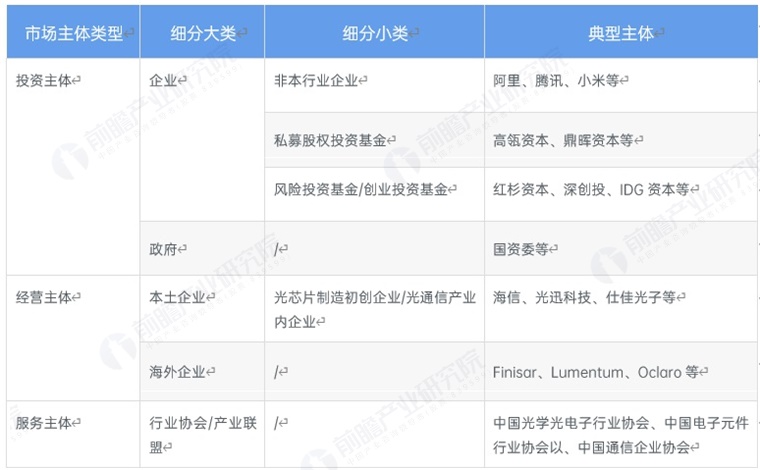
Market Structure - The Chinese optical chip industry consists of three main types of market entities: investment entities, operating entities, and service entities [1] - Investment entities include non-industry companies like Alibaba, Tencent, and Xiaomi, private equity funds such as Hillhouse Capital and IDG Capital, and government bodies like the State-owned Assets Supervision and Administration Commission [1] - Operating entities are categorized into domestic companies (e.g., Hisense, Lightwave Technology) and foreign companies (e.g., Finisar, Lumentum) [1] - Service entities include industry associations and organizations like the China Optical Optoelectronic Industry Association [1] Entry Methods - Companies in the Chinese optical chip industry adopt various entry methods, including independent R&D, collaboration with research institutions, acquisitions, and participation in industry standards [2][4] - Vertical integration (IDM model) allows companies to cover the entire supply chain from chip design to packaging, exemplified by Source Technology focusing on InP optical chips [4] - The "Fab-lite" model combines self-built facilities with outsourcing to balance flexibility and cost, as seen with Zonghui Chip Light [4] - Mergers and acquisitions are used to quickly gain core patents and resources, demonstrated by Shijia Photon acquiring Dongguan Fuke Xima [4] Industry Statistics - As of August 2025, there are approximately 56 registered optical chip companies in China, with a low annual increase of 1-2 companies from 2016 to 2024 [5] - Nearly 45% of these companies have registered capital exceeding 10 million yuan, while around 40% have capital between 1-5 million yuan [6] - Guangdong province leads in the number of registered optical chip companies, followed by Hubei and Jiangsu [7]