
VCSEL芯片

Search documents
乾照光电20260329
2026-03-30 05:15
Summary of Qianzhao Optoelectronics Conference Call Company Overview - **Company**: Qianzhao Optoelectronics - **Year**: 2025 - **Revenue**: 3.401 billion (up 39.78%) - **Net Profit**: 115 million (up 19.32%) - **GaAs Solar Cell Shipment**: Ranked first globally [2][3] Core Business Insights - **LED Business**: - Entered a mature development phase, focusing on high-end market and product structure optimization. - Revenue from main business slightly declined due to cautious capacity expansion and credit risk management [3][4]. - **Commercial Aerospace**: - Rapid growth with GaAs battery technology leading the market. - Expected overseas business growth of 2-3 times by 2026, with flexible battery solutions to be scaled in the second half of 2026 [2][6]. - **VCSEL Business**: - Shifted focus from sensing to optical communication and AI. - Mid-speed products have been sampled, with automotive products undergoing validation in Q2 2026 [2][6]. - **MiniLED and MicroLED**: - MiniLED production capacity reached 10,000KK/month, with expected growth exceeding 100% in 2026. - MicroLED technology expected to clarify by Q3 2026, with significant growth anticipated in small-screen applications [2][7][8]. Industry Dynamics - **LED Industry**: - Mature but with structural opportunities in high-end applications like automotive and commercial displays. - New demands in MiniLED and MicroLED segments are emerging, providing avenues for competitive enhancement [4][5]. - **Commercial Aerospace**: - Key challenges include achieving low costs through innovations like reusable rockets and standardized satellite production. - Anticipated growth in satellite manufacturing and launch demand, with GaAs technology expected to maintain dominance despite competition from other technologies [5][6]. - **Optical Communication**: - Expansion driven by the ongoing shift from copper to optical solutions, with VCSEL chips poised for growth in data centers [5][6]. Financial Performance and Projections - **2025 Financials**: - Revenue: 3.401 billion (up 39.78%) - Net Profit: 115 million (up 19.32%) - Cash Flow: 560 million (up 2.56%) [3][6]. - **2026 Projections**: - LED business expected to grow by double digits. - Battery business projected to grow 2-3 times overseas. - VCSEL business anticipated to expand significantly with new automotive applications [15]. Strategic Collaborations - **Partnership with Hisense**: - Enhanced collaboration in LED backlight and AI data communication sectors. - Development of RGB backlight chips and expansion into automotive applications [6][7]. Cost Management Strategies - **Cost Reduction**: - MOCVD equipment upgrades and automation to lower costs by 30%-50%. - Flexible battery solutions using GaAs to reduce material costs significantly [11][12]. Market Opportunities and Risks - **GaAs Technology**: - Dominant in space photovoltaic applications, with strong demand expected from European markets. - Concerns about potential oversupply in the future, but high entry barriers mitigate risks [9][10][13]. - **Supply Chain Dynamics**: - Tight supply for traditional optical components may accelerate the adoption of MicroLED technologies [8][10]. Conclusion - **Outlook**: - Confidence in achieving better performance in 2026 based on current orders and market conditions. - Continuous focus on optimizing product and customer structures to enhance operational quality [15].

乾照光电20260327
2026-03-30 05:15
Company and Industry Summary Company Overview - The company is focused on three main business segments: LED, commercial aerospace, and optical communication. [2][4] Financial Performance - In 2025, the company achieved a revenue of 3.401 billion yuan, a year-on-year increase of 39.78%. [3] - The total profit was 99.64 million yuan, with a net profit attributable to shareholders of 115 million yuan, reflecting a growth of 19.32%. [3] - The operating cash flow was 560 million yuan, up by 2.56%. [3] - Earnings per share reached 0.12 yuan, an increase of 20%. [3] Business Segments and Growth Drivers LED Business - LED products accounted for approximately 85%-90% of total revenue in 2025, with Mini LED backlighting showing significant growth due to collaboration with major stakeholders. [6][17] - The company is transitioning to high-margin products, with a stable gross margin maintained despite a 10% decrease in comparable LED product prices. [8][6] - The Mini LED backlight business is expected to maintain strong growth in the next 2-3 years. [6] Commercial Aerospace - Revenue from the commercial aerospace segment exceeded 100 million yuan in 2025, with expectations for overseas revenue to rise from 20% to over 30% by 2026. [2][10] - The company anticipates 2026 to be a year of mass deployment in commercial aerospace, with significant growth expected in 2027 if rocket recovery technology advances. [2][8] - The company is developing flexible thin-film solar cells to meet market demands for lower-cost solutions. [6][15] Optical Communication - The optical communication segment is expected to see orders for 10G and 25G products in 2026, with a revenue target for VCSEL chips set at the million-level. [2][22] - The demand for optical chips is driven by the explosion of AI computing needs, with the optical chip sector included in national strategic emerging industries. [5][22] Market Trends and Competitive Landscape - The LED industry is in a mature phase, but high-end segments like automotive displays and TV backlighting still present growth opportunities. [4] - The commercial aerospace sector is positioned as a new pillar industry, with significant cost reductions due to advancements in reusable rocket technology and satellite standardization. [4][5] - The company faces competition in the gallium arsenide solar cell market but maintains a strong position due to its established technology and customer base. [14] Future Outlook - The company expects to maintain double-digit revenue growth over the next 2-3 years, driven by advancements in LED, commercial aerospace, and optical communication sectors. [22][24] - Strategic focus includes improving product structure, customer quality management, and operational efficiency. [23][24] - The company aims to enhance its market position through continuous innovation and talent acquisition. [23][24] Key Challenges - The LED market faces pricing pressures, with a narrowing margin for cost reductions. [17] - The commercial aerospace sector's growth is contingent on overcoming technological bottlenecks, particularly in rocket recovery capabilities. [8][10] Conclusion - The company is well-positioned for future growth with a diversified business model and strategic focus on high-margin products and emerging technologies in commercial aerospace and optical communication. [24]
【光通信芯片】行业市场发展现状:市场将保持快速增长,国产化率水平提高
Xin Lang Cai Jing· 2026-02-09 10:21
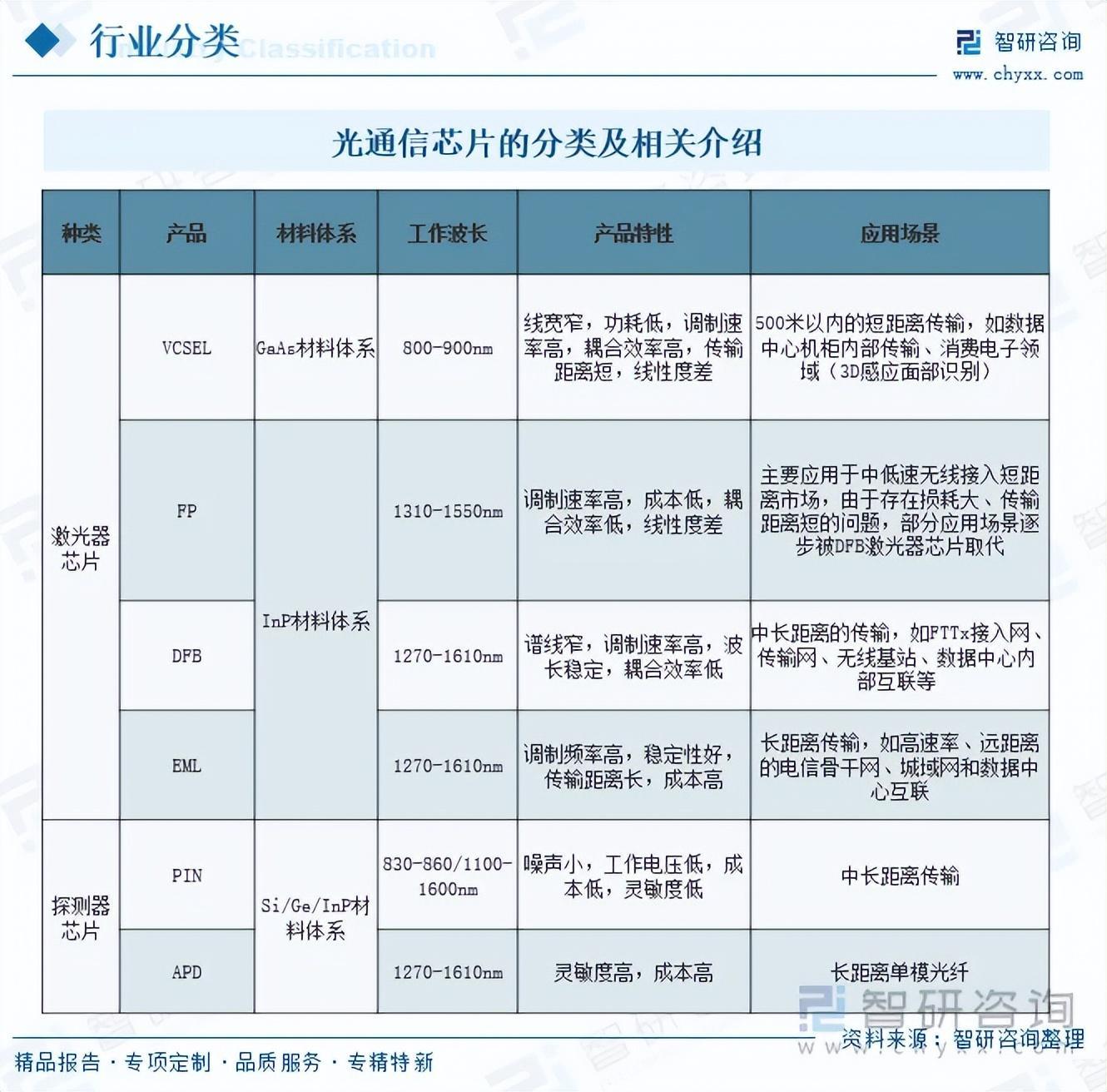
Core Insights - The optical communication chip market in China is experiencing continuous growth driven by artificial intelligence, data center expansion, consumer electronics, and 5G deployment [1][20][27] - The production and demand for optical communication chips are projected to increase significantly, with production reaching 867 million units and demand reaching 1.198 billion units in 2024, resulting in a market size of 15.16 billion yuan [1][20][27] - The market is expected to maintain rapid growth, with production estimated at 904 million units and demand at 1.249 billion units in 2025, leading to a market size of approximately 16.02 billion yuan [1][20][27] Industry Definition and Classification - Optical communication chips are defined as chips that convert optical signals and are used for generating, modulating, amplifying, and detecting optical communication signals [2][21] - These chips can be classified into laser chips and detector chips, with laser chips further divided into surface-emitting and edge-emitting types [2][21] Current Industry Status Global Market - The global optical communication chip market is projected to reach $5.43 billion in 2024, with North America accounting for $1.317 billion, Europe for $829 million, and the Asia-Pacific region for $3.048 billion [5][24] - The demand for optical communication chips is driven by the rapid development of new information technologies such as mobile internet, 5G, and cloud computing [5][24] Chinese Market - The Chinese optical communication chip market is expected to see a demand increase to 1.198 billion units in 2024, with high-speed optical communication chips accounting for approximately 13.98% of the total demand [8][27] - The market size for optical communication chips in China is projected to reach 15.16 billion yuan in 2024, with high-speed chips contributing 50.6 billion yuan [8][27] Industry Supply and Competition - The number of companies entering the domestic optical communication chip industry is increasing, leading to improved production technology and a rising domestic production rate [11][30] - The production of optical communication chips in China is expected to grow from 517 million units in 2018 to 867 million units in 2024 [11][30] Industry Value Chain - The optical communication chip industry value chain consists of upstream materials and equipment, midstream chips and modules, and downstream application markets [13][32] - The current landscape shows a monopoly in high-end materials and equipment by overseas companies, while domestic companies dominate the lower-end applications [13][32]






商道创投网·会员动态|瑞识科技·完成数亿元C轮融资
Sou Hu Cai Jing· 2026-01-24 10:04
Core Insights - RuiShi Technology has completed a multi-billion C round financing led by various investors, indicating strong market interest and confidence in the company [1] - The company specializes in semiconductor optical chips, particularly VCSEL chips, and has achieved significant breakthroughs in technology and production since its establishment in 2018 [1] - The CEO stated that the funds will be used for core VCSEL product R&D, capacity expansion, and market development, aiming to enhance product performance and reliability [2] Company Overview - RuiShi Technology focuses on providing leading VCSEL chips and optical solutions for sectors such as smart driving, consumer electronics, industrial manufacturing, and medical beauty [1] - The company was founded by a team of returnee PhDs from the U.S., possessing deep backgrounds and rich experience in the optoelectronic semiconductor industry [1] - Since its inception, RuiShi Technology has shipped over 200 million VCSEL chips and has maintained rapid revenue growth for four consecutive years [1] Investment Rationale - The Photon Strong Chain Fund highlighted RuiShi Technology's exceptional technical strength, strong market competitiveness, and excellent team background as key factors for investment [3] - The company's innovative achievements and mass production capabilities in the VCSEL chip field provide critical technological support for various sectors, including smart driving and consumer electronics [3] Industry Context - The financing round is seen as a significant advancement in the semiconductor optical chip sector, supported by ongoing government policies promoting the development of the semiconductor industry [4] - The participation of venture capital institutions not only provides financial support but also helps the company stand out in market competition [4] - RuiShi Technology's innovative spirit and technological breakthroughs in key areas inject new vitality into the entire venture capital ecosystem, showcasing the strong potential of hard tech companies [4]

茅台旗下基金为何看中老鹰半导体?
Sou Hu Cai Jing· 2026-01-05 06:36
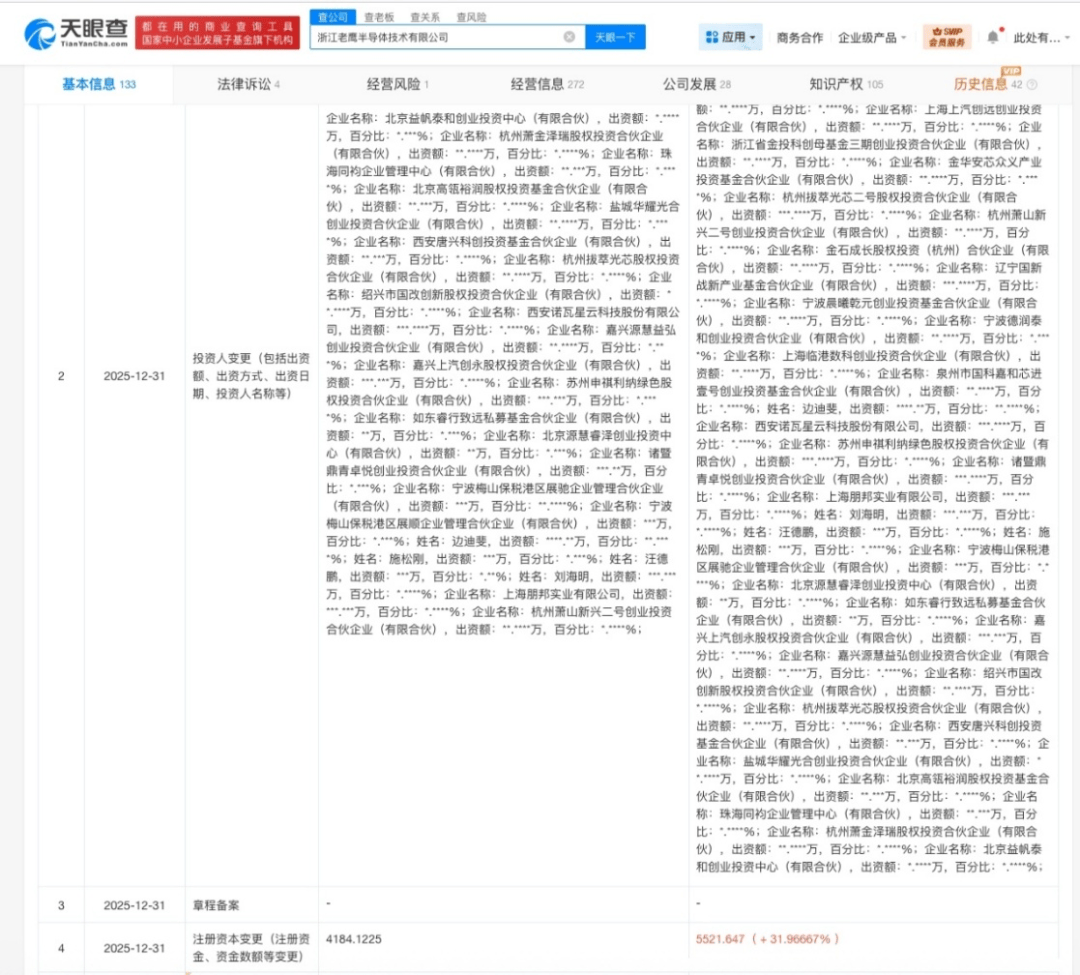
Group 1 - Zhejiang Eagle Semiconductor Technology Co., Ltd. focuses on the design of new semiconductor materials, VCSEL chip research and development, and packaging, with applications in optical interconnects, autonomous driving, and consumer electronics [1] - The company recently underwent a business change, adding new shareholders including Moutai Jinshi (Guizhou) Industrial Development Fund Partnership and Shanghai SAIC Chuangyuan Venture Capital Partnership, increasing its registered capital from approximately 41.84 million RMB to about 55.22 million RMB, a change of approximately 31.97% [1][2] - Established in April 2018, the company is recognized as a national high-tech enterprise, with its legal representative being Wang Depeng [1] Group 2 - The company's business scope includes research and development of electronic special materials, engineering and technical research, semiconductor discrete device manufacturing, integrated circuit chip design and services, and sales of integrated circuits [1] - Current shareholders include Bian Difei, Ningbo Meishan Bonded Port Area Zhanchi Enterprise Management Partnership, and Xi'an Nova Star Cloud Technology Co., Ltd., along with the newly added shareholders [1]
乾照光电(300102.SZ):应用于光通信领域的10G/25G产品已送样并处于客户验证阶段
Ge Long Hui· 2025-12-31 01:11
Core Viewpoint - The company, Qianzhao Optoelectronics, is actively engaged in the development of VCSEL (Vertical-Cavity Surface-Emitting Laser) technology, particularly for optical communication applications, which are crucial for AI infrastructure [1] Group 1: Company Developments - Qianzhao Optoelectronics has indicated that its 10G/25G products for optical communication have been sent for customer validation, while the 50G/100G products are in the wafer production stage [1] - The company is focusing on the significant advantages of VCSEL chips in short-distance data communication, which aligns with the growing market demand [1] Group 2: Industry Insights - The optical module, as a core component of AI computing infrastructure, is experiencing technological upgrades that are deeply synchronized with the development of AI [1] - Industry data suggests that the demand for VCSEL technology is increasing due to its effectiveness in short-distance data communication, highlighting a trend that benefits both the company and the broader market [1]
国盛证券:高速率光芯片前景广阔 看好光芯片景气周期
Zhi Tong Cai Jing· 2025-12-29 06:53
Core Insights - The global Ethernet optical module market is expected to grow rapidly, with a projected increase of 35% to reach $18.9 billion by 2026, driven by strong demand for AI infrastructure and the application of optical interconnect technology in AI scale-up networks [3][1] - The demand for optical chips, which are essential components of optical modules, is expected to remain tight due to increasing requirements for high-speed optical communication [4][3] Group 1: Optical Chip Market Dynamics - Optical chips, consisting of laser and detector chips, are critical for optical modules, primarily used for optical signal conversion and processing [1] - The EML laser chip market is projected to reach $3.71 billion by 2024 and grow to $7.41 billion by 2030, with a compound annual growth rate (CAGR) of 12.23%, dominated by a few international giants [2][1] - Silicon photonic modules are driving demand for continuous wave (CW) lasers due to their high integration, low power consumption, and suitability for high-speed short-distance transmission [2][1] Group 2: Demand Drivers and Supply Constraints - The demand for optical modules is expected to continue rising, with the global Ethernet optical module market projected to exceed $35 billion by 2030, supported by AI infrastructure and cloud service providers increasing GPU purchases [3][1] - Major companies like Coherent and Lumentum are expanding their production capacities to meet the growing demand for high-speed optical components, with Coherent's production capacity expected to double within a year [4][5] - Tower's silicon photonic business is anticipated to exceed $220 million in revenue by 2025, driven by strong demand for 1.6T products and significant investments in capacity expansion [6][5] Group 3: Company-Specific Developments - Coherent is experiencing strong growth in orders for 800G and 1.6T transceivers, with plans to expand production capabilities in multiple locations [4][1] - Lumentum has set a record for EML laser shipments driven by demand for 100Gbps products and is beginning to deliver CW lasers to 800G optical module manufacturers [5][1] - Broadcom's AI network demand has led to a significant increase in orders for optical components, with a backlog of approximately $73 billion, including $20 billion from network and optical interconnect products [7][1]


突破美国垄断,浙江小城跑出一只黑马
虎嗅APP· 2025-12-18 23:54
Core Viewpoint - Eagle Semiconductor is positioned as a leading player in the VCSEL (Vertical-Cavity Surface-Emitting Laser) market, having achieved significant milestones in high-end optical communication technology, particularly with the production of 100G VCSEL chips, breaking the monopoly of American companies in this field [5][11][12]. Group 1: Company Overview - Eagle Semiconductor, founded by Bian Difei, has over 50% of its workforce dedicated to R&D and is the only company in China capable of mass-producing 100G VCSEL chips for optical communication [5][11]. - The company has recently completed a B+ round financing of 700 million yuan, setting a record for domestic companies in this sector, with participation from major investors including CITIC Jinshi and Guoxin Fund [6][29]. - The founder's previous experience in the semiconductor industry, particularly in LED chips, has informed the company's strategy to adopt an IDM (Integrated Device Manufacturer) model, which is capital-intensive but necessary for long-term success [7][21]. Group 2: Market Dynamics - The VCSEL market is expected to grow significantly, with a compound annual growth rate (CAGR) of 22.2% in the optical communication sector from 2022 to 2027, driven by increasing demand for data centers and AI computing [11][12]. - The company strategically chose to enter the challenging optical communication market rather than the more accessible consumer electronics market, believing that tackling the hardest challenges first would provide a competitive advantage [32][33]. - The demand for optical interconnects is rising due to the increasing number of GPUs in data centers, which necessitates high-speed communication solutions [6][8]. Group 3: Competitive Landscape - Prior to Eagle Semiconductor's entry, the VCSEL market was dominated by American companies like Coherent and Lumentum, which held nearly 80% of the market share [11]. - The company aims to fill the gap in the domestic market for high-end VCSELs, which has been largely absent, and is focused on building a complete ecosystem for optical communication in China [28][41]. - Despite a 1-2 year technological gap compared to the U.S., the company is confident in its ability to catch up quickly due to the unique demands of the Chinese market [41][42]. Group 4: Future Outlook - The founder envisions a future where every household may have access to mini supernodes, with VCSEL technology playing a crucial role in the intelligent era of data processing and transmission [13][14]. - The company is also exploring opportunities in related fields such as laser radar and 3D sensing, indicating a broader vision for growth beyond just optical communication [43].

立昂微(605358.SH):已有应用于光通信、光模块的VCSEL芯片工艺
Ge Long Hui· 2025-12-17 15:51
Group 1 - The core viewpoint of the article is that Lian Micro (605358.SH) is focused on the manufacturing of compound semiconductor RF and optoelectronic chips, specifically highlighting its VCSEL chip technology used in optical communication and optical modules [1] Group 2 - Lian Dongxin, a subsidiary of Lian Micro, serves as a dedicated foundry platform for these semiconductor technologies [1] - The company has already developed processes for VCSEL chips, indicating its capabilities in advanced semiconductor manufacturing [1]

立昂微:立昂东芯已有应用于光通信、光模块的VCSEL芯片工艺
Zheng Quan Ri Bao Wang· 2025-12-17 13:17
Group 1 - The core viewpoint of the article is that Lian Micro (605358) has confirmed its focus on compound semiconductor RF and optoelectronic chip foundry manufacturing through investor interactions [1] - Lian Dongxin, a subsidiary of Lian Micro, specializes in VCSEL chip processes that are already applied in optical communication and optical modules [1]