Private Funds

Search documents
大连4家私募基金2025年已被注销
Sou Hu Cai Jing· 2026-01-26 12:42
Core Points - The Dalian Securities Regulatory Bureau announced the cancellation of four private fund managers for the year 2025, warning investors against their continued use of terms like "fund" or similar names in their business activities [1][2] Group 1: Canceled Fund Managers - The four canceled private fund managers are: 1. Dalian Changshan Investment Management Co., Ltd. (Unified Social Credit Code: 912102310794550158) [1] 2. JunDe Private Investment Fund (Dalian) Co., Ltd. (Formerly known as JunDe Investment Management (Dalian) Co., Ltd., Unified Social Credit Code: 91210213MA103TPE8G) [1] 3. Huichang Asset Management Co., Ltd. (Unified Social Credit Code: 91210200098879489A) [1] 4. Taicheng Capital Management Co., Ltd. (Unified Social Credit Code: 91210200071551280J) [1] Group 2: Regulatory Actions - The Dalian Securities Regulatory Bureau emphasized the need for the relevant entities to promptly deregister or change their business names and scope of operations as per the Private Investment Fund Supervision and Administration Regulations [2] - Canceled private fund managers and related parties are required to properly manage the funds under their administration and ensure the protection of investors' legal rights in accordance with relevant securities laws and fund contracts [2]


私募基金规模稳步提升 AI成行业发展高频词
Zhong Guo Jing Ji Wang· 2026-01-14 06:19
Group 1 - The 20th Private Equity Fund Development Forum was held, focusing on AI empowerment in investment and opportunities in the equity market, aiming to explore new paths for high-quality development in the private equity fund industry [1] - According to the China Securities Investment Fund Industry Association, by the end of November 2025, the scale of existing private securities investment funds is expected to reach 7.04 trillion yuan, driven by steady market growth and strategic innovation [1] - The private equity industry is expected to show robust vitality, with the number of private funds exceeding 100 billion yuan steadily increasing, and significant growth in product registration numbers [1] Group 2 - Industry experts shared insights on trends and investment opportunities for 2026, indicating that the growth rate of quantitative investment may surpass that of active management, with "fixed income +" strategies being a key growth direction [2] - Over 90% of private equity firms are expected to achieve positive excess returns in 2025, attributed to strong market beta and advancements in quantitative private equity technology [2] - AI is becoming an essential tool in the investment research process, and firms are encouraged to embrace new technologies to maintain core competitiveness [2] Group 3 - In terms of investment opportunities, it is anticipated that stock and gold prices may continue to rise in 2026, supported by a potential easing of monetary policy that could attract more off-market funds [3] - The demand for gold ETFs is expected to increase in a rate-cutting environment, which will resonate with central bank gold purchases, providing support for gold prices [3] - The technology sector is highlighted as a key area for investment in 2026, with expectations of a structural market and opportunities [3]
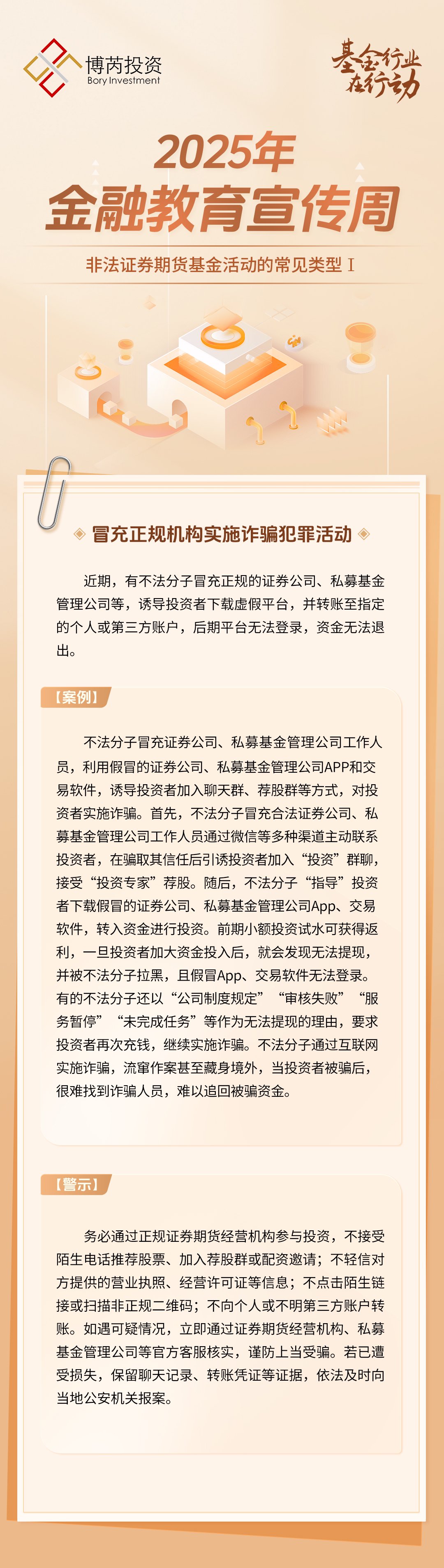
博芮投资|2025年金融教育宣传周——非法证券期货基金活动的常见类型Ⅰ
Xin Lang Ji Jin· 2025-09-23 10:23
Core Points - Recent fraudulent activities involve criminals impersonating legitimate securities firms and private equity fund management companies to deceive investors into downloading fake platforms and transferring funds to specified personal or third-party accounts, resulting in inaccessible funds and inability to log into the platforms [2][6]. Group 1: Fraudulent Activities - Criminals are using fake apps and trading software to lure investors into chat groups and stock recommendation groups, initially gaining their trust and encouraging them to invest [7]. - After small initial investments yield returns, victims are encouraged to invest larger amounts, only to find they cannot withdraw their funds and are subsequently blocked by the fraudsters [7]. - Fraudsters often provide excuses such as "company policy," "audit failure," or "service suspension" to prevent withdrawals, further enticing victims to invest more money [7]. Group 2: Prevention Measures - Investors are advised to only engage with legitimate securities and futures institutions, avoid unsolicited stock recommendations, and refrain from transferring money to unknown personal or third-party accounts [3]. - It is crucial for investors to verify any suspicious activity through official customer service channels of recognized securities and private equity firms [3].
7月新备案私募规模破千亿
Huan Qiu Wang· 2025-08-23 02:09
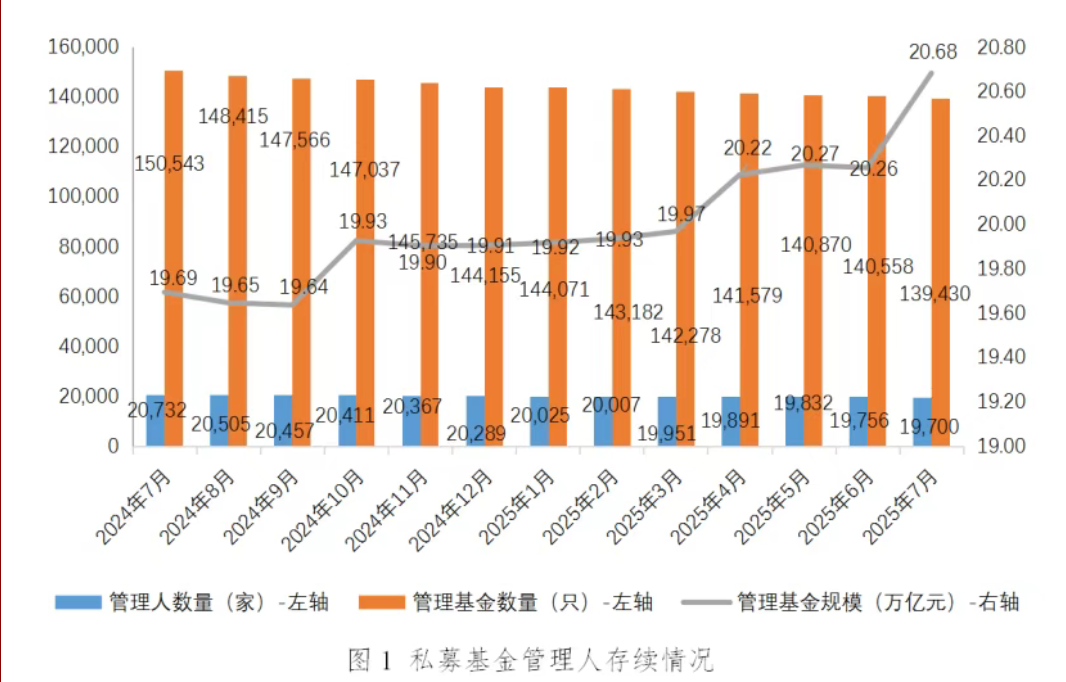
Group 1 - In July, the number of newly registered private equity funds reached 1,689, with a total scale of 107.43 billion yuan, representing a 114.6% increase compared to June's 50.06 billion yuan [1] - Among the new registrations, private securities investment funds accounted for 1,313, with a scale of 79.28 billion yuan, showing a significant growth of 163.8% from June [1] - The new registration scale for private equity investment funds and venture capital funds was 11.36 billion yuan and 16.79 billion yuan, respectively [1] Group 2 - By the end of July, there were 22 institutions that processed through the AMBERS system, including 6 private securities fund managers and 16 private equity and venture capital fund managers [1] - In July, 78 private fund managers were deregistered, leaving a total of 19,700 active private fund managers managing 139,430 funds with a total scale of 20.68 trillion yuan [1] Group 3 - The distribution of registered private fund managers is concentrated in Shanghai, Beijing, Shenzhen, Zhejiang (excluding Ningbo), Guangdong (excluding Shenzhen), and Jiangsu, accounting for 72.20% of the total, slightly up from 72.19% in June [3] - The number of private fund managers in Shanghai is 3,695, in Beijing is 3,234, in Shenzhen is 2,961, in Zhejiang (excluding Ningbo) is 1,569, in Guangdong (excluding Shenzhen) is 1,561, and in Jiangsu is 1,203 [3]
深圳证监局通报辖区私募基金监管情况 要求加强投资运作管理
news flash· 2025-05-08 09:02
Core Viewpoint - The Shenzhen Securities Regulatory Bureau has reported on the regulatory situation of private equity funds in the region, highlighting issues of non-compliance with laws and regulations by some fund managers, which have harmed investor rights [1] Group 1: Regulatory Findings - The Shenzhen Securities Regulatory Bureau has identified violations by certain private equity fund managers, including breaches of legal regulations and fund contract agreements during investment operations [1] - Notable issues include improper product valuation, subscription and redemption practices, and related party transactions that have significantly harmed investor interests [1] - Some institutions have crossed the line by misappropriating fund assets, indicating a serious lack of diligence in fulfilling investment management obligations [1] Group 2: Regulatory Requirements - The Shenzhen Securities Regulatory Bureau has mandated that all private equity fund managers in the region must exercise due diligence and prudence in their investment management duties [1] - Fund managers are required to ensure that their investment operations comply with regulatory rules and fund contract stipulations, and must not harm the legitimate rights and interests of investors [1]
私募基金风险评级那些事儿:一旦与自身不匹配,这样做就对了
Sou Hu Cai Jing· 2025-05-05 17:12
Core Viewpoint - Private equity funds are favored by investors for their high return potential, but the associated risks are often overlooked, highlighted by recent payment crises due to regulatory violations by several private equity firms [1] Group 1: Risk Rating of Private Equity Funds - The risk rating of private equity funds is classified into five levels (R1-R5) based on both quantitative and qualitative analyses, as per the "Guidelines for the Management of Investor Suitability in Fund Raising Institutions (Trial)" [3] - Quantitative indicators include beta coefficient, standard deviation, and Value at Risk (VaR), which measure volatility and liquidity risks [3] - Qualitative factors involve the concentration of investment targets, complexity of product structure, and special risks from related transactions, emphasizing the importance of compliance in risk rating [3] Group 2: Responding to Mismatched Risk Ratings - Investors must ensure their risk tolerance aligns with the fund's risk rating through a questionnaire that assesses their risk preference (C1-C5 levels) [6] - If the fund manager fails to conduct a substantive assessment, investors can claim a breach of suitability obligations and seek compensation [7] - Strategies for addressing mismatched products include exercising the "cooling-off period" to withdraw investments within 24 hours, negotiating adjustments to investment plans, and timely exit if there are violations such as fund misappropriation [7][8] Group 3: Legal Recourse and Investor Rights - Investors can file administrative complaints with the CSRC or the Asset Management Association of China to trigger regulatory investigations [8] - Civil lawsuits can be pursued against fund managers for breaching fiduciary duties, requiring proof of direct causation between disclosure violations and losses [8] - Effective legal actions include seeking civil compensation for breaches of suitability obligations or disclosure violations, and reporting to law enforcement for illegal fundraising or fraud [12] Group 4: Best Practices for Investors - Investors should ensure that contracts clearly stipulate disclosure obligations regarding underlying assets to avoid information blind spots [9] - Contracts should include detailed risk disclosure clauses to highlight special risks such as related transactions and reliance on single targets [9] - Maintaining a comprehensive evidence chain, including risk assessment questionnaires and recorded communications, is crucial for future legal claims [9]