Virtual Currency

Search documents
八部门发文严管虚拟货币 首次明确RWA代币化定义|热聊
Sou Hu Cai Jing· 2026-02-07 15:26
Core Viewpoint - The People's Bank of China and seven other departments issued a notification to further prevent and address risks related to virtual currencies and related activities, emphasizing strict regulation and the prohibition of illegal financial activities [1][3]. Background - The notification was prompted by the resurgence of speculative activities in virtual currency trading, which had previously disrupted the economic and financial order and endangered public property safety. The authorities aim to enhance regulatory policies to address new challenges and maintain national security and social stability [3]. Definition of RWA Tokenization - The notification provides a first-time definition of Real World Asset (RWA) tokenization, which involves converting asset ownership and rights into tokens using encryption and distributed ledger technology. Activities related to RWA tokenization without approval from regulatory authorities are deemed illegal [5]. Strict Regulation - The notification emphasizes blocking cross-border regulatory loopholes, stating that domestic entities and their controlled overseas entities cannot issue virtual currencies abroad without approval. It also stresses the importance of maintaining monetary sovereignty, particularly regarding stablecoins pegged to the Chinese yuan [7]. Overseas Business Conduct - Domestic entities engaging in RWA tokenization abroad must adhere to strict regulatory requirements, ensuring compliance with local and international regulations. All such activities require approval or filing with relevant authorities [9]. Central-Local Coordination - The notification outlines a framework for central-local coordination in risk prevention and management, with central authorities establishing mechanisms for risk monitoring and local governments responsible for implementing these measures effectively [10].
Circle跌出价值了吗?
Sou Hu Cai Jing· 2025-12-12 12:28
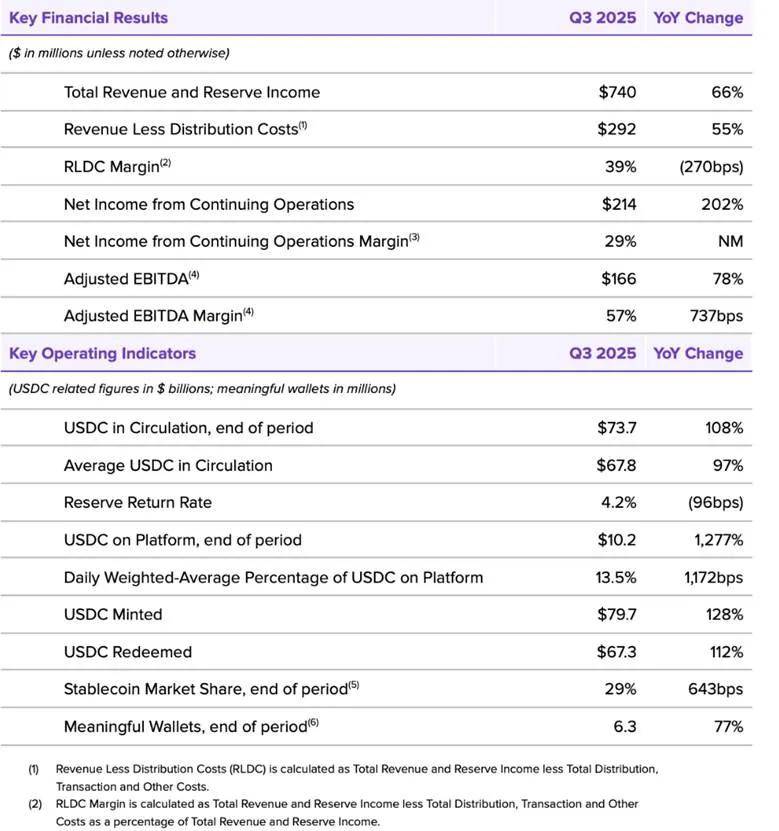
Core Viewpoint - Circle, a prominent player in the stablecoin market, has experienced significant volatility since its IPO, raising questions about its long-term value proposition and business model [1]. Group 1: Business Model and Revenue Generation - Circle's primary product, the stablecoin USDC, is pegged to the US dollar at a 1:1 ratio, contrasting with traditional cryptocurrencies by being centralized and non-volatile [2]. - The company's revenue model is straightforward: Revenue = USDC scale * investment yield * retention ratio (40%), with 96% of revenue derived from interest income on USDC reserves invested in US Treasury bonds [2][5]. - USDC's circulation has grown significantly, with $73.7 billion in circulation at the end of Q3 2025, representing a 108% year-over-year increase [3]. Group 2: Market Dynamics and Competition - The stablecoin market is still relatively small, comprising about 1.5% of the US M2 money supply, and its primary use case remains as a medium for cryptocurrency transactions rather than widespread cross-border payments [4]. - USDC faces competition from other stablecoins, particularly USDT, which has a larger market share and less regulatory oversight, potentially impacting USDC's growth trajectory [12][13]. - The growth of USDC has been closely tied to its partnership with Coinbase, which accounts for a significant portion of its revenue sharing [15]. Group 3: Financial Performance and Sensitivity - Circle reported total revenue of $740 million in Q3 2025, a 66% increase year-over-year, with net income from continuing operations reaching $214 million, a 202% increase [3][16]. - The company's financial performance is highly sensitive to interest rate changes; a decrease in US Treasury yields could significantly impact revenue and profitability [17]. - The current high interest rate environment (around 4%) has bolstered Circle's earnings, but a shift to lower rates could drastically reduce revenue [15][17]. Group 4: Future Outlook and Challenges - The future growth of USDC is contingent on its ability to penetrate cross-border payment markets and compete effectively against other stablecoins [19][23]. - There is skepticism regarding the sustainability of USDC's growth, with concerns about the long-term viability of its business model and the potential for declining market share [21][23]. - The potential for regulatory support for stablecoin applications could provide a boost to valuations, but the competitive landscape remains challenging [22][23].

XBIT助力虚拟货币最新主流化进程
Sou Hu Cai Jing· 2025-10-29 15:15
Core Trends in Cryptocurrency Mainstreaming and Industry Demand - The development of Bitcoin ETFs in 2025 signifies a major shift in institutional investment strategies, moving cryptocurrencies from niche assets to integral parts of diversified investment portfolios [3][10] - Institutions are transitioning from traditional self-custody models to ETFs due to the regulatory transparency and operational convenience they offer, indicating a recognition of cryptocurrencies as core assets [3][10] - The global rollout of cryptocurrency ETFs is ongoing, with different regions launching tailored products based on their regulatory frameworks, enhancing institutional investment options [3][10] Institutional Participation and Asset Diversification - Institutional involvement in the cryptocurrency sector is evolving from a focus on core assets like Bitcoin to exploring the value of emerging cryptocurrencies, necessitating platforms that can support both [4][10] - The demand for platforms that ensure stable operations for core assets while accommodating the technical characteristics of new cryptocurrencies aligns with XBIT's design philosophy [4][10] XBIT's Technological Innovations and Security Measures - XBIT has established a multi-layered security system to address the safety needs in the cryptocurrency space, utilizing decentralized exchanges where users control their private keys, thus minimizing asset risk [5][10] - The platform supports cross-chain operations and is compatible with multiple mainstream public chains, facilitating smooth asset transfers across different ecosystems [5][10] - XBIT balances compliance and user experience through zero-knowledge proof technology, meeting regulatory requirements while protecting user privacy [7][10] XBIT's Role in Supporting Emerging Cryptocurrency Assets - XBIT's decentralized trading platform and chain-based services provide essential support for the compliant allocation of emerging cryptocurrencies, aligning with the dual-track demand for core and new assets [10] - The increasing focus on emerging virtual currencies in the Asian market is met by XBIT's cross-chain adaptability and regional compliance design, positioning it as a vital link in connecting various cryptocurrency assets [10] Addressing Industry Challenges - Regulatory uncertainty and security risks remain significant barriers to broader institutional participation in the cryptocurrency sector [8][10] - XBIT's compliance technology and security framework effectively mitigate these concerns, aligning with the industry's trend towards seeking safe and compliant services [8][10] Conclusion on Cryptocurrency Mainstreaming - The growth of Bitcoin ETFs and institutional participation marks a new phase in the mainstreaming of cryptocurrencies, with XBIT's features providing effective support for industry demands [10] - As regulatory environments become clearer, the integration of cryptocurrencies with traditional finance is expected to deepen, with platforms that possess technological innovation and compliance capabilities likely to play a crucial role [10]
SNX rallies 25% as Synthetix kicks off $1M trading competition on Ethereum
Invezz· 2025-10-20 16:31
Core Insights - The global crypto market capitalization increased by 1.45% to reach $3.68 trillion [1] - Synthetix's native token, SNX, experienced significant growth, soaring approximately 26% within a 24-hour period [1] Market Performance - The overall crypto market saw a minor gain, reflecting a positive trend in virtual currencies [1] - SNX's price rose from $1.37 to an intraday high of $1.73, indicating a strong performance among altcoins [1]