
比特币ETF

Search documents
Why Is Crypto Crashing? Bitcoin, XRP, Ethereum, and Solana All Down This Week
Yahoo Finance· 2026-03-28 14:01
Market Overview - The financial markets are experiencing significant volatility due to geopolitical tensions, particularly the Iran-Israel war, which has led to threats of blocking key oil chokepoints, pushing oil prices above $100 [1][4] - The broader crypto market is in bearish territory, with major cryptocurrencies like Bitcoin, Ethereum, XRP, and Solana down 6-8% in a week, resulting in a total market value loss of over $80 billion since March 24 [5][6] Bitcoin Options Expiry - On March 27, a record $14.16 billion in Bitcoin options expired, leading to a liquidation of nearly 40% of open positions on the Deribit exchange and causing Bitcoin to drop 5% to as low as $65,720 [2][4] - The forced selling resulted in over 122,000 traders being liquidated, with total losses reaching $451 million [2][4] Price Movements - Bitcoin's price fell from $71,000 at the start of the week to $66,457, marking a 47% decline from its all-time high of $126,080 in October 2025 [11] - Ethereum dropped below $2,000 for the first time since mid-2024, down 60% from its August 2025 high of $4,953 [12] - XRP fell to $1.33, down 65% from its July 2025 cycle high of $3.65, while Solana experienced the largest decline, down 72% from its peak [12][13] Market Sentiment and Indicators - The Fear & Greed Index is currently at 23, indicating extreme fear in the market, while the average crypto RSI has dropped to 39, suggesting oversold conditions [5] - Bitcoin's support level is at $66,000; a daily close below this level could trigger further declines towards $50,000 [6][19] Macro Economic Factors - The Federal Reserve's recent meeting revised its 2026 PCE inflation forecast from 2.4% to 2.7%, pushing rate cut expectations further out, which negatively impacts risk assets [7] - The 10-year Treasury yield is near 4.5%, and the dollar index has increased by 0.57% in a week, leading to capital moving from crypto to bonds [8] Potential Recovery Signals - A ceasefire or de-escalation in the Iran-Israel conflict could lead to a recovery in the crypto market, as seen in early March when Bitcoin rose 16% following ceasefire reports [15] - The CLARITY Act is progressing towards a Senate vote, which could provide a legal framework for institutional investment in crypto, a key requirement for many investors [16] - Stablecoin supply is near a record $316 billion, indicating that capital remains within the crypto ecosystem and could flow back into major assets once conditions improve [17]
Bitcoin, Ethereum Slip on Inflation Surprise as Oil Prices Jump
Yahoo Finance· 2026-03-18 15:05
Market Overview - The price of Bitcoin decreased by 5% to around $71,135, while Ethereum and Solana fell by 7% to $2,185 and 6% to $89 respectively [2] - The S&P 500 index fell by 0.4%, the Nasdaq declined by 0.3%, and the Dow Jones Industrial Average dropped by 300 points [5] Inflation and Economic Indicators - The Producer Price Index (PPI) rose by 3.4% year-over-year, exceeding economists' expectations of a 2.9% increase [1] - Elevated energy prices are contributing to inflation concerns, as indicated by the recent PPI data [3] Federal Reserve and Interest Rates - The Federal Reserve is expected to maintain its benchmark interest rate in the range of 3.5% to 3.75% [8] - There is growing confidence among traders that the Fed will keep interest rates unchanged for the remainder of the year [8] - The Fed's response to prolonged elevated energy costs may lead to higher interest rates for an extended period, which could negatively impact the cryptocurrency market [4][5] Geopolitical Factors - Brent crude futures increased by over 5% to $109 due to reports of attacks on Iran's South Pars gas field [6] - President Trump's comments regarding Iran and the Strait of Hormuz may influence market sentiment and energy prices [6][7]
Nikkei, Kospi Plunge as Oil Surges on U.S.-Iran War Fears; Bitcoin Holds Steady
Yahoo Finance· 2026-03-09 09:19
Core Insights - Asian stock markets experienced significant declines due to rising oil prices, with Japan's Nikkei 225 dropping approximately 7% and South Korea's Kospi falling 8.2% as Brent crude surged about 27% to around $117.58 per barrel, marking one of the largest daily gains on record [1][3][7] Group 1: Economic Impact - The sudden rise in oil prices is expected to quickly influence fuel costs, inflation expectations, and currency pressures, prompting investors to reassess growth and interest rate outlooks [2] - For Japan and South Korea, the oil price rally represents an immediate economic shock, impacting their economies that heavily rely on imported energy [3][7] Group 2: Market Reactions - South Korea announced plans to impose a domestic fuel price cap and consider broader support measures in response to local asset sell-offs and currency weakening [3] - Asian equities have fallen more sharply than cryptocurrencies, as higher crude prices raise input costs and fuel inflation fears, particularly affecting import-dependent economies [3][5] Group 3: Cryptocurrency Stability - Despite the geopolitical shock, cryptocurrencies like Bitcoin have shown more stability compared to Asian equities, rebounding above $73,000 after an initial drop to around $63,000 [4][5] - The crypto market has been less directly impacted by oil-driven pressures, allowing it to hold up better amid rising inflation fears and changing earnings expectations [5] Group 4: Trading Dynamics - Some trading activity related to the geopolitical situation has shifted to crypto-linked commodity markets, with traders utilizing platforms to trade oil, gold, and silver-linked derivatives while traditional markets were closed [6] - Arthur Hayes has indicated that global markets may still be underestimating the risks associated with a prolonged conflict, suggesting potential for a later sell-off in the crypto market [7]
重磅!8大顶级机构Q4持仓汇总
贝塔投资智库· 2026-03-03 01:00
Core Viewpoint - The article provides insights into the holdings of various well-known investment institutions as of December 31, 2025, highlighting significant positions, increases, and decreases in their portfolios [3][5][10][13][15][17][21][23]. Group 1: Major Holdings - Baillie Gifford has a portfolio consisting of 265 companies with a total market value of $120 billion [5]. - Berkshire Hathaway holds 42 companies with a market value of $274 billion [10]. - Ark Invest, led by Cathie Wood, has 200 companies in its portfolio valued at $15.1 billion [13]. - David Tepper's holdings include 39 companies with a market value of $6.93 billion [17]. - Hillhouse Capital, managed by Zhang Lei, has 33 companies valued at $3.1 billion [21]. Group 2: Increased Holdings - Baillie Gifford's significant increases include positions in Nvidia (6.80%) and Datadog [6]. - Berkshire Hathaway increased its stake in Chevron (22.6%) and Apple [11]. - Ark Invest has notably increased its holdings in Tesla (8.7%) and CoreWeave [14]. - David Tepper has increased his positions in Micron Technology and Korean ETFs [17]. - Hillhouse Capital has increased its stake in Alibaba (39.17%) and Pinduoduo [21]. Group 3: Decreased Holdings - Baillie Gifford has reduced its holdings in several companies, including Axon and Cloudflare [6][7]. - Berkshire Hathaway has decreased its positions in Apple and American Express [11]. - Ark Invest has reduced its stake in Tesla and Palantir [14]. - David Tepper has decreased his holdings in Alibaba and AMD [17]. - Hillhouse Capital has reduced its positions in various companies, including Futu Holdings [21].





这一次币圈寒冬,底层基建没有崩
Hua Er Jie Jian Wen· 2026-02-26 13:15
Group 1 - The core viewpoint is that despite recent sell-offs in Bitcoin and a potential market winter, the underlying infrastructure supporting the cryptocurrency market remains intact, providing confidence to bullish investors [1] - Unlike previous cycles, the current market mechanisms are functioning well, with cryptocurrency exchanges operating normally and custodians maintaining good solvency, while many U.S. banks are actively developing cryptocurrency products, effectively preventing a systemic collapse [1][2] - Resilience in funding further limits downside risks in the market, as most assets remain in the market despite concerns over ETF fund outflows, with institutional buyers holding their ground and no panic selling observed [1] Group 2 - The resilience of the infrastructure is evident as the market did not experience systemic collapses like in 2022, where notable institutions such as FTX and Celsius failed, indicating significant improvements in market mechanisms [2] - The supply-demand structure of Bitcoin is undergoing substantial changes, with Bitcoin ETF assets being held steadily during price declines and a reduction in the free trading supply of Bitcoin [2] - This structural change alters the physical mechanism of potential recovery, suggesting that if market sentiment shifts, buying pressure will be transmitted through narrower channels, potentially generating greater momentum for market rebounds [3]
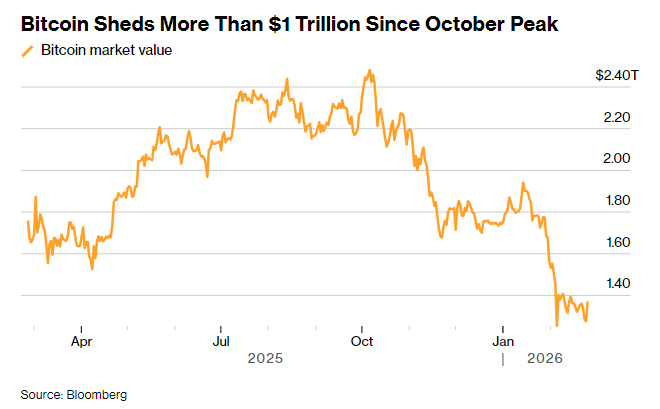
万亿美元市值蒸发背后 比特币的看涨逻辑正在悄然浮现
Zhi Tong Cai Jing· 2026-02-26 00:57
Core Viewpoint - The recent Bitcoin price drop, nearly halving since its peak last October, is the most severe sell-off since the FTX collapse, yet the institutional framework built during the bull market remains intact, indicating a potential bullish sentiment despite the downturn [1][12]. Group 1: Market Resilience - Bitcoin ETF funds have largely remained stable, with Wall Street not exiting the market entirely, as long-term holders show strong commitment to their positions [1][2]. - Despite a significant price drop, over 45% of Bitcoin holdings are currently at a loss, and option traders are buying contracts to hedge against further declines [1][6]. - The outflow of ETF funds, while concerning, represents only about 6% of the total since the launch of the spot Bitcoin ETF in January 2024, which has seen net inflows of hundreds of billions [1][9]. Group 2: Institutional Stability - Unlike the previous downturn in 2022, there have been no major institutional collapses this time, with exchanges operating normally and custodial institutions maintaining solvency [5][6]. - Major U.S. banks are accelerating their entry into the cryptocurrency space, with over half having launched or developing crypto-related products [5][9]. Group 3: Long-term Demand and Supply Dynamics - Institutional holdings of Bitcoin, including ETFs and public companies, now account for nearly 12% of the circulating supply, indicating a growing base of long-term demand [9]. - The supply side is tightening, with the upcoming Bitcoin halving in April 2024 expected to reduce new issuance, potentially leading to a significant price rebound when market sentiment shifts [10][12]. Group 4: Market Sentiment and Future Outlook - The current bearish sentiment is contrasted by a robust underlying infrastructure that has not only survived but is expanding, suggesting that the market may not remain in a downturn for long [12]. - The fundamental reasons driving Bitcoin's value over the past 15 years remain valid, including increasing digitization, concerns over fiat currencies, and improving regulatory conditions [12].
NCE平台:比特币重现底部信号
Xin Lang Cai Jing· 2026-02-23 13:52
Core Insights - Bitcoin's current market performance aligns closely with the bottoming phase of the bear market observed at the end of 2022, indicating a transition from panic to calm, which is typical in the later stages of a bear market [1][4] - The significant drop in trading activity, with a 59% month-over-month decrease in spot trading volume and perpetual contract open interest hitting a four-month low, suggests a concentrated release of bearish sentiment [1][4] Market Dynamics - Over 90% of Bitcoin-based assets remain firmly held despite a notable decline in Bitcoin ETF exposure, reflecting the resilience of long-term capital [2][5] - The extreme low of the Crypto Fear and Greed Index at 5 historically coincides with the emergence of cyclical market bottoms, indicating potential long-term value in the current pessimistic narrative [2][5] Investment Strategy - Patience in long-term investment will be crucial, as Bitcoin's price increases often occur on a few explosive trading days, making it easy to miss significant upward movements if investors exit during consolidation phases [2][5] - Current market fluctuations provide a golden opportunity for low-cost accumulation, suggesting a systematic approach to positioning rather than attempting to time market volatility [2][5] Future Outlook - The ongoing "bottoming" phase, similar to late 2022, is expected to lay the groundwork for future value discovery, with the potential for Bitcoin to regain an upward trajectory if macro uncertainties are effectively managed [3][6]
比特币受挫于亚洲交易周开局 关税不确定性重挫加密货币市场
Xin Lang Cai Jing· 2026-02-23 08:01
Group 1 - Bitcoin experienced a decline, dropping to a low of $64,338 amid rising uncertainty regarding tariffs [1][2] - The recent downturn in Bitcoin reflects a cautious sentiment in the risk asset market, influenced by the court's rejection of Trump's tariff measures and the announcement of new global tariffs [1][2] - Policy uncertainty tends to trigger short-term "safe-haven" sentiments for Bitcoin, leading investors to prefer cash and bonds over high-volatility assets [1][2] Group 2 - A significant factor contributing to the decline in Bitcoin is the noticeable decrease in ETF inflows, which directly impacts market demand and diminishes expectations for a sustainable bull market cycle [1][2] - According to LSEG data, Bitcoin is currently down 3.4%, trading at $65,351 [1][2]
Coinbase CEO:Coinbase 托管了美国 80% 以上的比特币和以太坊 ETF 资产
Xin Lang Cai Jing· 2026-02-21 01:50
Group 1 - Coinbase CEO Brian Armstrong stated that Coinbase holds over 80% of the Bitcoin and Ethereum ETF assets in the U.S. [1] - In 2025, Coinbase is projected to record a peak net inflow of ETF funds amounting to $31 billion [1] - Coinbase serves as a custody partner for several large financial institutions and government ETF products, emphasizing its commitment to security through ongoing penetration testing by top cryptography experts [1]

李林创立的 Avenir Group 披露最新比特币 ETF 持仓:2025 年第四季度 Avenir Group 对 BlackRock IBIT 的持仓维持不变
Xin Lang Cai Jing· 2026-02-14 01:55
Group 1 - Avenir Group disclosed its latest Bitcoin ETF holdings, maintaining its position as the largest institutional holder of Bitcoin ETFs in Asia for seven consecutive quarters since Q2 2024 [1] - As of the end of Q4 2025, Avenir Group's holdings in BlackRock IBIT remain unchanged at 18,287,323 shares, with only a minor adjustment of approximately -0.053% due to trading friction compared to Q3 [1]
