
《云之羽》

Search documents
12月21日,女演员周也
Xin Lang Cai Jing· 2025-12-21 15:32
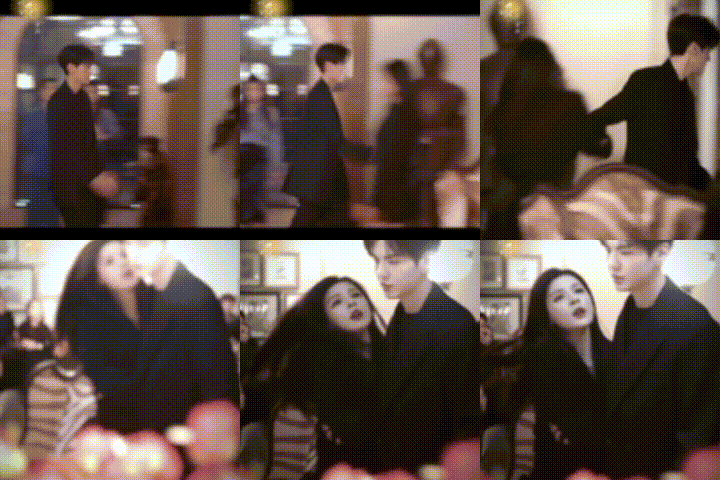
Group 1 - Actress Zhou Ye appeared at the "Starry Night Awards" wearing a long train veil that got caught during the red carpet event [1] - Actor Cheng Lei assisted Zhou Ye by lifting her veil during the red carpet walk [1] - Zhou Ye gained attention for her role as Wei Lai in the film "Better Days" and graduated from Beijing Film Academy [1] Group 2 - Cheng Lei, born in 1993, became known for his role as Gong Shangjiao in the TV series "Cloud Feather" [1] - Upcoming projects for Cheng Lei include "Jin Yue Ru Ge," "With Jin Chang'an," and "Footprints," all set to air in 2025 [1]
幼态败退、成女反攻,内娱小花“变脸”
Hu Xiu· 2025-08-04 11:01
Core Insights - The article discusses the shifting dynamics in the Chinese entertainment industry, particularly focusing on the rise and fall of young actresses known as "小花" (little flowers) and their evolving roles in dramas [1][9][10] - It highlights the challenges faced by younger actresses like Zhao Lusi and Yu Shuxin, who are struggling to maintain their popularity amidst changing audience preferences and industry standards [1][8][18] - The emergence of new actresses such as Chen Duling and Meng Ziyi is noted, indicating a potential shift in the types of roles and characteristics that are currently favored by audiences [1][20][21] Industry Trends - The article identifies a trend where younger actresses with "幼态" (youthful traits) are facing difficulties in adapting to more mature roles, leading to a decline in their popularity [3][4][7] - It discusses the concept of "成女小花" (mature little flowers), emphasizing the importance of physical maturity and the ability to portray complex emotional roles in contemporary dramas [10][11] - The changing audience preferences are leading to a demand for actresses who can embody a more mature and sophisticated image, moving away from the previously favored youthful aesthetic [21][22] Challenges and Opportunities - The article outlines the challenges faced by actresses like Zhao Jinmai, who struggle with typecasting and audience perception due to their youthful appearance [5][6][8] - It suggests that actresses need to either enhance their acting skills or undergo physical transformations to remain relevant in the industry [4][18] - The rise of "穿书题材" (穿书 genre) is highlighted as a new opportunity for actresses, allowing them to take on diverse roles that may not fit traditional casting molds [12][20] Audience Dynamics - The article notes a shift in audience preferences, with viewers becoming fatigued with the "甜妹" (sweet girl) archetype, leading to a demand for more diverse and mature character portrayals [7][21] - It emphasizes that the entertainment industry is experiencing rapid changes, with audience tastes evolving quickly, making it essential for actresses to adapt [17][19] - The potential for new actresses to gain popularity through innovative roles and narratives is discussed, indicating a possible resurgence of interest in different character types [22]
我在CP感玄学课考了99分的好成绩
Hu Xiu· 2025-08-02 09:35
Core Viewpoint - The article discusses the concept of "CP感" (Couple Chemistry) in Chinese dramas, suggesting that it can be analyzed and understood through specific frameworks rather than being purely mystical or random [4][5][15]. Group 1: CP感 Analysis - CP感 can be likened to a chemical reaction, where the right elements and conditions lead to successful pairings in dramas [6][13]. - The article categorizes CP感 into five basic types of reactions: 1. **Combustion Reaction**: Intense physical chemistry, exemplified by the drama "这一秒过火" [8]. 2. **Acid-Base Neutralization**: Character contrasts that create balance, seen in "永夜星河" and "念念有词" [9][10]. 3. **Oxidation-Reduction Reaction**: Characters drawing out needed traits from each other, as in "雁回时" [10]. 4. **Decomposition Reaction**: Unleashing suppressed traits, illustrated by "苍兰诀" [11]. 5. **Synthesis Reaction**: Combining two distinct characters for a common goal, as in "朝雪录" [12]. Group 2: Industry Trends - The article notes that the understanding of CP感 is not just theoretical but also practical, requiring careful casting and direction to achieve desired emotional responses [15][26]. - It highlights the trend of "CP邪修" (CP Deviance), where unconventional pairings are explored, often leading to unexpected audience engagement [18][20]. - The phenomenon of audience-driven "self-generated CP" is also discussed, where fans create their own narratives and pairings through editing and reinterpretation [22].

扇巴掌才是收视密码
Hu Xiu· 2025-04-30 08:46
Group 1 - The article discusses the resurgence of slapping scenes in Chinese dramas, highlighting their role in conveying intense emotions and audience engagement [3][12][13] - It notes that slapping has become a significant element in both short and long dramas, reflecting a shift in narrative style and audience expectations [11][14] - The article emphasizes that slapping serves as a form of immediate emotional feedback, contrasting with the slower pacing and emotional restraint seen in some contemporary dramas [12][13] Group 2 - The piece mentions specific dramas that have effectively utilized slapping, such as "Summer Family Three Thousand Gold" and "Cloud of Feather," showcasing the variety of contexts in which slapping is employed [8][9][10] - It highlights the cultural significance of slapping in storytelling, suggesting that it has evolved from a trope of lowbrow entertainment to a more nuanced expression of character dynamics and societal commentary [3][12] - The article also points out that the portrayal of slapping can vary in effectiveness, with some scenes resonating well with audiences while others may detract from the overall narrative [5][11]