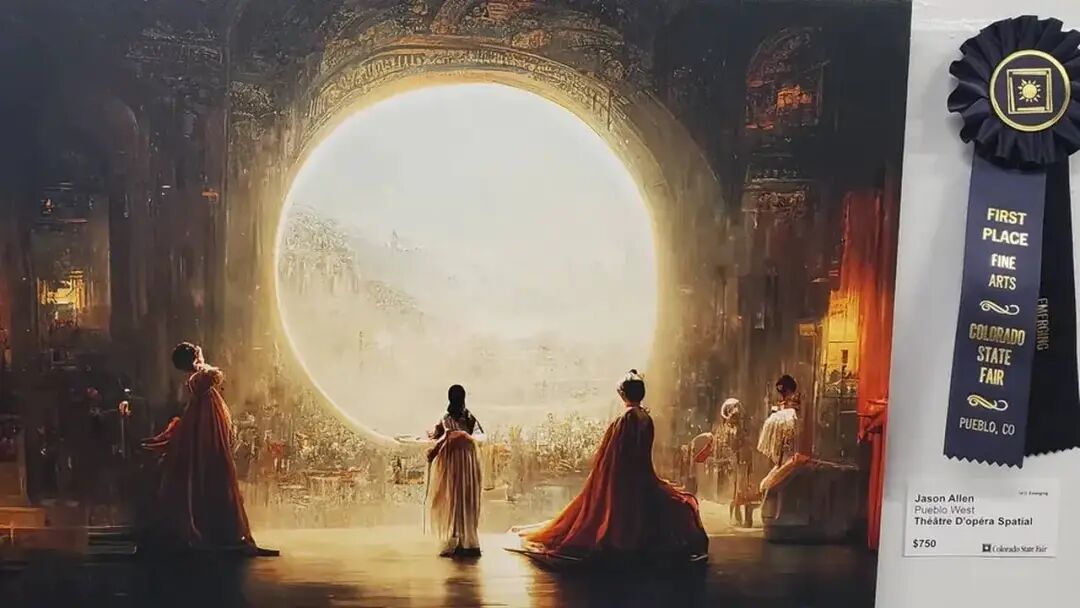
《太空歌剧院》

Search documents
AI重塑艺术生产:在协同共生中释放创造张力
Jiang Nan Shi Bao· 2026-01-27 23:10
Core Insights - The rapid evolution and widespread application of artificial intelligence (AI) are fundamentally reshaping artistic production across various dimensions, leading to unprecedented changes in productivity, subjects, objects, methods, and processes in art [2][5] - The emergence of AI-generated art has sparked debates about the true nature of authorship and creativity, particularly highlighted by the success of AI artworks in prestigious competitions and exhibitions [2][7] - The essence of art is being redefined in the AI era, challenging traditional views that prioritize the artist's individual creativity [3][4] Artistic Production Transformation - AI is transforming artistic production by acting as a "technical partner" and "creative assistant," significantly altering data processing, creative logic, and social collaboration [5][6] - The data processing capabilities of generative AI allow for rapid assimilation of artistic techniques and styles, enabling the creation of innovative combinations that surpass human capabilities [5][6] - AI is facilitating a shift from individual expression to social collaboration in art, making interactions between artists and audiences more immediate and visible [6][12] Philosophical and Aesthetic Considerations - The debate on whether AI-generated works can be classified as art is ongoing, with perspectives ranging from "result-oriented" views that focus on aesthetic qualities to "intentionality" arguments that emphasize human consciousness in creation [7][8] - The unique value of AI art lies in its ability to blend traditional aesthetics with novel, unexpected combinations, expanding the boundaries of artistic experience [11] Human-AI Collaboration - The collaboration between human artists and AI is evolving, with artists transitioning from mere executors of technique to creative drivers who inject personal insights into the artistic process [12][13] - This dynamic collaboration fosters a distributed creative environment, where various stakeholders contribute to the artistic output, challenging the traditional linear relationship between concept and execution [12][13] Future of Art - The future of art is envisioned as a collaborative ecosystem where human creativity and AI capabilities coexist, redefining the role of the artist to include both humans and AI entities [13]
AI 画作卖出 100 多万,这个世界没有疯
3 6 Ke· 2025-11-03 01:55
Core Viewpoint - The acceptance of AI-generated art has significantly evolved, with major art institutions now recognizing and collecting such works, indicating a shift in the perception of AI as a legitimate form of artistic creation [3][4][8]. Group 1: Institutional Acceptance - The Museum of Modern Art (MoMA) in New York has included Refik Anadol's AI artwork "Unsupervised" in its permanent collection, marking it as the first AI art piece in the museum [4][6]. - Other traditional art institutions, such as the Denver Art Museum and the Los Angeles County Museum of Art (LACMA), have also begun to collect AI-generated works, signaling a broader acceptance within the art community [6][8]. Group 2: Market Dynamics - In early 2023, Christie's held the first auction dedicated to AI art, featuring over 30 pieces and achieving a total sales amount of approximately $729,000, with an 82% success rate in sales [11]. - Refik Anadol's work sold for $277,200 at this auction, highlighting the financial viability and market interest in AI-generated art [12]. Group 3: Artistic Identity and Value - The emergence of AI art has sparked debate among traditional artists, who question the authenticity and value of works created through algorithms compared to traditional artistic methods [17][19]. - The role of artists is shifting from creators to curators, where they select and present AI-generated images, emphasizing the importance of concept and process over traditional craftsmanship [21][23]. Group 4: Future Considerations - The uniqueness traditionally associated with art, derived from personal experiences and emotional struggles, is challenged by the efficiency of shared algorithms, raising questions about the future of artistic identity [23][25]. - The competitive edge in AI art may increasingly rely on philosophical insights and emotional depth, aspects that machines struggle to replicate, suggesting a new paradigm in evaluating artistic merit [25].