《女人心》

Search documents
近2万名艺术家带来1400余场展演 第24届中国上海国际艺术节落幕 这场金秋文化之约跻身“世界一流”
Jie Fang Ri Bao· 2025-11-28 01:40
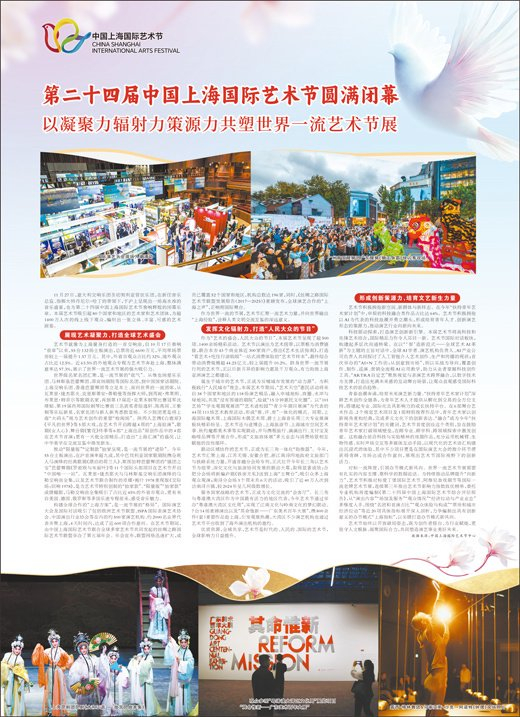
Core Insights - The 24th China Shanghai International Arts Festival successfully concluded with over 20,000 artists from more than 80 countries participating, showcasing a total of 1,400 performances across various art forms, attracting 14.44 million attendees both online and offline [1][2] Group 1: Festival Highlights - The festival's main performances generated nearly 66 million yuan in ticket sales, with an average increase of 15,700 yuan per performance compared to the previous year, indicating a growing market appeal [2] - International audience representation was significant, with 32% of attendees coming from other provinces and 12.5% from overseas, including art enthusiasts from the USA and Germany [2] - The festival featured renowned international groups such as the Vienna Philharmonic and the Mariinsky Ballet, alongside prominent Chinese institutions, enhancing Shanghai's status as an artistic hub [2][3] Group 2: Economic Impact - The festival collaborated with 43 commercial entities and nearly 300 businesses, creating an "Art Life Guide" that integrated various consumer experiences, leading to a total consumption boost of over 4.425 billion yuan, a 10.2% increase from the previous year [4] - The average ticket price and per capita spending have shown a consistent upward trend, reflecting the recovery of cultural market consumption capabilities [4] Group 3: Regional Collaboration - The festival served as a catalyst for regional integration in the Yangtze River Delta, with special trains connecting cities like Shanghai, Wuxi, and Hefei, significantly increasing attendance at related events [5] - The "Guangdong-Hong Kong-Macao Greater Bay Area Cultural Week" featured performances and exhibitions that fostered cultural exchange and garnered international attention [5] Group 4: Technological Integration - The festival embraced technological advancements, with 64% of submissions for the "Support for Young Artists Program" being technology-integrated works, highlighting a trend towards the fusion of art and technology [6] - Initiatives like the "AI+N Workshop" and the use of digital technologies in performances showcased innovative approaches to artistic creation [6] - The festival's impact index and the publication of a "Blue Book" provide a framework for evaluating festival models, positioning Shanghai as a benchmark for global arts festivals [6]
第二十四届中国上海国际艺术节圆满闭幕
Ren Min Wang· 2025-11-28 01:21
Core Insights - The 24th China Shanghai International Arts Festival concluded with a high-level performance by the Santa Cecilia Orchestra under the direction of Daniel Harding, attracting over 14 million online and offline viewers from more than 80 countries and regions [4][5]. Group 1: Festival Overview - The festival featured 132 main performances with a total box office revenue of nearly 660 million yuan, an increase of 1.57 million yuan per performance compared to the previous year [5]. - Approximately 32% of the audience came from outside Shanghai, with nearly 12.5% being international visitors, showcasing the festival's strong appeal [5][6]. - The overall satisfaction rate among attendees reached 97.3%, indicating the festival's success in attracting and engaging audiences [5]. Group 2: Artistic Collaboration - The festival brought together world-class artists and ensembles, including the Vienna Philharmonic and the Mariinsky Ballet, alongside local groups like the Shanghai Symphony Orchestra [5][6]. - A significant number of performances were exclusive to the festival, with over 90% being premieres in Shanghai, highlighting the festival's role as a platform for unique artistic presentations [6][7]. Group 3: Economic Impact - The festival generated a consumption scale exceeding 4.425 billion yuan, a 10.2% increase from the previous year, demonstrating its economic influence on the local market [8]. - Collaborations with nearly 300 local businesses created a one-stop consumption experience, integrating arts with dining, accommodation, and tourism [8][9]. Group 4: Cultural Exchange and Education - The festival included 118 performances from 38 countries, promoting cultural exchange and creating a "15-minute cultural circle" for local communities [9][10]. - Educational initiatives featured 111 activities aimed at youth, fostering a new generation of artists and enhancing community engagement [9][10]. Group 5: Innovation and Technology - The festival embraced technology, with 64% of submissions for the "Support for Young Artists Program" being tech-integrated works, reflecting a trend towards innovation in the arts [13][14]. - Workshops focused on AI applications in the arts were introduced, providing practical training for industry professionals [13][14]. Group 6: Strategic Development - The festival served as a cultural "diplomatic" platform, facilitating cooperation among various regions, including the Yangtze River Delta and the Guangdong-Hong Kong-Macao Greater Bay Area [10][11]. - The festival's influence is growing globally, positioning itself as a leading arts festival with a commitment to cultural exchange and collaboration [11][12].