《炽道》

Search documents
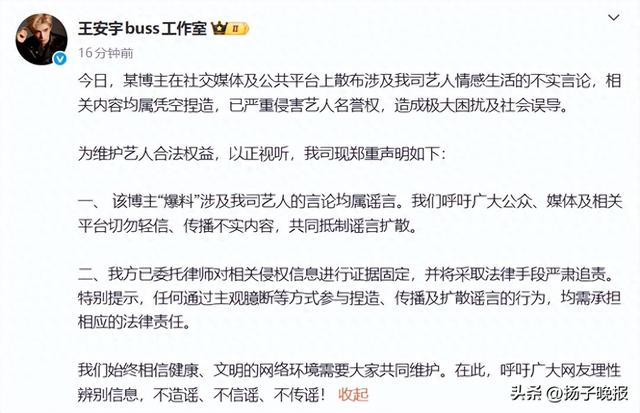
演员王安宇否认与关晓彤恋情:相关内容均属凭空捏造,已进行证据固定并将采取法律手段追责
Xin Lang Cai Jing· 2026-01-03 02:49
Group 1 - The studio of male star Wang Anyu denied rumors of a romantic relationship with actress Guan Xiaotong, stating that the claims are fabricated and have severely harmed the artist's reputation [1][2] - The studio has called for the public and media to refrain from spreading false information and has taken legal action against the source of the rumors [2] - The rumors originated from a blogger who claimed that Wang Anyu and Guan Xiaotong were dating, which sparked significant public interest and discussion [4] Group 2 - Guan Xiaotong, born on September 17, 1997, is a well-known actress and singer in mainland China, having previously been in a long-term relationship with Lu Han since October 8, 2017 [4] - Wang Anyu, born on February 3, 1998, gained fame after participating in the reality show "Tomorrow's Son" and has starred in several popular dramas [6] - The interactions between Wang Anyu and Guan Xiaotong have been limited to their professional collaboration in the drama "Little Alley Family," with no personal relationship confirmed [8]

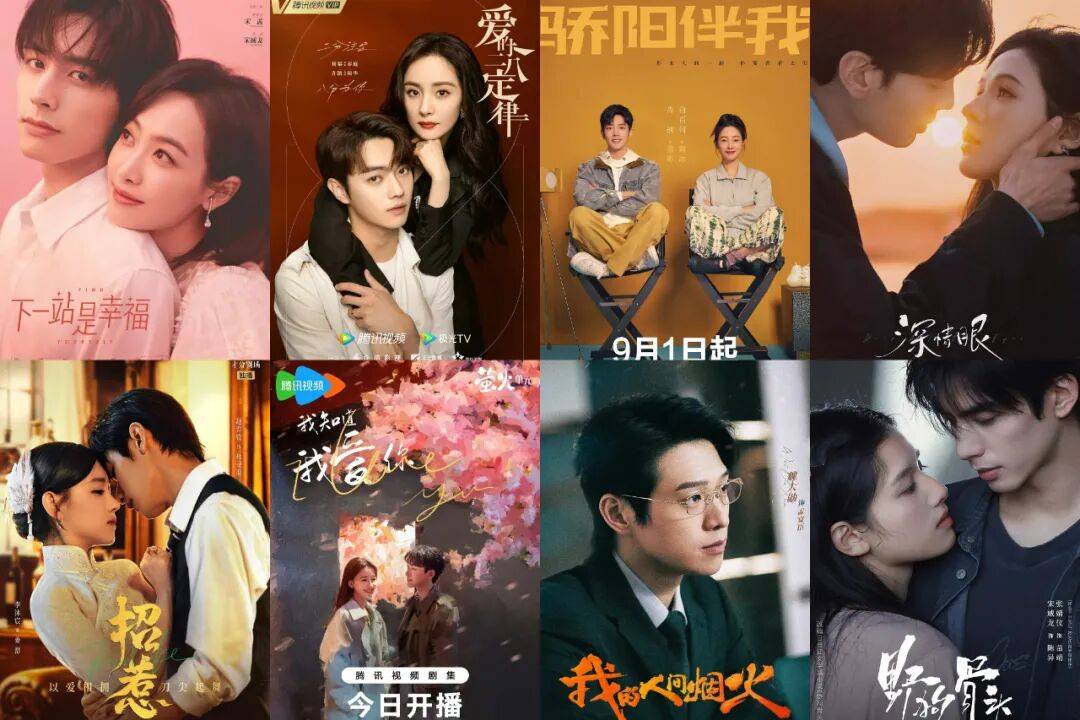
《许我耀眼》的不纯爱实验,成了还是败了?
Hu Xiu· 2025-10-11 08:35
Core Insights - The article discusses the shift in Chinese contemporary romance dramas, particularly highlighting the series "许我耀眼," which features morally flawed protagonists, diverging from the traditional pure love narrative [1][2][4] - The series has gained significant popularity, breaking the 30,000 heat threshold on Tencent Video, indicating a departure from conventional storytelling in the genre [2] - The emergence of non-pure love narratives reflects a broader trend in the industry, suggesting that there is potential for more diverse storytelling beyond the established norms [6][7] Summary by Sections Traditional Narratives - Historically, Chinese contemporary romance has been confined to pure love narratives, focusing on themes of growth, conflict, and choices centered around love, often relegating social issues to mere background elements [3] - Recent years have seen a rise in narratives that challenge the pure love archetype, with series like "半熟男女" and "许我耀眼" introducing characters with ulterior motives and moral ambiguity [4][5] Non-Pure Love Narratives - The article identifies multiple layers of non-pure love narratives, starting with the challenge to traditional gender dynamics and societal norms, as seen in various recent dramas [8][10] - The second layer involves a re-examination of sexual dynamics, where characters may not adhere to the "double purity" trope, thus complicating the portrayal of relationships [11][12] - The third layer critiques the commodification of love, where marriage and relationships are depicted as transactional, a theme more common in international series than in domestic productions [13][14] Industry Trends - Despite the emergence of non-pure love narratives, pure love remains a dominant force in the genre, with many series ultimately reverting to familiar romantic tropes by their conclusion [5][30] - The article notes that while there is a growing interest in non-pure love stories, they still represent a minority within the genre, with platforms favoring adaptations of popular pure love IPs [16][27] - The success of short dramas has accelerated the evolution of the genre, allowing for more complex narratives and character dynamics to be explored [32][36] Future Directions - The article suggests that the evolution of contemporary romance dramas could take multiple paths, including refining pure love narratives, integrating social issues, or exploring fantastical elements [40][41] - The potential for growth in the genre lies in expanding narrative boundaries and diversifying emotional experiences for audiences, moving beyond the traditional dichotomy of sweet versus painful storytelling [39][42]