
《读者》

Search documents
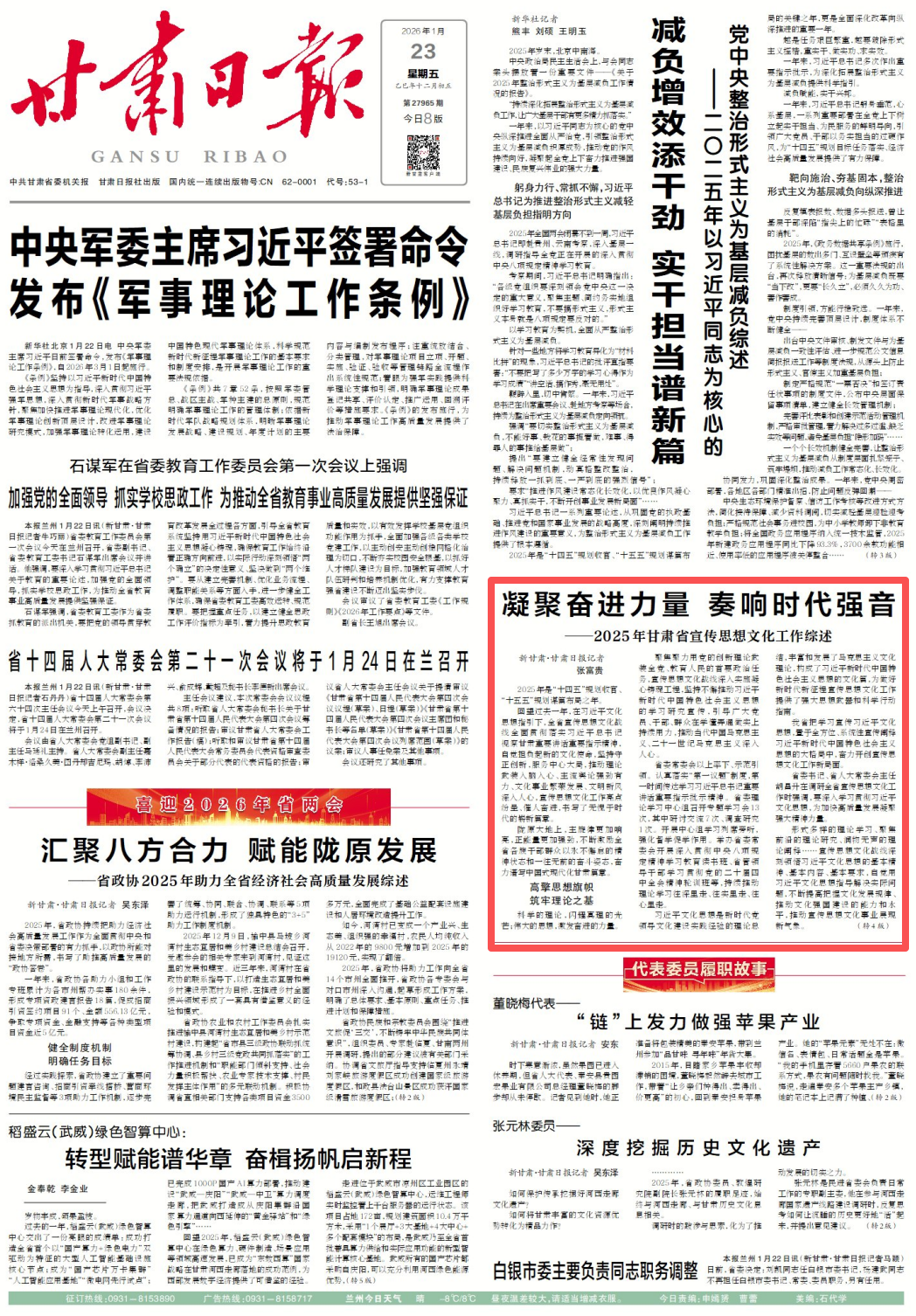
凝聚奋进力量 奏响时代强音——2025年甘肃省宣传思想文化工作综述
Xin Lang Cai Jing· 2026-01-23 00:21
Core Viewpoint - The article emphasizes the significant progress made in promoting cultural and ideological work in Gansu Province under the guidance of Xi Jinping's cultural thought, highlighting the achievements in theory education, cultural innovation, and the integration of culture and tourism as part of the province's development strategy [9][10][12][59]. Group 1: Cultural and Ideological Work - The cultural and ideological front in Gansu has fully implemented Xi Jinping's important speeches and directives, leading to a vibrant cultural atmosphere and a strong sense of mission among the people [9][10]. - The provincial government has conducted 32 thematic press conferences to showcase the achievements of the past five years, reflecting a commitment to high-quality development [18][19]. - Over 42,000 sessions of the 20th National Congress spirit were delivered, reaching approximately 8.47 million people, demonstrating the extensive outreach of ideological education [14]. Group 2: Theoretical Education and Innovation - The province has established a comprehensive theoretical education framework, including 13 special study sessions by the provincial committee, to deepen the understanding of Xi Jinping's cultural thought [10][12]. - Gansu has launched various initiatives to promote Marxist theory, resulting in 122 projects approved for national social science funding, showcasing the province's commitment to theoretical research [15][16]. Group 3: Cultural Heritage and Tourism Development - Gansu has made significant strides in cultural heritage protection, with the establishment of a joint laboratory for cultural heritage protection and the implementation of over 60 research projects related to Dunhuang studies [42][43]. - The province's tourism sector is projected to receive 500 million visitors and generate 400 billion yuan in revenue, marking a year-on-year growth of 10.8% and 15.9% respectively, solidifying its status as a strategic pillar industry [52][54]. - Cultural and tourism integration has been emphasized, with initiatives like the "Silk Road on Dunhuang" art tour reaching over 20 countries, enhancing Gansu's cultural presence internationally [27][48]. Group 4: Media and Communication - Gansu has enhanced its media landscape through systematic reforms, with over 497 million reports published across various platforms, significantly increasing the province's media influence [23][25]. - The province's media has effectively responded to social concerns and promoted positive narratives, particularly during emergencies, showcasing a robust communication strategy [23][29]. - The integration of traditional and new media has been prioritized, with a focus on creating impactful and engaging content that resonates with the public [58].

为全民阅读提供条件保障
Xin Lang Cai Jing· 2026-01-14 10:20
Group 1 - The newly introduced "National Reading Promotion Regulation" aims to provide legal support for the cultural and spiritual life of the public and to enhance the development of a reading culture in China [1][2] - The core focus of the regulation is on "promoting" rather than mandating individual reading behaviors, placing the responsibility on government departments to create favorable conditions for public reading [2][3] - The regulation consists of six chapters and forty-five articles, emphasizing the government's role in ensuring a conducive reading environment and aligning with existing laws to protect citizens' cultural rights [2][3] Group 2 - The regulation addresses the low average reading rates among citizens and mandates schools to enhance reading programs and activities to foster reading habits among students [3][4] - It encourages the revival and upgrading of public reading facilities, such as newsstands and reading kiosks, to improve access to reading materials in urban areas [4] - The regulation promotes the development of quality content by publishing units and encourages the growth of digital reading formats, while also emphasizing support for reading initiatives in underprivileged regions [4][5] Group 3 - The establishment of public cultural venues, such as libraries and community centers, is aligned with the regulation's requirements, highlighting the need for adequate reading spaces to meet public demand [5][6] - The regulation outlines the necessity for detailed implementation strategies, including the scientific allocation of reading spaces and the selection of appropriate reading materials to cater to diverse community needs [6]