
中兴努比亚M153

Search documents
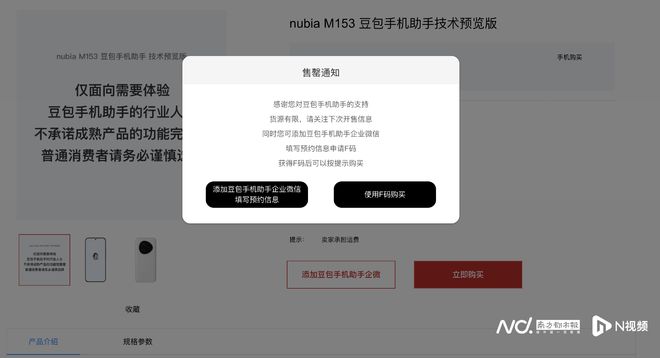
“豆包助手”手机自动化操作触发微信账号强制下线
Nan Fang Du Shi Bao· 2025-12-03 04:30
Core Insights - The launch of the "Doubao Assistant" smartphone by ByteDance has led to user complaints regarding abnormal logouts from WeChat after using the AI assistant for automated operations [1][2] - ByteDance is currently verifying the situation and has advised users to refrain from using the AI assistant for WeChat operations [1] - The "Doubao Assistant" smartphone, specifically the Nubia M153 model, has sold out, with prices on secondary markets significantly inflated [2] Group 1: Product and Market Response - The "Doubao Assistant" smartphone is a collaboration between Doubao and smartphone manufacturers, designed to automate tasks like ordering food and replying to WeChat messages [1] - Despite being labeled as an engineering sample, the Nubia M153 has seen high demand, with the original price of 3499 yuan being resold for around 5000 yuan [2] - Morgan Stanley's report suggests that deep integration of AI assistants with smartphone operating systems may face resistance from major manufacturers due to potential conflicts of interest [2] Group 2: Privacy and Security Concerns - The automated operations of the AI assistant raise privacy concerns, as they require real-time access to user screen information [2][3] - The "Doubao Assistant" employs a hybrid privacy protection model, processing sensitive data locally on the device while ensuring cloud data access is controlled [3] - The emergence of AI assistants as traffic entry points could lead to conflicts between AI assistant providers and third-party app developers, potentially undermining app security mechanisms and affecting their revenue models [3]

e公司观察“豆包助手”手机未发先火!移动终端新一轮卡位战打响
Zheng Quan Shi Bao Wang· 2025-12-02 15:47
Core Viewpoint - The launch of the "Doubao Phone Assistant" by ByteDance marks a significant step in the competition for control over the mobile terminal ecosystem in the AI era, with partnerships between internet companies and smartphone manufacturers becoming increasingly important [1][3]. Group 1: Product Launch and Market Reaction - On December 1, ByteDance's Doubao team released the technical preview of the "Doubao Phone Assistant," showcasing its capabilities on the ZTE Nubia M153 prototype, including the ability to execute tasks across applications automatically [1]. - Following the announcement, stocks of ZTE, Tianyin Holdings, Furong Technology, and Daoming Optics hit the daily limit, indicating strong market interest [1]. - The first "Doubao Assistant" phone sold out quickly, with prices on second-hand platforms reaching a premium of up to 3,500 yuan [1]. Group 2: Competitive Landscape - Major smartphone manufacturers like Huawei, Apple, OPPO, Xiaomi, and Vivo have been developing AI capabilities for years, with each having their own AI voice assistants [2]. - Huawei's HarmonyOS 6 has launched over 80 intelligent agents covering various fields, while Honor has integrated over 4,000 ecological MCPs and intelligent agents [2]. - The industry anticipates that AI phones will evolve into personal assistants, with AI voice assistants serving as the primary interface for human-computer interaction, potentially transforming the mobile ecosystem [3]. Group 3: Future Trends and Collaborations - The collaboration between ByteDance and ZTE is seen as a strategic move to seize control over traffic distribution in the evolving AI landscape, indicating a new wave of competition for influence in the mobile terminal market [3]. - The likelihood of replicating the Doubao and ZTE partnership with mainstream smartphone brands is low, but opportunities may exist with smaller brands or other consumer electronics like glasses, headphones, and smartwatches [3]. - The industry has yet to establish a unified standard for collaboration in the intelligent agent era, with various participants vying for a share of the emerging market [3].
