中欧新趋势

Search documents
总金额超300亿元 开年公募分红热潮涌动
Xin Lang Cai Jing· 2026-01-23 15:50
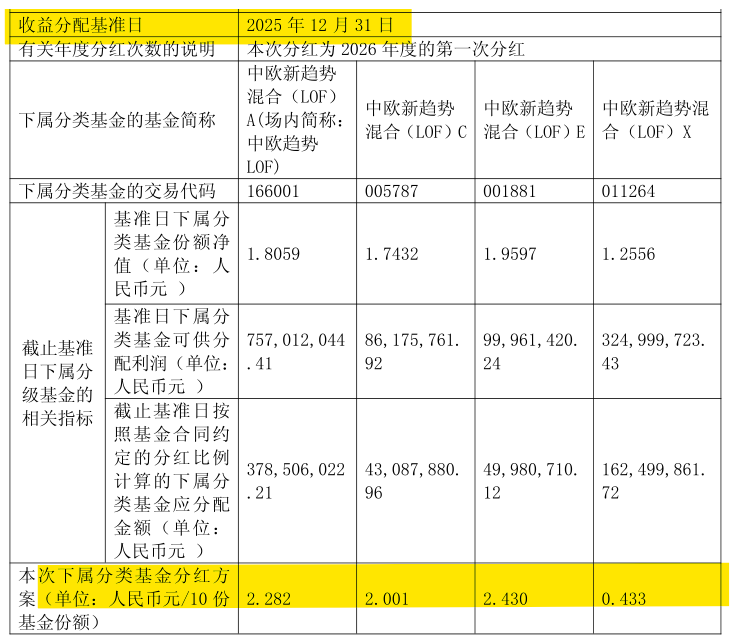
Core Viewpoint - The public fund industry in China is experiencing a significant increase in dividend distributions, reflecting a shift from a focus on scale to prioritizing investor returns [2][7]. Group 1: Dividend Distribution Trends - As of January 22, 2026, over 500 funds have announced dividend plans, with total distributions exceeding 30 billion yuan, indicating a strong correlation between dividend activity and market enthusiasm [1][3]. - The Huatai-PineBridge CSI 300 ETF is set to distribute approximately 9.81 billion yuan, marking the highest single dividend payout for a fund in 2026 [1][3]. - The total number of funds distributing dividends has reached 524, with a cumulative payout of 32.31 billion yuan, showcasing a robust trend in dividend announcements [3][4]. Group 2: Active Equity Funds - Active equity funds have emerged as a new highlight in the dividend landscape, contributing approximately 6.02 billion yuan, which accounts for about 19% of total dividends [4]. - Some active equity funds have reported dividend ratios exceeding 10%, with the China Europe New Trend fund distributing 2.282 yuan per 10 shares, representing over 12% of its net asset value [4]. - The strong performance of these funds, with annual net value growth rates exceeding 50%, has supported their generous dividend distributions [4][6]. Group 3: Historical Growth in Dividend Scale - The total dividend amounts for public funds have shown steady growth over the past three years, with figures of 224.71 billion yuan in 2023, 225.63 billion yuan in 2024, and 242.42 billion yuan in 2025 [5]. - The increasing dividend enthusiasm among public funds is attributed to both the growth in fund scale and a shift in focus towards investor returns [5][6]. Group 4: Regulatory Influence and Future Outlook - Regulatory policies are encouraging fund managers to distribute dividends, enhancing the stability and sustainability of the dividend mechanism in the public fund market [6][8]. - The industry is expected to adopt a more proactive approach to dividend distributions, driven by regulatory guidance and the development of passive investment products [7][8]. - The anticipated economic recovery and supportive policies are likely to lead to a sustained increase in dividends from high-quality equity products [8].
一批绩优基金宣布分红
Zhong Guo Ji Jin Bao· 2026-01-13 00:39
Core Viewpoint - A number of high-performing funds have announced significant dividend distributions at the beginning of 2026, with dividend ratios exceeding 10% [1] Group 1: Fund Dividend Announcements - The China Europe New Trend fund announced a dividend distribution of 2.282 yuan per 10 fund shares, representing a dividend ratio of over 12% [2] - This marks the first dividend distribution for the China Europe New Trend fund in over three years, with a record of over 60 billion yuan in fund size as of the last quarterly report [2][3] - Other high-performing funds, including Dongwu Jiahe Advantage and Changsheng Aerospace Equipment, have also announced dividends exceeding 10% [6] Group 2: Market Performance and Trends - As of January 12, 2026, the China Europe New Trend A fund has achieved a one-year net value growth rate of over 77%, ranking in the top 10% of its category [2][6] - The market has seen a significant increase in dividend distributions, with over 3,600 funds announcing dividends in 2025, totaling over 240 billion yuan, a 7.5% increase from 2024 [6] - In 2026, more than 100 public funds have already implemented dividend distributions, totaling over 3.1 billion yuan within the first half of January [6] Group 3: Economic and Market Insights - The chairman of the equity investment decision committee at China Europe Fund, Zhou Weiwen, believes that the core drivers for positive returns in the A-share and Hong Kong markets in the first half of 2026 will be supported by both domestic and international liquidity [4] - Zhou notes that the current stock market is not at historically low levels, indicating that market opportunities are not primarily driven by attractive valuations [5]