东吴嘉禾优势

Search documents
一批绩优基金宣布分红
中国基金报· 2026-01-13 02:00
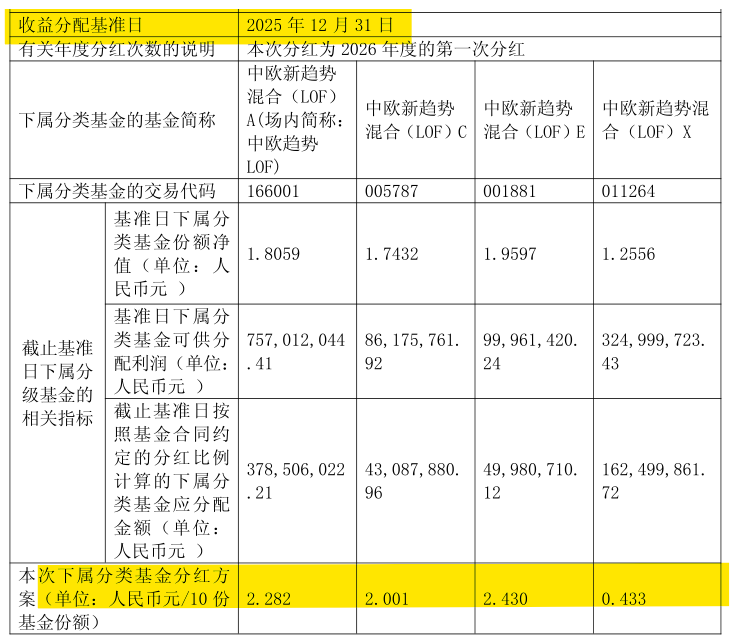
Core Viewpoint - A number of high-performing funds have announced significant dividend distributions at the beginning of 2026, with distribution ratios exceeding 10% [2][8]. Fund Dividend Announcements - The China Europe New Trend fund, managed by Zhou Weiwen, announced its first dividend in over three years, with a distribution of 2.282 RMB per 10 fund shares, resulting in a distribution ratio exceeding 12% [4][6]. - Other high-performing funds, such as Dongwu Jiahe Advantage, Changsheng Aerospace Marine Equipment, Guotai Junan Jinma Stable Return, and others, have also announced dividends exceeding 10% [8]. Fund Performance Metrics - As of January 12, 2026, the China Europe New Trend A fund has a one-year unit net value growth rate of over 77%, ranking in the top 10% of its category [6]. - The performance of other funds includes Baoying Strategy Growth with a growth rate exceeding 117%, and Dongwu Jiahe Advantage A and China Europe New Trend A with growth rates of over 98% and 77%, respectively [8]. Market Context and Outlook - Zhou Weiwen, the chairman of the equity investment decision committee at China Europe Fund, believes that the core drivers of positive returns in the A-share and Hong Kong markets in the first half of 2026 will be supported by both domestic and international liquidity [6]. - The current market is not at historically low valuation levels, indicating that opportunities are not primarily driven by attractive valuations but rather by liquidity support from policy measures [6].

一批绩优基金宣布分红
Zhong Guo Ji Jin Bao· 2026-01-13 00:39
Core Viewpoint - A number of high-performing funds have announced significant dividend distributions at the beginning of 2026, with dividend ratios exceeding 10% [1] Group 1: Fund Dividend Announcements - The China Europe New Trend fund announced a dividend distribution of 2.282 yuan per 10 fund shares, representing a dividend ratio of over 12% [2] - This marks the first dividend distribution for the China Europe New Trend fund in over three years, with a record of over 60 billion yuan in fund size as of the last quarterly report [2][3] - Other high-performing funds, including Dongwu Jiahe Advantage and Changsheng Aerospace Equipment, have also announced dividends exceeding 10% [6] Group 2: Market Performance and Trends - As of January 12, 2026, the China Europe New Trend A fund has achieved a one-year net value growth rate of over 77%, ranking in the top 10% of its category [2][6] - The market has seen a significant increase in dividend distributions, with over 3,600 funds announcing dividends in 2025, totaling over 240 billion yuan, a 7.5% increase from 2024 [6] - In 2026, more than 100 public funds have already implemented dividend distributions, totaling over 3.1 billion yuan within the first half of January [6] Group 3: Economic and Market Insights - The chairman of the equity investment decision committee at China Europe Fund, Zhou Weiwen, believes that the core drivers for positive returns in the A-share and Hong Kong markets in the first half of 2026 will be supported by both domestic and international liquidity [4] - Zhou notes that the current stock market is not at historically low levels, indicating that market opportunities are not primarily driven by attractive valuations [5]
以业绩比较基准为锚 再定义绩优主动权益基金
2 1 Shi Ji Jing Ji Bao Dao· 2025-11-05 23:23
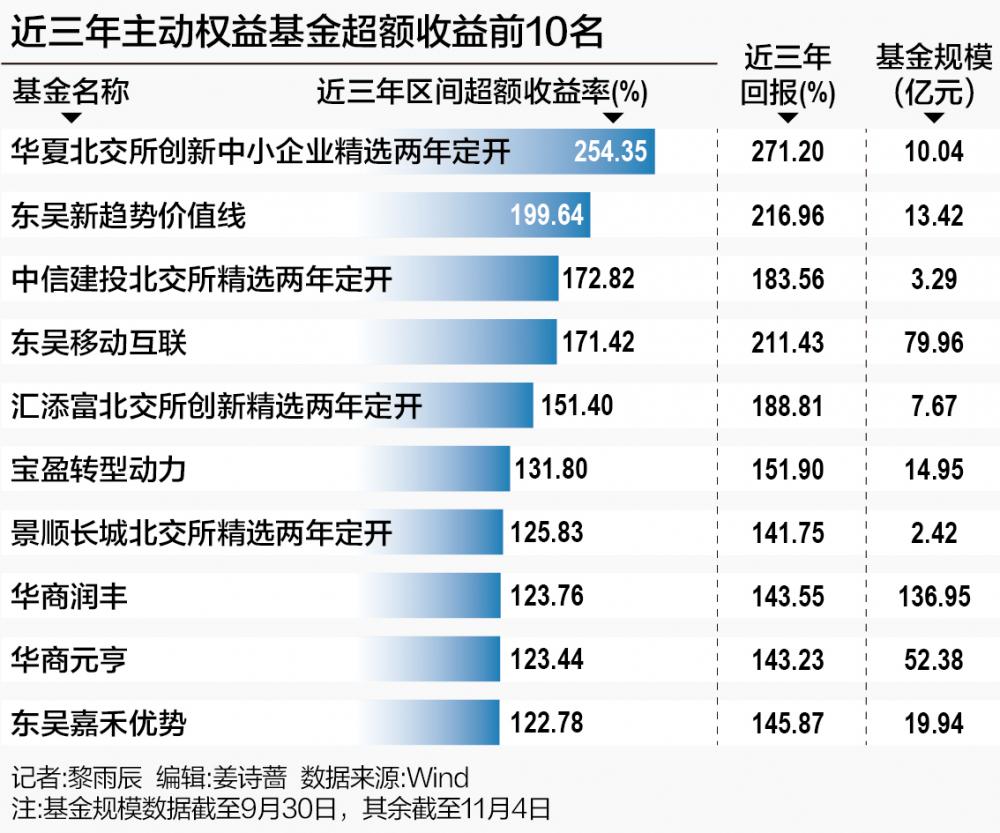
Core Viewpoint - The new regulations on performance benchmarks for public funds in China aim to enhance the accountability of fund managers by linking their compensation to the performance benchmarks, promoting a return to the fundamental purpose of asset management, which is to provide stable long-term returns for investors [1][9]. Group 1: Regulatory Changes - The China Securities Regulatory Commission (CSRC) released an action plan in May to promote high-quality development in the public fund industry, emphasizing the importance of performance benchmarks [1]. - A draft of new regulations regarding performance benchmarks was published on October 31, which is expected to improve the discipline of active investment and stabilize investment styles [1][9]. - The introduction of a performance benchmark element library aims to standardize the selection of benchmarks and prevent arbitrary changes, enhancing the comparability and normativity of benchmarks [9][8]. Group 2: Fund Performance Analysis - As of November 4, 2023, 3731 active equity funds were analyzed, with an average return that lagged behind their benchmarks by 7.26%, and only 34% of these funds outperformed their benchmarks over the past three years [2]. - Among the top-performing funds, only 20 funds achieved over 100% excess returns, indicating that achieving superior performance under the new standards is challenging [2]. - Some high-performing funds may have misleadingly high returns due to benchmark mismatches, highlighting the importance of appropriate benchmark selection [2][3]. Group 3: Size and Performance Correlation - Larger active equity funds do not necessarily correlate with superior excess returns; only 40% of funds over 10 billion yuan in size outperformed their benchmarks [5]. - Smaller funds, with an average size of 30.57 million yuan, showed better excess return capabilities, supporting the notion that smaller funds can adapt more flexibly to market changes [6][5]. Group 4: Fund Manager Impact - The total management scale of fund managers influences their active management capabilities, with a significant number of successful funds managed by managers overseeing over 10 billion yuan [7]. - The average tenure of fund managers does not significantly correlate with their ability to generate excess returns, indicating that experience alone may not guarantee performance [7]. Group 5: Industry Evolution - The new regulations are expected to lead to a systematic restructuring of the public fund industry, with a one-year transition period for existing products to adjust their benchmarks [9][10]. - The emphasis on long-term performance and the establishment of a benchmark-linked compensation system for fund managers will promote more transparent and standardized investment behaviors [9][10].