中证A500ETF(国泰)

Search documents
超500亿元,“跑了”
中国基金报· 2026-01-21 07:13
Core Viewpoint - The A-share market experienced a significant adjustment with a net outflow of over 500 billion yuan from stock ETFs on January 20, indicating a trend of investors cashing out amidst market volatility [2][6]. Group 1: Market Performance - On January 20, the three major indices in the A-share market collectively declined, with the ChiNext Index dropping over 2% at one point [2]. - The total net outflow from stock ETFs over the past four trading days exceeded 240 billion yuan, with over 92 billion yuan flowing out in just the first two days of the week [2]. Group 2: ETF Trading Volume and Trends - As of January 20, the total scale of all stock ETFs reached 4.75 trillion yuan, with a trading volume of 313.08 billion yuan, an increase of over 15 billion yuan compared to the previous day [4]. - The A500 ETF (Huaxia) led the trading volume with 14.25 billion yuan, followed closely by other major ETFs such as the A500 ETF (Hua Tai) and the CSI 300 ETF [4]. Group 3: Sector Performance - The building materials and real estate sectors led the gains among stock ETFs, with several ETFs in these categories seeing increases of over 3.3% [5]. - Conversely, sectors such as satellites, aviation, and communication equipment performed poorly, with many ETFs in these categories experiencing declines exceeding 3% [5]. Group 4: Fund Inflows and Outflows - On January 20, the stock ETF market saw a reduction of 6.182 billion units, with a net outflow of approximately 504.66 billion yuan [7]. - Despite the overall outflow, 51 stock ETFs recorded inflows exceeding 100 million yuan, with the top inflows seen in the electric grid equipment ETF, chemical ETF, and Chinese concept internet ETF [7]. Group 5: Leading ETFs by Inflow - The top inflow ETFs included the electric grid equipment ETF with a net inflow of 27.55 billion yuan, followed by the KI ETF and the Chinese concept internet ETF [8]. - The leading ETFs by outflow included the CSI 300 ETF (Huatai) with a net outflow of 109.84 billion yuan, indicating significant investor withdrawal from major indices [9]. Group 6: Fund Management Insights - Fund managers from leading firms like E Fund and Huaxia reported continued inflows into their ETFs, driven by favorable monetary policy and positive macroeconomic data [10]. - Market analysts suggest that the current market may enter a phase of consolidation due to regulatory measures aimed at stabilizing market fluctuations, but a spring rally could still be anticipated [11].


包揽宽基ETF成交前五名 A500指数相关ETF成交持续放大
Xin Hua Cai Jing· 2025-12-19 08:08
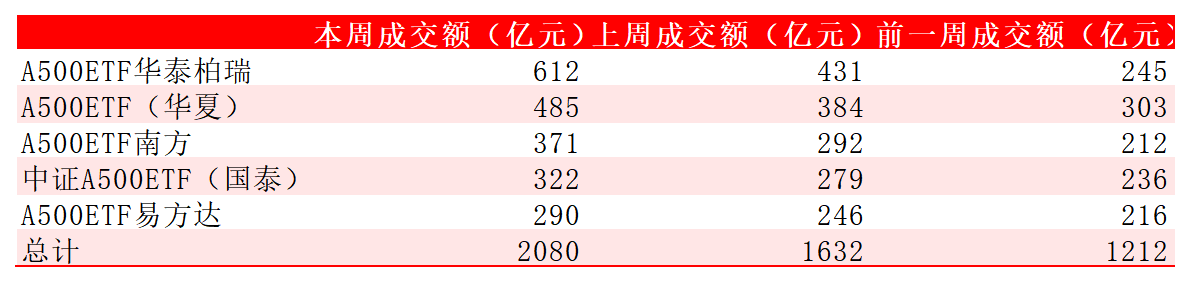
Core Viewpoint - The trading volume of A500 index-related ETFs has significantly increased this week, indicating strong market interest and potential investment opportunities in this sector [1][4]. Group 1: Trading Volume Data - On December 19, the A500ETF from Huatai-PB recorded a trading volume of 13.365 billion yuan, making it the top performer among broad-based ETFs [1]. - The A500ETF from Huaxia also surpassed 10 billion yuan in trading volume, reaching 10.003 billion yuan, marking it as the second ETF to exceed this threshold in a single day [1]. - The top five ETFs by trading volume for the day were all A500 index-related, including A500ETF from Southern, CSI A500ETF, and A500ETF from E Fund, which ranked third to fifth respectively [1]. Group 2: Weekly Trading Volume Comparison - The total trading volume for the five A500 index-related ETFs this week was 208 billion yuan, up from 163.2 billion yuan the previous week, and significantly higher than 121.2 billion yuan two weeks ago, showing an increase of over 40 billion yuan weekly [2][4]. - Specifically, the trading volume for A500ETF from Huatai-PB rose to 61.2 billion yuan this week from 43.1 billion yuan last week, while the A500ETF from Huaxia increased to 48.5 billion yuan from 38.4 billion yuan [2]. Group 3: Market Drivers - Industry experts suggest that insurance funds may be a primary driver behind this surge in trading volume, as regulatory changes have lowered the capital occupation costs for insurance companies, facilitating their entry into the stock market [4]. - The backdrop of declining bond yields and a scarcity of non-standard assets has created an asset shortage, making the CSI A500 index, which covers 500 mid-cap leading companies, attractive for long-term stable returns sought by insurance capital [4]. - Additionally, bank wealth management subsidiaries, brokerage proprietary trading, and foreign institutions are also identified as potential buying forces in this market [4].