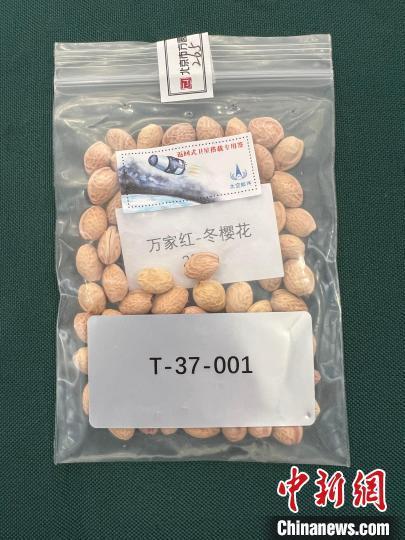
云南冬樱花种子

Search documents
遨游太空樱花种子在云南华宁播种
Huan Qiu Wang Zi Xun· 2025-05-19 03:31
Core Viewpoint - The successful planting of Yunnan winter cherry seeds, which were sent to space and returned, marks a significant step in space breeding technology in China [1][3]. Group 1: Space Breeding Technology - The Yunnan winter cherry seeds, weighing 220 grams (1,800 seeds), were launched aboard the Shijian-19 satellite and successfully returned to Earth [1]. - The seeds are expected to germinate within approximately half a month after planting, reaching a height of about 1 meter for transplanting [3]. - The project aims to innovate cherry germplasm resources and enhance the domestic cherry industry in China [4]. Group 2: Research and Development - The focus will be on closely collaborating with project partners to monitor the growth process and conduct rigorous scientific tests to select superior varieties based on traits such as flower color, shape, and resistance [3][4]. - Advanced research methods, including morphology, cytology, physiological and biochemical testing, and molecular biology, will be employed to study the mutated plants [4]. - The initiative is expected to provide scientific evidence for large-scale grafting and propagation, promoting the cultivation of new varieties [4].


220克遨游太空樱花种子在云南华宁交接
Huan Qiu Wang Zi Xun· 2025-04-12 02:42
Core Viewpoint - The successful return of winter cherry seeds from space marks a significant advancement in space breeding technology and is expected to enhance the flower industry in Yunnan province [1][3]. Group 1: Space Breeding Project - The winter cherry seeds, weighing 220 grams (1,800 seeds), were brought back by the Shijian-19 satellite, which was launched on September 27, 2024, and successfully returned on October 11, 2024 [3]. - The project involves collaboration among multiple institutions, including Yunnan Agricultural University, Nanjing Forestry University, and Yunnan Jianhua Green Development Co., Ltd. [3][5]. - The seeds will be cultivated to select superior varieties with larger petals, longer blooming periods, more vibrant colors, and stronger resistance [5]. Group 2: Research and Development - The project will utilize various scientific methods, including morphology, cytology, physiological and biochemical testing, and molecular biology, to study the mutated plants [5]. - The aim is to determine suitable planting regions and environments for the new varieties, providing a scientific basis for large-scale cultivation [5]. - It is anticipated that new cherry blossom varieties will be developed within three years, contributing to the aesthetic enhancement of the environment [5].