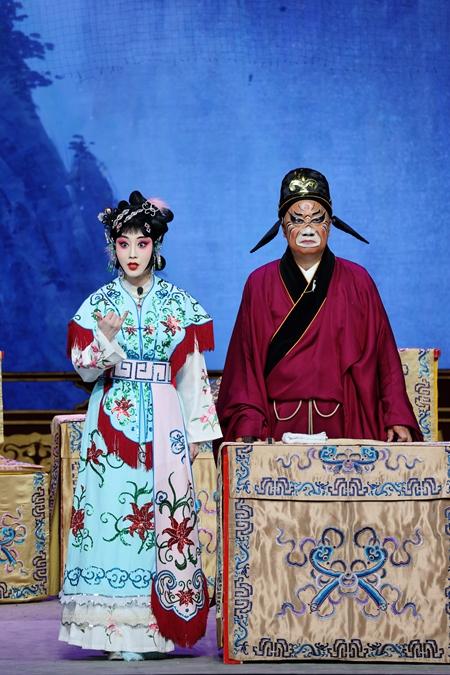
京剧《玉堂春》

Search documents
2026农历初一到初三,吉祥大戏院好戏连台贺新春
Bei Jing Ri Bao Ke Hu Duan· 2026-02-09 04:04
Core Viewpoint - The article highlights a series of six traditional Chinese opera performances at the Jixiang Grand Theatre in Beijing, celebrating the Lunar New Year from February 17 to 19, featuring renowned actors and rich cultural themes [1]. Performance Details - **Peking Opera "Red Mane Horse"**: Scheduled for February 17 at 14:00, it tells the story of Xue Pinggui reuniting with his wife Wang Baochuan after 18 years, culminating in a dramatic confrontation and eventual victory [1][3]. - **Peking Opera "Yutang Spring"**: Scheduled for February 17 at 19:30, it follows the tragic tale of the courtesan Su San, who faces wrongful accusations and ultimately finds justice with the help of her former lover, Wang Jinlong [6][7]. - **Peking Opera "Locking the Lining Bag"**: Scheduled for February 18 at 14:00, it narrates the story of Xue Xiangling, who, after a series of misfortunes, reunites with her family through acts of kindness [10][12]. - **Peking Opera "Mu Ke Zhai: Mu Tianwang's Great Victory"**: Scheduled for February 18 at 19:30, it depicts the battles between the Song and Liao dynasties, focusing on the heroic deeds of Yang Liulang and Mu Guiying [13][14]. - **Peking Opera "Mirror of Fortune and Longevity"**: Scheduled for February 19 at 14:00, it tells the story of a woman who faces trials and tribulations but ultimately reunites with her son after many years [16][19]. - **Peking Opera "Zhu Lian Zhai"**: Scheduled for February 19 at 19:30, it revolves around the historical context of the Huang Chao uprising and the strategic maneuvers of Li Ke Yong [20][22]. Ticket Information - Ticket prices range from 100 to 380 yuan, with a 30% discount available for online purchases [5][9][10][23].

让00后“入坑”的爆款京剧,观众买账是硬道理
Zhong Guo Qing Nian Bao· 2025-06-05 23:37
Core Viewpoint - The article highlights the innovative approach of young Peking opera actor Wang Mengting in modernizing traditional performances, particularly through the play "Dao Hun Ling," which has gained significant popularity among younger audiences [1][5]. Group 1: Performance and Audience Engagement - "Dao Hun Ling" has achieved nearly 100 million views online and received a strong box office response during the May Day holiday, indicating its widespread appeal [1]. - The play incorporates modern elements, such as the use of tango dance and contemporary language, to resonate with younger audiences while maintaining traditional themes [1][5]. - Wang Mengting emphasizes the importance of audience acceptance in determining the success of a performance, reflecting a shift towards more interactive and relatable storytelling in Peking opera [1]. Group 2: Artistic Innovation and Tradition - The play is categorized as a "joke play," blending traditional Peking opera with contemporary humor and relatable content, showcasing the evolution of the art form [1][5]. - Wang Mengting, as a third-generation inheritor of the Xun school, aims to integrate modern elements into traditional performances, aligning with the historical adaptability of Peking opera [4]. - The revival of classic works, such as "Yu Tang Chun," demonstrates a commitment to preserving traditional art while making it accessible to modern audiences through innovative presentation formats [5]. Group 3: Personal Journey and Training - Wang Mengting's journey into Peking opera began at a young age, influenced by her family's appreciation for traditional arts, highlighting the importance of early training and dedication in the performing arts [3]. - The rigorous training methods she underwent reflect the traditional practices of Peking opera, emphasizing the need for strong foundational skills [3]. - Her experiences illustrate the balance between maintaining traditional techniques and embracing modern influences in performance [4].