
人和大模型2.0

Search documents
AI Agent重塑智慧城市:谁执下一代升级牛耳?
Ge Long Hui· 2025-12-05 04:36
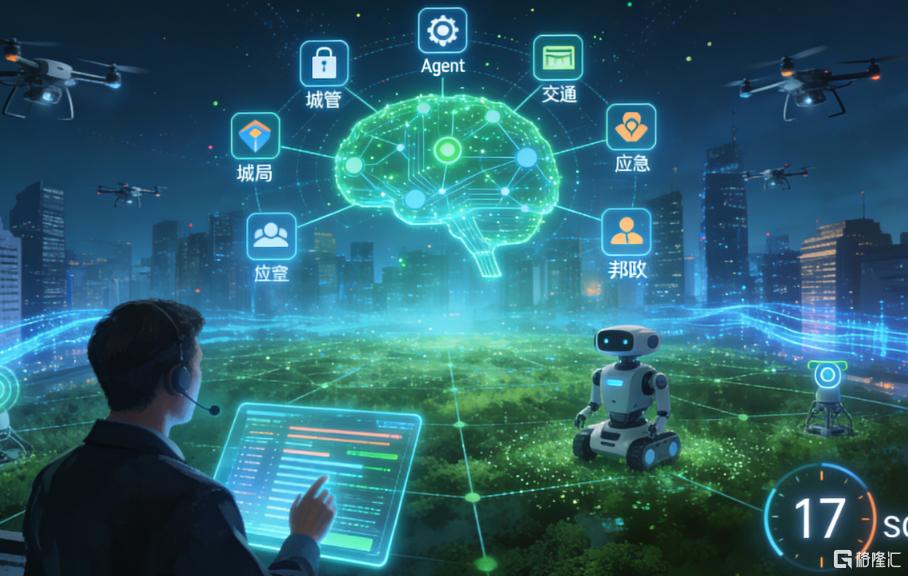
Core Insights - The article discusses the rapid evolution and integration of AI Agents in urban governance, highlighting their potential to transform smart cities by 2030 through advanced technology and practical applications [1][10] - The global AI Agent market is projected to reach $5.4 billion in 2024, with a compound annual growth rate (CAGR) of 45.8% from 2025 to 2030, potentially expanding to nearly $40 billion by 2030 [1] Group 1: Key Players in AI Agent and Smart City Development - The first category consists of vertical industry specialists like Digital Government and Zall Software, who leverage over 20 years of experience in urban governance to enhance scene understanding and business data assets [3] - The second category includes full-stack technology enablers such as Huawei and Lenovo, focusing on a comprehensive layout of computing power, algorithms, and hardware to support smart city initiatives [4] - The third category features general model giants like Google and Alibaba, which provide foundational AI support but face challenges in applying their technology to specific urban scenarios due to integration issues [4][10] Group 2: Future Smart City Characteristics - The future smart city will exhibit a three-layer intelligent agent architecture, including a perception and execution layer with IoT devices and drones, a cognitive decision-making layer with industry-specific models, and a service experience layer for citizen interaction [7] - The transformation of governance models from reactive to proactive is anticipated, with AI Agents enabling predictive capabilities for urban management, such as preemptively addressing safety hazards and optimizing waste management [8] - Human-machine collaboration will enhance governance efficiency, allowing AI Agents to handle routine tasks while humans focus on complex decision-making, ultimately shifting the service model from a reactive to a proactive approach [8][10] Group 3: Competitive Landscape and Strategic Insights - Vertical industry specialists are currently positioned to lead the market by deeply understanding urban governance needs and effectively integrating technology with practical applications [5][10] - The competitive advantage for these players lies in their ability to navigate complex urban scenarios, accumulate industry-specific knowledge, and foster multi-agent collaboration within government structures [10][11] - Technology giants have the opportunity to provide operational frameworks for AI Agents, similar to historical operating systems, but the most lucrative market will likely belong to those who understand both AI and business intricacies [11][12]


数字政通“政通人和,百业具兴——人和大模型2.0行业智能体发布会”圆满召开
Zheng Quan Shi Bao Wang· 2025-11-03 10:57
Core Insights - The release of "Renhe Model 2.0" signifies a major leap for the company from pilot applications of AI technology to a comprehensive promotion of "governance productivity" in smart city management [1][6] - The event highlighted the integration of AI agents in various government sectors, showcasing the practical applications of large model technology in urban governance [1][2] Group 1: Product and Technology Development - "Renhe Model 2.0" utilizes a "data-algorithm-application" matrix to transform business operations from "mouse operations" to "natural language interactions," addressing common pain points in government data applications [2][4] - The technology framework supports rapid deployment, allowing for industry model training within 15 days and application launch within 5 days, enhancing operational efficiency [4] Group 2: Industry Applications - The intelligent agents have been implemented in cities like Beijing, Shenzhen, and Chongqing, effectively converting creative potential into tangible governance productivity [3] - Specific applications include efficient regulation of construction waste, a closed-loop supervision model for administrative law enforcement, and proactive safety systems for urban infrastructure [2][3] Group 3: Collaborative Solutions - The company announced four joint solutions with industry leaders like Huawei and Baidu, marking a new phase in smart city ecosystem collaboration [5][6] - These solutions aim to enhance urban governance capabilities, including a comprehensive monitoring system for low-altitude environments and customizable digital government employees [5][6] Group 4: Strategic Implications - The launch of "Renhe Model 2.0" represents a pivotal moment in the company's evolution, integrating extensive industry knowledge with cutting-edge AI technology to drive business model innovation [6] - The core product, the government AI agent, is expected to provide stable subscription revenue, enhancing the company's profitability and market position in the smart city sector [6]
数字政通:公司发布新产品
Zheng Quan Ri Bao Wang· 2025-10-31 14:16
Group 1 - The core announcement is about the upcoming event titled "Zhengtong Renhe, Baiye Juxing - 'Renhe Large Model 2.0' Industry Intelligent Agent Release Conference" scheduled for October 30, 2025 [1] - The focus of the conference will be on the integration and practical application of large model technology in smart city governance [1]