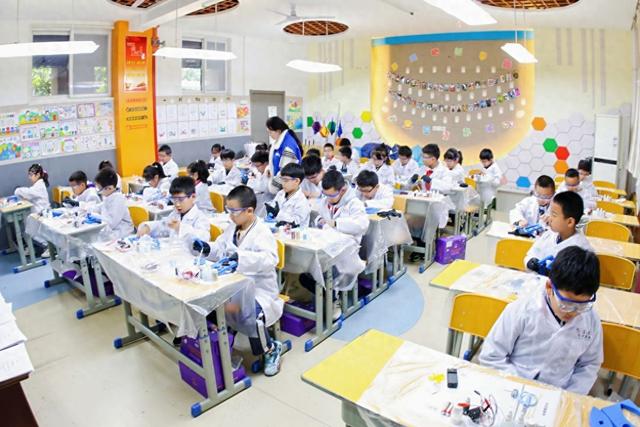
人工智能校本课程

Search documents
新城区教育局人工智能与数字化工作的创新探索
Zhong Guo Xin Wen Wang· 2026-01-07 03:31
Core Viewpoint - The New District Education Bureau is implementing a comprehensive digital education strategy, focusing on the integration of artificial intelligence in education, achieving significant results in infrastructure upgrades, teaching innovations, and enhancing teacher and student competencies, thereby establishing a unique model for digital education development in the region [1][10]. Group 1: Policy and Strategic Framework - The strategic framework includes four key areas: infrastructure upgrades, innovative teaching integration, smart campus creation, and enhancement of teacher and student competencies, with 12 specific tasks outlined in the 2025 work plan [1]. - The establishment of a dedicated AI education task force for primary and secondary schools aims to institutionalize and systematize AI education from 2025 to 2027 [1]. Group 2: Infrastructure and Resource Sharing - Significant investments have been made to enhance the educational network, achieving 100% coverage of smart teaching equipment in all primary and secondary schools and vocational schools [3]. - The "Shaanxi Education Empowerment Platform" has been actively utilized, facilitating over 120 inter-school support activities and 86 public demonstration classes, promoting equitable distribution of quality educational resources [3][4]. Group 3: Teaching Innovation and AI Integration - A tiered curriculum for AI education has been developed, ensuring all students receive the required hours of AI education, with a focus on experiential learning in lower grades and project-based learning in higher grades [4]. - Innovative teaching methods, including AI-assisted explanations and personalized learning approaches, have led to a 40% increase in classroom interaction efficiency [4]. Group 4: Teacher and Student Development - Over 1,200 teachers have participated in specialized training on AI and digital tools, with a 95% application rate of intelligent teaching tools among educators [6]. - A total of 1.5 million students engaged in AI course projects, significantly enhancing their innovative thinking and practical skills [8]. Group 5: Smart Campus Development - The establishment of 16 district-level smart campuses has been achieved, with ongoing support for schools to apply for higher-level smart campus designations [9]. - Eight AI innovation laboratories have been set up, facilitating over 300 AI club activities and 80 competitions, fostering student interest and capabilities in AI [9]. Group 6: Future Outlook - The New District Education Bureau aims to continue deepening the integration of AI in education, enhancing the AI education ecosystem, and contributing to the modernization of education in the region [10].