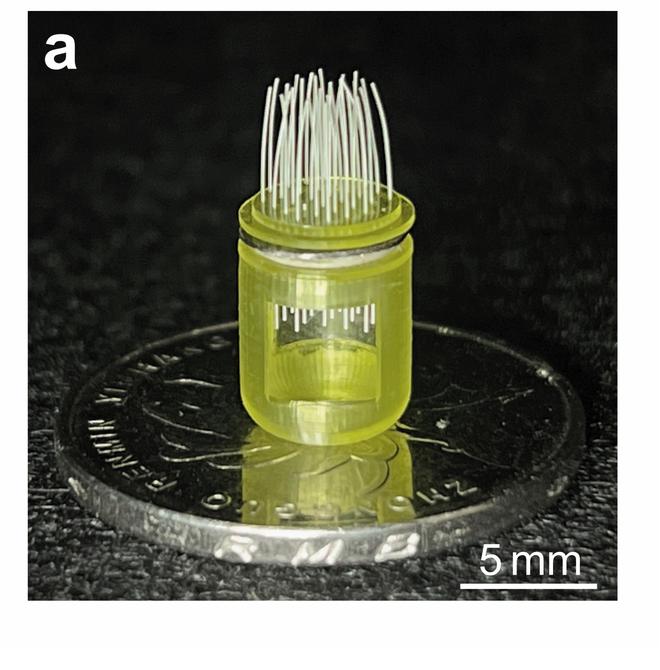
仿生人工纤毛阵列

Search documents
“声控胶囊” 巧用共振原理递释药物
Ke Ji Ri Bao· 2025-10-24 01:12
研究团队将不同共振频率组合的纤毛集成于同一阵列,发现在钢琴曲和语音等声音信号的刺激下, 纤毛阵列的振动响应模式与声音信号时频图基本一致,显示出其在声音频率可视化解析方面的潜力。团 队进一步研究证实,共振状态下的纤毛可显著加快液体流速,可有效促进模型药物在液体环境中的释放 与扩散。 在此基础上,研究团队分别将胰岛素和胰高血糖素搭载于不同长度直径比的仿生纤毛上,构建了胶 囊型的声学共振响应性药物递释器件,并在1型糖尿病模型小鼠身上验证了药物递释器件双向调控血糖 的功能。 "通过施加不同频率的声波刺激,这一器件可选择性触发胰岛素或胰高血糖素的释放。"顾臻告诉记 者,未来,这一仿生人工纤毛阵列可以进一步优化其材料与结构设计,以拓宽频率响应范围,提升对复 杂声音信号的解析能力,用于执行更多个性化任务。 科技日报讯 (记者江耘)10月22日,记者从浙江大学获悉,该校药学院、金华研究院顾臻教授、 王金强研究员团队开发了一种仿生人工纤毛阵列,可通过声学共振机制实现对声音信号的可视化解析, 并利用可听频率声波实现共振响应性药物递释。相关研究日前发表于学术期刊《自然·生物医学工 程》。 人类感知声音的过程很精巧——耳蜗中的基底膜 ...
浙大研究团队发明“声控胶囊”控释药物
Xin Hua She· 2025-09-25 06:20
Core Insights - A research team from Zhejiang University has developed a bionic artificial cilia array inspired by cochlear hair cells, which visualizes sound signal analysis through acoustic resonance mechanisms and utilizes this principle to create a "sound-controlled capsule" for drug release [1][5] Group 1: Research Development - The research was published in the journal "Nature-Biomedical Engineering" on the 24th, with contributions from professors and researchers at Zhejiang University [1] - The team used 3D modeling and high-precision 3D printing technology to simulate the structure of cochlear hair cell cilia, designing and fabricating bionic artificial cilia arrays with varying length-to-diameter ratios [1] Group 2: Experimental Findings - Experiments showed that the artificial cilia arrays, with different diameters and length-to-diameter ratios, vibrate under sound wave stimulation, with resonance frequencies ranging from 100 to 6000 Hz, covering the common frequency range of human hearing [2] - The integration of cilia with different resonance frequencies in a single array demonstrated potential for visualizing sound frequency analysis and significantly accelerated liquid flow rates, enhancing the release and diffusion of model drugs in liquid environments [2] Group 3: Future Applications - The team constructed a capsule-type drug delivery device responsive to acoustic resonance, capable of selectively triggering the release of insulin or glucagon by applying different sound wave frequencies [5] - Future optimizations of the bionic artificial cilia array's material and structural design aim to broaden the frequency response range and improve the analysis of complex sound signals, potentially integrating with brain-machine interfaces and electronic drugs [5]