信托制物业模式

Search documents
物业怎么干 居民说了算——郑州市“信托制”物业小区治理模式掠影
He Nan Ri Bao· 2025-09-11 23:40
虽然增大了约束,但物业乐见于此。"居民能看到账户资金的动态变化,更加信任物业,也更配合工 作,有利于公司可持续运营。"星月社区物业经理时俊义说,短短几个月,物业费缴存率从不足一半提 高至85%以上。 从被动接受物业管理,到主动参与物业服务,近段时间以来,得益于"信托制"物业模式的实施,郑州市 管城回族区北下街街道星月社区居民的幸福感不断上升。 9月9日,记者走进星月社区,只见道路干净整洁,管理井然有序。老住户马先生热心公益,是社区物管 会成员之一,每天除了接送孙子上下学,就在社区转悠着监督物业的工作。 今年6月,郑州市推行"信托制"物业小区治理,星月社区作为试点之一,选举出物管会,与物业公司达 成委托管理协议,并在银行开设共有账户,通过资金透明化对物业进行约束。 马先生点开"郑好办"APP"信托制"物业板块,小区账户收支明细一目了然,还有在线缴费、一键报修、 议事征集等功能。"物业想要动用资金,必须和物管会、业主共同商议。"马先生说,还有打扫卫生、修 剪树枝、修补道路等工作不到位的,可以随时要求他们整改。 巩义市新华路街道货场路社区拖厂北院曾是个"老破小",2018年开展简易自治,多次尝试引入物业企业 无果。 ...
哪一种物业付费模式才是未来?
3 6 Ke· 2025-07-25 02:21
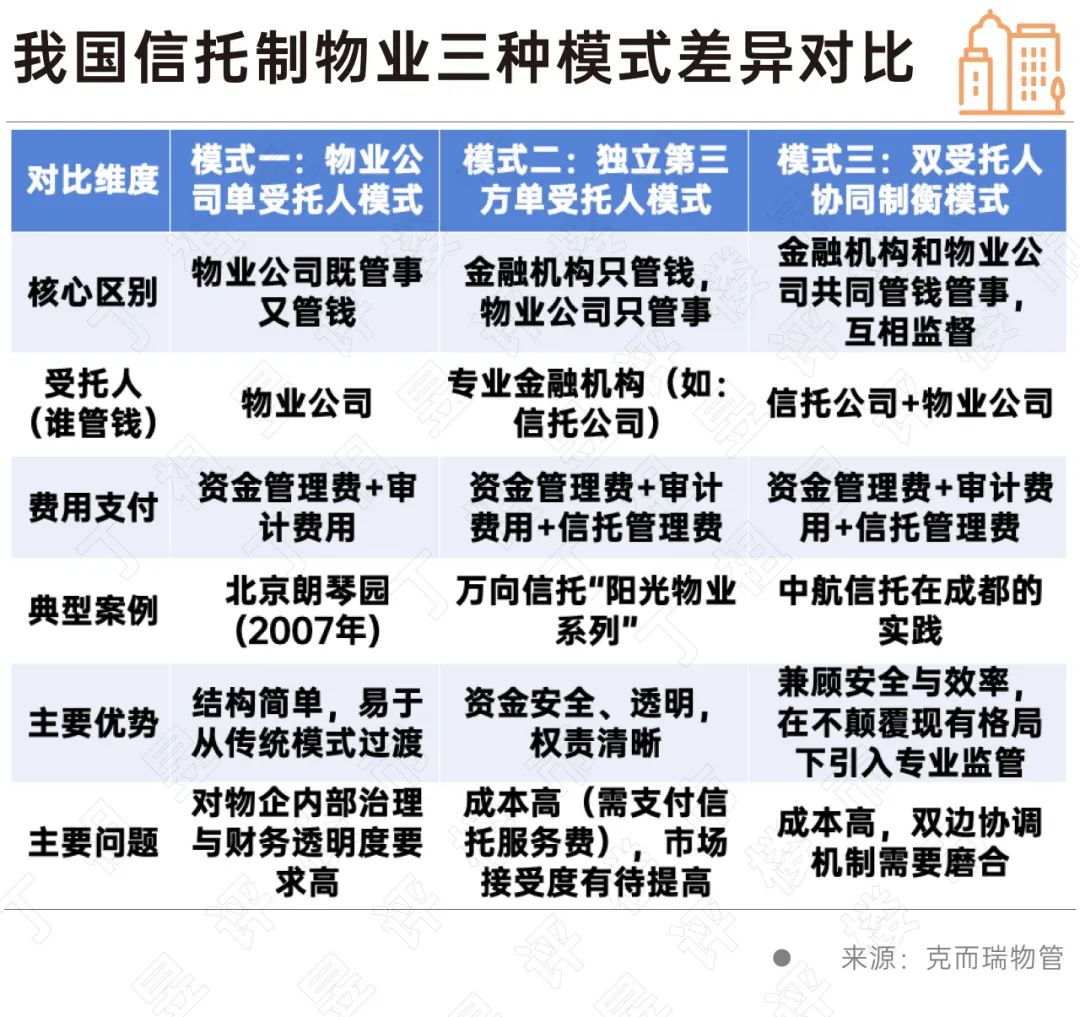
Core Viewpoint - The property management industry is undergoing a significant transformation due to recent national policies and urbanization trends, shifting from a focus on real estate support services to comprehensive urban operation and grassroots governance [1][4]. Group 1: Property Management Role Transformation - The role of property management is evolving from "real estate support service provider" to "urban comprehensive operator" and from "community maintenance provider" to "grassroots governance collaborator" [1]. - The central urban work conference highlighted the transition of urbanization from rapid growth to stable development, emphasizing quality improvement over quantity [1]. Group 2: Property Fee Models - There is increasing discussion around property fees, driven by rising expectations for service professionalism and transparency concerns regarding fee structures [1]. - Three main trust-based models have emerged in property management: 1. Single trustee model where the property company manages both services and funds, which is simple but requires high internal governance [2][3]. 2. Independent third-party trustee model where a financial institution manages funds, ensuring safety and transparency but at a higher cost [2][3]. 3. Dual trustee collaborative model where both the financial institution and property company manage funds and services, balancing safety and efficiency but also incurring higher costs [2][3]. Group 3: Challenges of Trust-Based Models - The trust-based model faces challenges such as unclear legal status and financial difficulties, including additional costs for third-party audits and the inability to resolve inherent funding gaps [4]. - The shift in roles under the trust model may lead to governance issues, as property companies become mere executors without the authority to respond flexibly to emergencies [4]. Group 4: Commission-Based Model - The commission-based model, which allows property companies to charge a fixed commission while reimbursing actual expenses, is gaining traction due to its transparency and alignment with owner interests [5][6]. - This model has shown positive results, such as a 30% increase in maintenance funds in a Shanghai project, enhancing trust between owners and property management [5]. Group 5: Comparison of Models - The commission-based model is less disruptive to existing operations compared to the trust model, requiring only contract adjustments rather than a complete overhaul of financial systems [6][7]. - The commission model is legally mature and aligns with existing regulations, while the trust model faces legal ambiguities and higher operational costs [7]. Group 6: Challenges of Owner Autonomy - The concept of owner autonomy in property management is currently more of an ideal than a practical reality, facing challenges such as large community sizes and the lack of effective governance structures [9][10]. - The existing owner committee system has inherent weaknesses, including unclear legal status and operational inefficiencies, which hinder effective self-governance [13][14]. Group 7: Core Industry Issues - The fundamental conflict in the industry stems from a misalignment in the perception of service value rather than merely financial opacity, suggesting a need to enhance professional service capabilities rather than complicate systems [15].