
儿童福利服务

Search documents
2024年东营民政事业发展统计公报
Qi Lu Wan Bao Wang· 2025-09-10 06:33
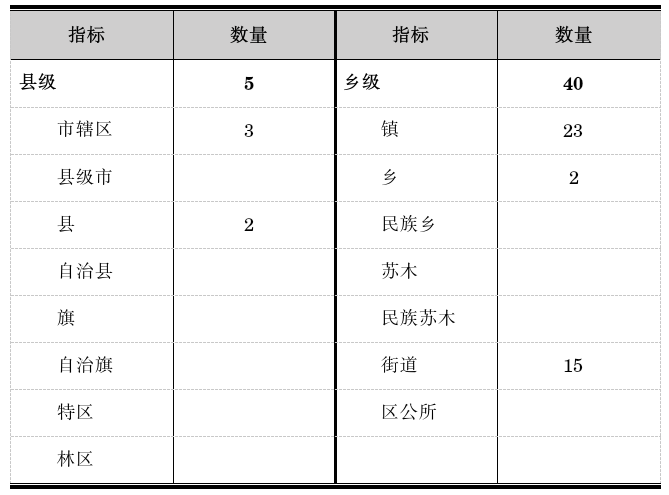
Group 1: Administrative Division - As of the end of 2024, the city has 5 county-level administrative divisions and 40 township-level administrative divisions [2] - There are 15 county-level administrative boundary lines, totaling 785.897 kilometers [2] - A total of 118 standard administrative boundary markers have been installed [2] Group 2: Social Services with Accommodation - By the end of 2024, there are 73 various social service institutions providing accommodation, with 69 registered as elderly care institutions [4][5] - The total number of beds in these institutions is 8,375, with 3,117 individuals receiving care [4][5] - The city has 610 elderly care institutions and facilities, with a total of 14,493 beds [7] Group 3: Child Welfare and Protection Services - There are 3 registered child welfare and protection institutions, providing 63 beds, with 18 children under care at year-end [8] - The basic living guarantee standard for children is 2,688 yuan per person per month [8] - The city has 110 orphans, with a living guarantee standard of 2,150 yuan per person per month [11] Group 4: Social Assistance - By the end of 2024, there are 1,230 urban low-income individuals, with a monthly assistance standard of 1,075 yuan, reflecting a 7.1% increase from the previous year [14] - The rural low-income population is 16,184, with a monthly assistance standard of 930 yuan, showing a 9.4% increase [14] - A total of 1,629 temporary assistance cases were implemented in 2024, with expenditures of 205.6 million yuan [14] Group 5: Charity and Social Organizations - In 2024, charity organizations and the Red Cross received donations totaling 393 million yuan [16] - The city has 2,243 social organizations, including 2,243 social groups and 830 private non-enterprise units [17] - A total of 6,968 marriage registrations were processed in 2024, a decrease of 31.7% from the previous year [19]

杭州民政事业高质量发展线路,方向定了
Hang Zhou Ri Bao· 2025-07-10 02:52
Core Viewpoint - The article discusses the comprehensive reform measures in Hangzhou's civil affairs sector, focusing on a three-year action plan for elderly care and a "123456" framework aimed at high-quality development in civil affairs, with the goal of establishing Hangzhou as a benchmark city for modernized and happy living in China [1][2]. Group 1: Development Goals and Framework - Hangzhou's civil affairs system aims to achieve the goal of becoming a benchmark city for modernized happiness over the next five years, anchored by "two persistences": "party leadership" and "common prosperity" [1]. - The "123456" framework includes four systems: policy and institutional improvement, service guarantee, supervision and management, and social participation, alongside enhancing five capabilities: elderly care, social assistance, social welfare, social affairs, and social governance [1]. Group 2: Specific Initiatives - In the "Elderly Care" leading area, Hangzhou plans to accelerate the establishment of a three-tier elderly care service network, aiming for a mature "happiness at the doorstep" elderly care model by the end of 2030 [1]. - The "Weak Support" leading area will expand social assistance coverage and improve service mechanisms, focusing on a dynamic monitoring and support system for low-income populations [2]. - The "Warm Love" leading area will promote the transformation of social welfare institutions and enhance welfare policies for children and disabled individuals, aiming for a sustainable development model in children's welfare [2]. Group 3: Integration and Innovation - Hangzhou will enhance the integration, standardization, and intelligence of basic social services, including achieving full coverage of marriage registration agencies and promoting public welfare in funeral services [2]. - The "Industry Empowerment" leading area will focus on diversifying the elderly care sector and promoting the integration of marriage and industry, tapping into the potential of the "sweet economy" [3]. - The "Good Governance" leading area will strengthen charity trust reforms and develop community and strategic charity initiatives, aiming for a vibrant and orderly social organization development system [3].