光储一体化电站

Search documents
光储一体化加速落地!如何布局万亿级市场的投资机遇?
Xin Lang Cai Jing· 2025-11-25 09:43
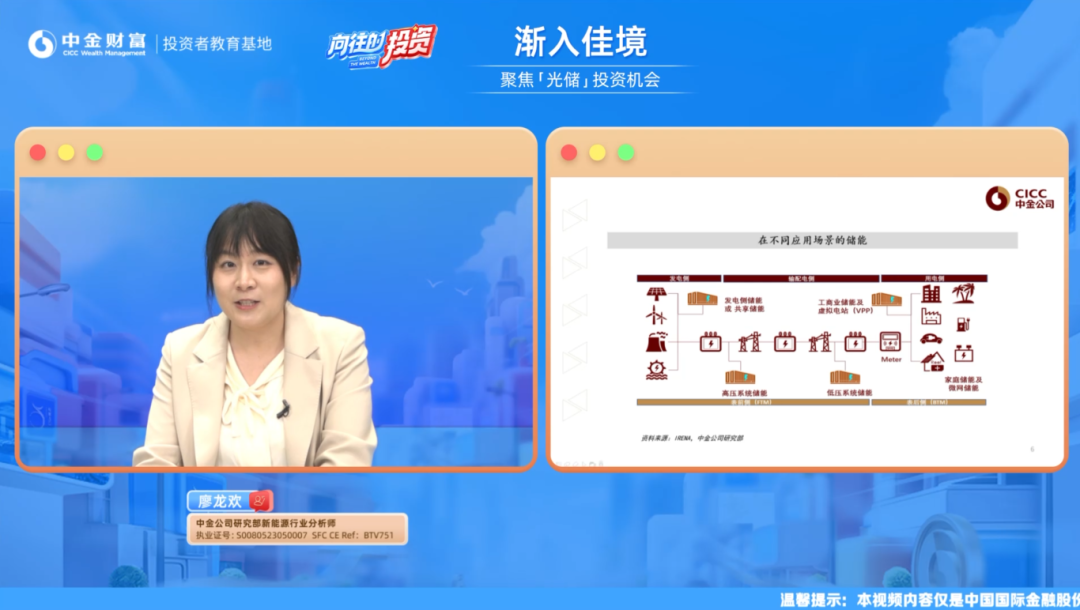
Core Insights - The integration of solar and storage (光储一体化) is experiencing significant development opportunities amid energy transition and electricity market reforms, with a multi-trillion market potential highlighted by the "14th Five-Year Plan" and the emphasis on building a new energy system [1][2] Group 1: Solar-Storage Integration - Solar-storage integration is advancing rapidly across three dimensions: generation side, grid side, and user side, forming a multi-layered application structure including large centralized solar-storage power stations, commercial solar-storage charging systems, and household storage systems [1][2][4] - Large centralized solar-storage power stations are being developed in specific areas, integrating wind and solar power with storage technologies to create a multi-energy complementary supply system [4] - Commercial solar-storage charging systems create a closed loop of generation, storage, and consumption, effectively reducing operational costs by utilizing solar power for charging during peak hours [4] - Household storage systems support self-consumption and grid independence, ensuring continuous electricity supply during grid failures [4] Group 2: Necessity of Energy Storage - Energy storage is essential due to the complementary nature of technologies and the rigid demand from the grid, addressing the mismatch between solar generation and load curves [6] - The development of energy storage is categorized into four stages based on the variable renewable energy (VRE) share, with the current phase in China and the US at 15%, indicating a rapid growth point [6][9] Group 3: Drivers of Storage Market Explosion - The core drivers for the current energy storage development include significant cost reductions, policy catalysts, and overseas demand [9] - Storage system costs are expected to decrease significantly, with battery cell costs dropping by up to 60% from 2023 to 2025, enabling grid parity for solar-storage solutions in various countries [11] - The introduction of policy documents, such as the "Document No. 136," has transformed storage from a cost item to a flexible resource, enhancing project economics through mechanisms like capacity pricing and peak-valley arbitrage [11][12] Group 4: Storage Industry Chain and New Technologies - The storage industry chain includes components such as battery packs, storage inverters, energy management systems, and battery management systems, with lithium batteries currently dominating the market at a 97% share [16] - Emerging storage technologies include flow batteries, compressed air storage, and hydrogen storage, each with unique characteristics and applications [18][19][20] Group 5: Industry Restructuring and Investment Opportunities - The photovoltaic industry is undergoing a "de-involution" phase, facing challenges like overcapacity and price wars, but is expected to find bottoming opportunities through policy guidance and technological iteration [22] - Investment opportunities are identified in low-cost silicon material companies, battery cell companies with technological advantages, and firms extending into electronics and AI computing [24] Group 6: 2026 Industry Outlook - The domestic photovoltaic market is projected to see negative growth in new installations, while the global photovoltaic market may decline by approximately 10% [26] - The energy storage market is expected to reach over 600 GWh in shipments by 2026, with a growth rate exceeding 20%, focusing on high-quality development in major markets and new growth points in emerging regions [26]