光学望远镜

Search documents
科学与健康丨瞄深空!南极“天眼”看见了啥?
Xin Hua Wang· 2026-01-27 02:44
Core Insights - The article discusses China's advancements in astronomical research at the Antarctic Zhongshan Station, focusing on space debris monitoring and deep space exploration efforts [1][2]. Group 1: Space Debris Monitoring - The increasing density of human space activities has led to a hazardous "debris net" around Earth, with defunct satellites and rocket remnants traveling at speeds of approximately 7 to 10 kilometers per second [2]. - The Antarctic region, particularly Zhongshan Station, is identified as an ideal location for monitoring space debris due to its stable atmospheric conditions and the presence of a dedicated observation system [2]. - The monitoring system consists of a four-telescope array with 150mm fixed-point telescopes and a 310mm fast-tracking telescope, achieving a tracking precision of better than 50 meters for low Earth orbit debris [2]. Group 2: Deep Space Exploration - In July 2025, the Zhongshan Station successfully observed the interstellar object ATLAS (3I/ATLAS), marking a significant breakthrough in observing celestial bodies beyond the solar system [5]. - The observation utilized advanced techniques, including a 30-second single exposure and stacking 21 images to extract the faint signal of the interstellar visitor from a complex star background [5]. - The Antarctic telescope system is continuously improving its capabilities for rapid response and high-precision tracking of fast-moving astronomical targets [5][6]. Group 3: Scientific Achievements and Future Prospects - Over the past two decades, China's astronomical research in Antarctica has achieved multiple scientific milestones, including the installation of the first optical telescope array in 2008, which marked the beginning of China's astronomical observations in the region [7]. - Future plans include the construction of optical and infrared telescopes at the Kunlun Station in Antarctica, aimed at enhancing China's capabilities in deep space exploration and contributing to global astronomical research [7].

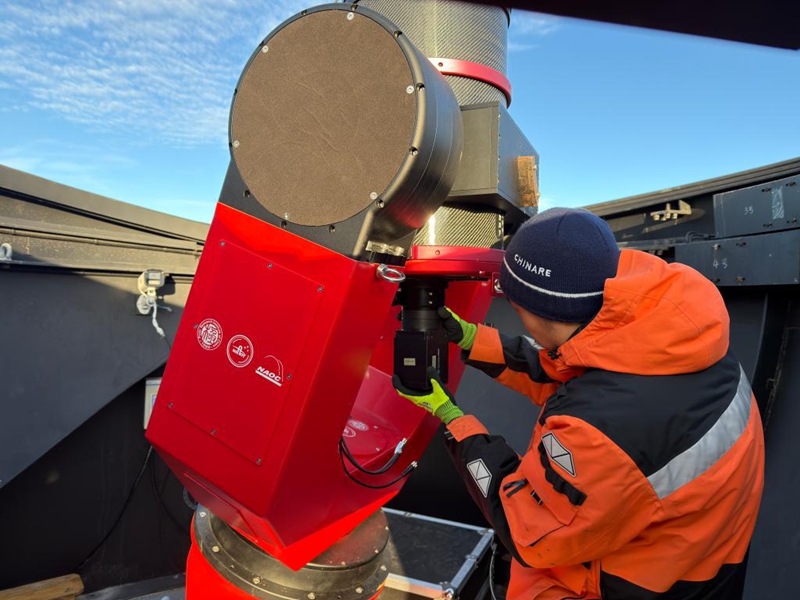
瞄深空!南极“天眼”看见了啥
Xin Lang Cai Jing· 2026-01-26 23:13
Group 1 - The core viewpoint of the article highlights China's advancements in space debris monitoring and astronomical research in Antarctica, emphasizing the importance of these efforts for the safety and sustainability of human space activities [1][2][3] Group 2 - The Antarctic observation system includes a set of four 150mm fixed-point telescopes and one 310mm fast-tracking telescope, which are crucial for precise tracking and forecasting of space debris [1] - In July 2025, the Zhongshan Station successfully observed the third confirmed interstellar object, ATLAS, marking a significant breakthrough in the observation of extraterrestrial bodies [2] - Future plans include the construction of optical and infrared telescopes at the Kunlun Station in Antarctica, aimed at enhancing China's capabilities in deep space exploration and astronomical research [3]
2025年度10大前沿科学问题、工程技术难题及产业技术问题发布,哪些仪器受热捧?
仪器信息网· 2025-07-08 07:38
Core Viewpoint - The 27th China Association for Science and Technology Annual Conference held on July 6 in Beijing announced 10 frontier scientific issues, 10 engineering technical challenges, and 10 industrial technology problems for 2025, aiming to promote original and disruptive scientific achievements [2]. Frontier Scientific Issues - The ten frontier scientific issues include: 1. Topological and geometric classification of manifolds 2. Properties of the Higgs boson and the origin of mass 3. Feasibility study of using post-transition metals as substitutes for transition metals in precise synthesis and catalytic reactions 4. Anomalies in typhoon paths and intensity mutations 5. Mechanisms of spatial pattern formation in macro-ecosystems and interactions between systems 6. New theories and protective systems for AI security from a cryptographic perspective 7. Multi-dimensional, reconfigurable supramolecular machine assembly 8. Dark energy and the Hubble constant crisis 9. Breeding potential of wild relatives of crops in enhancing stress resistance traits 10. Interaction regulation mechanisms between human microecology and hosts [4]. Engineering Technical Challenges - The ten engineering technical challenges include: 1. Integrated algorithms and theories for complex model design-simulation-manufacturing 2. Deep-sea large-scale mining equipment and environmental disturbance suppression 3. Collaborative utilization and governance technologies for regional surface water, groundwater, reclaimed water, external water, and seawater 4. Intelligent network technology system for communication and smart integration 5. Biomanufacturing of complex organs 6. Integrated development technology for coal and associated energy resources 7. Next-generation low-energy, low-cost carbon capture and storage technology 8. Energy integration and intelligent management for advanced airborne systems 9. Biomanufacturing technology for bulk food raw materials and high-value ingredients 10. Establishing a new drug development system based on clinical and multi-omics big data [5]. Industrial Technology Problems - The ten industrial technology problems include: 1. Breaking through the import bottleneck of high-end equipment for large and ultra-large seawater desalination projects 2. Enhancing the oxidation resistance of ultra-supercritical steam turbine blades 3. Research on key scientific and technological issues for autonomous mining in deep space resource development 4. Building an autonomous capability evaluation system for intelligent unmanned systems oriented towards industry 5. Industrial implementation of high-speed optical interconnect (optical I/O) technology between chips 6. Development of regenerative biomaterials in aging states 7. Pathways to achieve a comprehensive balance of "safety-low carbon-economy" in energy and electricity 8. Intelligent processing and industrial application of satellite remote sensing data 9. Intelligent response biological vaccines for pests and diseases driven by synthetic biology and AI 10. Brain function assessment and intelligent closed-loop intervention [6]. Instrument Demand - The R&D activities related to the 2025 issues will drive demand for various research instruments, including: - Precision measurement devices such as high-precision mass spectrometers and spectrometers for studying the properties of the Higgs boson [8]. - Astronomical observation equipment like large radio telescopes and optical telescopes for data support on dark energy and the Hubble constant crisis [8]. - Biochemical analysis instruments such as high-performance liquid chromatography (HPLC) and gas chromatography-mass spectrometry (GC-MS) for research on post-transition metal substitutes and human microecology [8]. - Advanced meteorological monitoring equipment for studying typhoon path anomalies [9]. - Simulation software and hardware for integrated algorithms in complex model design [10]. - Deep-sea exploration equipment for large-scale mining and environmental disturbance suppression [11]. - Communication testing devices for developing intelligent network technology systems [12]. - Life science research tools for biomanufacturing complex organs [13]. - Equipment related to seawater desalination technology [14]. - Energy efficiency assessment tools for achieving a balanced energy strategy [15]. - Satellite remote sensing data analysis platforms for intelligent processing and application [16].