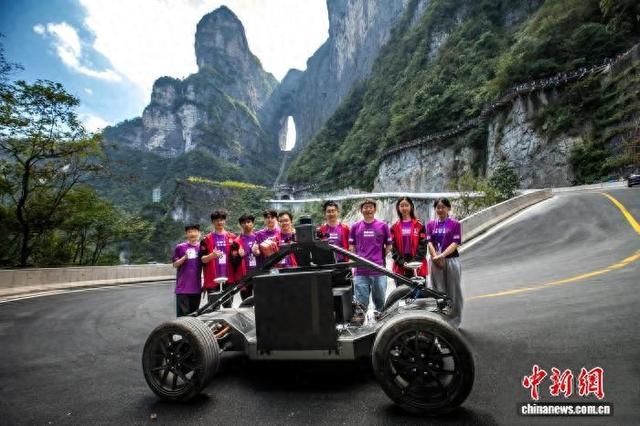
全栈神经网络化的端到端自动驾驶系统

Search documents
AI赛车开创世界纪录背后的“弯道”与“换道”
Xin Lang Cai Jing· 2026-01-24 05:10
Core Insights - The AI racing team from Tsinghua University set a world record by completing the 10.77 km Tianmen Mountain course in 16 minutes and 10.838 seconds, showcasing advancements in AI-driven autonomous racing technology [1][3]. Group 1: Technical Challenges and Innovations - The Tianmen Mountain course presents a "composite extreme" testing environment due to satellite signal interruptions, steep slopes, and numerous sharp turns, requiring AI to make precise decisions in milliseconds [3]. - The team developed a dynamic local map loading algorithm to address issues with traditional full-load 3D point cloud maps, enabling real-time high-precision positioning [3][4]. - Data collection methods were enhanced through vehicle-cloud collaboration and a combination of virtual and real-world data, integrating factors like corner entry angles and road conditions into the AI model [3]. Group 2: Learning and Development Pathways - Since 2018, the Tsinghua research team has focused on a new end-to-end autonomous driving approach centered on reinforcement learning, significantly reducing training costs compared to traditional methods reliant on vast amounts of real vehicle data [4]. - The team introduced China's first fully neural network-based end-to-end autonomous driving system, marking a significant technological breakthrough in the industry [4]. Group 3: Real-World Application and Future Directions - The success at Tianmen Mountain serves as a critical test for autonomous technology, emphasizing the need for AI algorithms to be validated in real and extreme scenarios to ensure their effectiveness and robustness [5]. - The developed perception-positioning fusion technology allows vehicles to achieve high real-time and high-precision trajectory estimation, enhancing stability in critical situations [5]. - Despite rapid advancements in autonomous driving technology, there remains a notable gap between AI capabilities and human performance in extreme road conditions, indicating ample opportunities for future research and innovation [5].