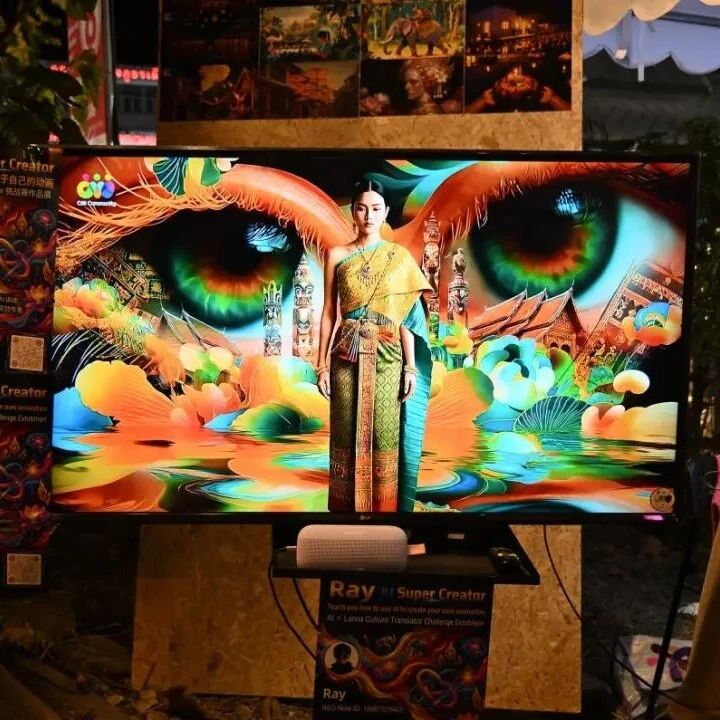
兰纳照妖镜

Search documents
第一批出海摆摊的程序员,已靠AI回本
创业邦· 2026-03-23 00:06
Core Insights - The article discusses how AI technology is transforming the landscape of entrepreneurship, particularly for independent developers venturing into international markets without the need for significant funding or large teams [4][31]. - It highlights two case studies: a Chinese programmer named Nanchuan in Thailand and a recent graduate named Rick in Nepal, both utilizing AI to create innovative products that resonate with local cultures [4][31]. Group 1: Nanchuan's AI Project - Nanchuan developed the "Lanna Demon Mirror," an interactive AI application that matches users' facial features with local cultural deities, completing 69 transactions in one night and earning 2,000 Thai Baht (approximately 450 RMB) [7][10]. - The project was conceptualized and executed in just 12 days, showcasing the rapid development capabilities enabled by AI tools [10][20]. - Nanchuan's approach involved using AI to analyze static facial features rather than expressions, leading to a more accurate matching mechanism for the cultural deities [8][10]. Group 2: Rick's AI Application - Rick created "OCTA," an app that provides Feng Shui advice based on environmental scanning, developed in just 48 hours during a hackathon [13][15]. - The app leverages AI's multimodal capabilities for image and video processing, making it suitable for the modern Feng Shui market, which is gaining popularity in Western countries [11][13]. - Rick's team has seen positive feedback from early users, indicating a strong demand for their product in international markets [13][15]. Group 3: Trends in AI Entrepreneurship - The article notes a significant increase in AI applications targeting international markets, with over 156 projects expected by April 2025, reflecting a growth of over 300% compared to the previous year [20][21]. - The lowering of technical barriers due to open-source AI models allows individual developers to create sophisticated applications at minimal costs, fundamentally changing the cost structure of entrepreneurship [21][22]. - The shift towards lightweight AI applications focuses on solving specific needs rather than grand narratives, as seen in the projects developed by Nanchuan and Rick [22][31]. Group 4: Community Support and Collaboration - The article emphasizes the role of community spaces, like the Chiang Mai guesthouse, in supporting entrepreneurs by providing resources and networking opportunities [24][28]. - These communities facilitate knowledge sharing and collaboration, enabling developers to navigate the complexities of launching products in foreign markets [27][28]. - The trend of community-driven entrepreneurship is growing, with platforms like WayToAGI becoming significant hubs for AI developers [27][29].