冰面锚定机器人

Search documents
登《npj Robotics》!NASA联合国际高校打造“劈冰镐”机器人,不钻孔、不熔化,低压力低能耗锚定冰面
机器人大讲堂· 2026-03-31 08:52
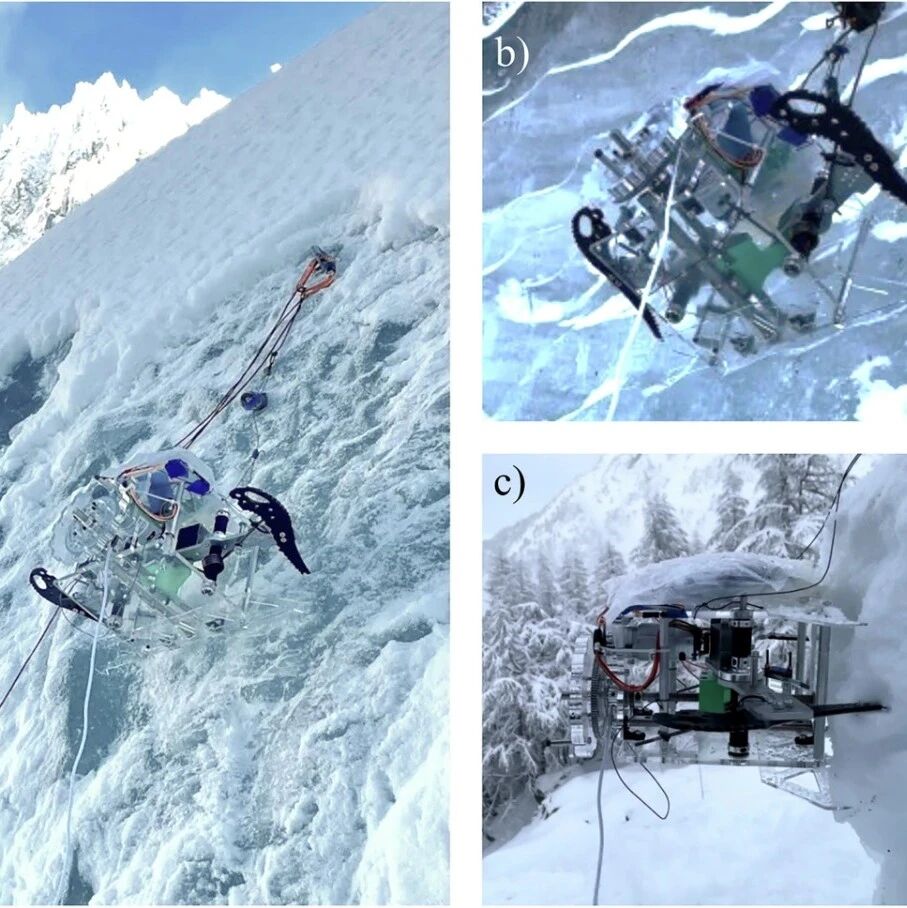
Core Viewpoint - NASA and UC Berkeley have developed a "low-pressure, low-energy" ice anchoring robot that may be capable of climbing the ice geysers of Antarctica, showcasing a novel anchoring technique inspired by mountaineers [1][3][5]. Group 1: Technology and Mechanism - The new anchoring method combines impact and grip, allowing the robot to create indentations in the ice and form secure anchor points [3][5]. - The robot operates with an initial compressive force as low as 8.3 N and a total mechanical energy of only 8 J, significantly reducing energy consumption compared to traditional methods [4][12]. - The anchoring process involves six stages: energy storage, impact, grip, load-bearing, release, and removal, all executed by a single DC motor, making it suitable for resource-limited robotic platforms [9][11]. Group 2: Performance and Testing - In laboratory tests at -14°C, the robot achieved a minimum successful anchoring initial force of 8.3 N, with anchoring strength reaching 75 N, which is more than double its own weight [12][14]. - Field tests on the Mer de Glace glacier confirmed the model's effectiveness, achieving a 100% anchoring success rate when the initial compressive force exceeded 16 N [13][14]. - The device demonstrated adaptability by successfully anchoring on various materials, including tree trunks and rocks, with anchoring strengths of 103 N and 90 N respectively [16]. Group 3: Future Applications - The technology is aimed at extreme environments, with potential applications in extraterrestrial exploration, particularly on the icy moon Enceladus, where energy efficiency is critical [20]. - The research highlights the combination of biomimicry and engineering mechanics, paving the way for new designs in extreme environment robotics [20].