利尿剂

Search documents
高血压患者如何降低冠心病风险?控制血压的关键措施有哪些?
Xin Lang Cai Jing· 2026-02-01 17:15
Core Viewpoint - Hypertension is a common chronic disease that poses significant health risks, particularly increasing the likelihood of coronary heart disease (CHD). Effective blood pressure management is crucial for reducing the risk of CHD and protecting heart health. Group 1: Relationship Between Hypertension and Coronary Heart Disease - Hypertension causes damage to blood vessel walls, leading to atherosclerosis and increased risk of CHD [1] - Increased workload on the heart due to hypertension can result in complications such as left ventricular hypertrophy and heart failure, further elevating CHD risk [2] - Hypertension may increase blood viscosity, which can exacerbate heart strain and promote thrombosis, heightening the risk of CHD [3] Group 2: Key Measures for Blood Pressure Control - Adherence to prescribed medication and regular blood pressure monitoring are fundamental for managing hypertension [4] - A healthy diet that limits salt and unhealthy fats while increasing potassium, calcium, and magnesium intake is essential for blood pressure control [5] - Regular physical activity, such as brisk walking, swimming, and strength training, is vital for maintaining healthy blood pressure and heart function [6][7] - Avoiding smoking and limiting alcohol consumption are critical for reducing hypertension and CHD risk [8] - Effective stress management and maintaining mental health are important for controlling blood pressure [9] Group 3: Importance of Regular Check-ups and Medical Advice - Regular health check-ups are necessary for monitoring blood pressure and adjusting treatment as needed, especially for elderly patients with comorbidities [10]
“简直神药!”浙江姑娘听信姐妹群建议,连吃半年被送进急诊!检查结果把她吓傻……
Xin Lang Cai Jing· 2026-01-25 06:55
Core Viewpoint - The article highlights the dangers of self-medicating with diuretics for weight management and the potential severe health consequences that can arise from their misuse [4][5][6]. Group 1: Health Risks of Diuretics - Diuretics can lead to significant electrolyte imbalances, including low potassium, calcium, and magnesium levels, which can cause symptoms like fatigue, muscle weakness, and heart palpitations [5][6]. - Long-term use of diuretics can disrupt kidney function and lead to irreversible damage, potentially resulting in acute kidney injury or chronic kidney disease [6][7]. - The perceived weight loss from diuretics is primarily due to water and salt loss, not fat loss, which can lead to weight rebound once the medication is stopped [5][6]. Group 2: Medical Guidance and Recommendations - Diuretics should only be used under medical supervision for specific conditions such as heart failure or kidney disease, not for temporary water retention or weight control [5][6]. - Patients experiencing symptoms like unexplained fatigue or heart issues should seek medical attention rather than self-treating with diuretics [6][7]. - Lifestyle changes, such as adjusting diet and sleep patterns, are recommended for managing temporary water retention instead of relying on diuretics [6].


研判2025!中国利尿剂药物行业市场规模、企业格局及未来趋势分析:利尿剂市场规模稳步增长,本土企业牢牢占据了国内主要市场[图]
Chan Ye Xin Xi Wang· 2025-07-05 01:01
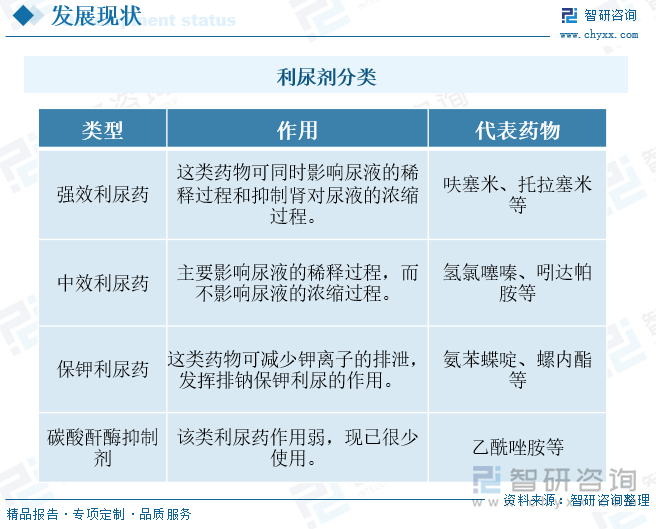
Core Insights - Diuretics are essential medications for treating conditions like hypertension and heart failure, with a growing market demand driven by increasing cardiovascular disease prevalence in China [1][7][16] Industry Overview - The current landscape of cardiovascular diseases in China is severe, with 330 million patients, including 8.9 million with heart failure and 245 million with hypertension [1][7] - The diuretic market in China is projected to reach 4.22 billion yuan in 2024, reflecting an 11% year-on-year growth [1][7] - Hospitals are the primary sales channel for diuretics, accounting for over 85% of sales, with hospital sales expected to reach 3.63 billion yuan in 2024, a 13% increase [9][11] Market Dynamics - The competitive landscape of the diuretic market is fragmented, with numerous manufacturers. The top ten companies hold a combined market share of 50% [13][15] - Notable domestic companies include Guilin Pharmaceutical, Tianjin Lisheng, Nanjing Haichen, and Hangzhou Minsheng [13][15] Product Classification - Diuretics are categorized into four main types: 1. **Loop Diuretics** (e.g., Furosemide, Torasemide) - affect both urine dilution and concentration [4] 2. **Thiazide Diuretics** (e.g., Hydrochlorothiazide, Indapamide) - primarily affect urine dilution [4] 3. **Potassium-Sparing Diuretics** (e.g., Amiloride, Spironolactone) - reduce potassium excretion [4] 4. **Carbonic Anhydrase Inhibitors** (e.g., Acetazolamide) - have weak effects and are rarely used [4] Future Trends - The aging population and rising chronic disease rates are significant factors driving the growth of the diuretic market [16] - There is a shift in hypertension treatment from monotherapy to combination therapy, with single-pill combinations becoming more prevalent [17] - Innovations in diuretic development are focused on creating more selective agents to minimize side effects like electrolyte imbalances and metabolic issues [18]