动力系统等关键铝合金精密零部件

Search documents
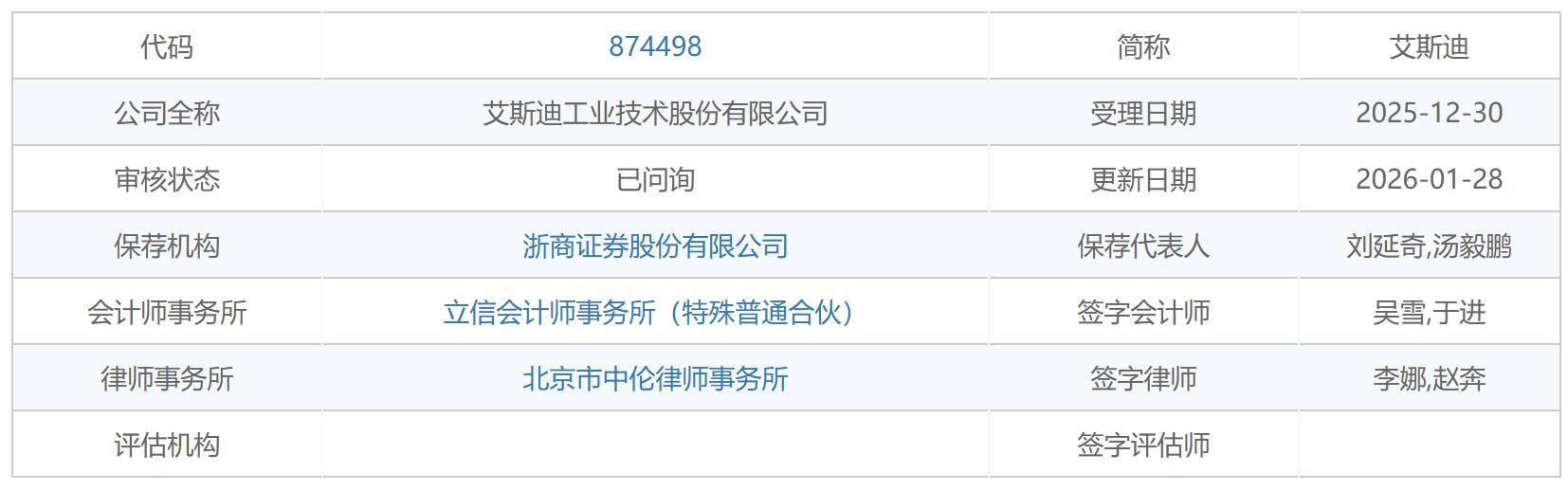
艾斯迪IPO收问询函:实控人向股东借款未清,曾存无真实交易的票据转让
Sou Hu Cai Jing· 2026-01-29 02:15
Core Viewpoint - The regulatory authority has raised concerns regarding the financial practices and governance of Aisidi Industrial Technology Co., Ltd., including issues related to the actual controller's outstanding loans to shareholders, declining gross margins, and irregular financial internal controls [1][3][10]. Group 1: Company Overview - Aisidi Industrial Technology Co., Ltd. was established in August 2017 and focuses on the research, production, and sales of aluminum alloy components for automotive lightweighting, with products used in both new energy and traditional fuel vehicles [2]. - The company is currently undergoing its first round of review for its IPO, with Zheshang Securities Co., Ltd. as the sponsor and Lixin Certified Public Accountants as the auditing firm [2]. Group 2: Financial Performance - Aisidi's revenue for the years 2022 to 2024 and the first half of 2025 was reported as 532 million, 567 million, 739 million, and 379 million yuan respectively, while net profits were 47.82 million, 43.56 million, 55.40 million, and 30.47 million yuan [7]. - The company's gross margin has shown a downward trend, with rates of 19.82%, 22.16%, 19.18%, and 17.25% during the same periods, indicating a significant decline [9]. Group 3: Shareholder and Control Issues - The actual controller, Ding Zhengdong, holds 41.01% of the voting rights in the company, with concerns raised about his outstanding loans to shareholders totaling 6.2 million yuan and 13 million yuan, respectively [3][5]. - Two shareholders have reduced their holdings below 5%, raising questions about potential regulatory evasion through related parties [6]. Group 4: Internal Control and Compliance - The company has been flagged for irregularities in financial internal controls, including issues with timely information transfer between departments and the existence of non-genuine transactions [10]. - Aisidi's procurement practices show a high concentration, with the top five suppliers accounting for over 72% of total purchases, raising concerns about dependency on specific suppliers [10][11].