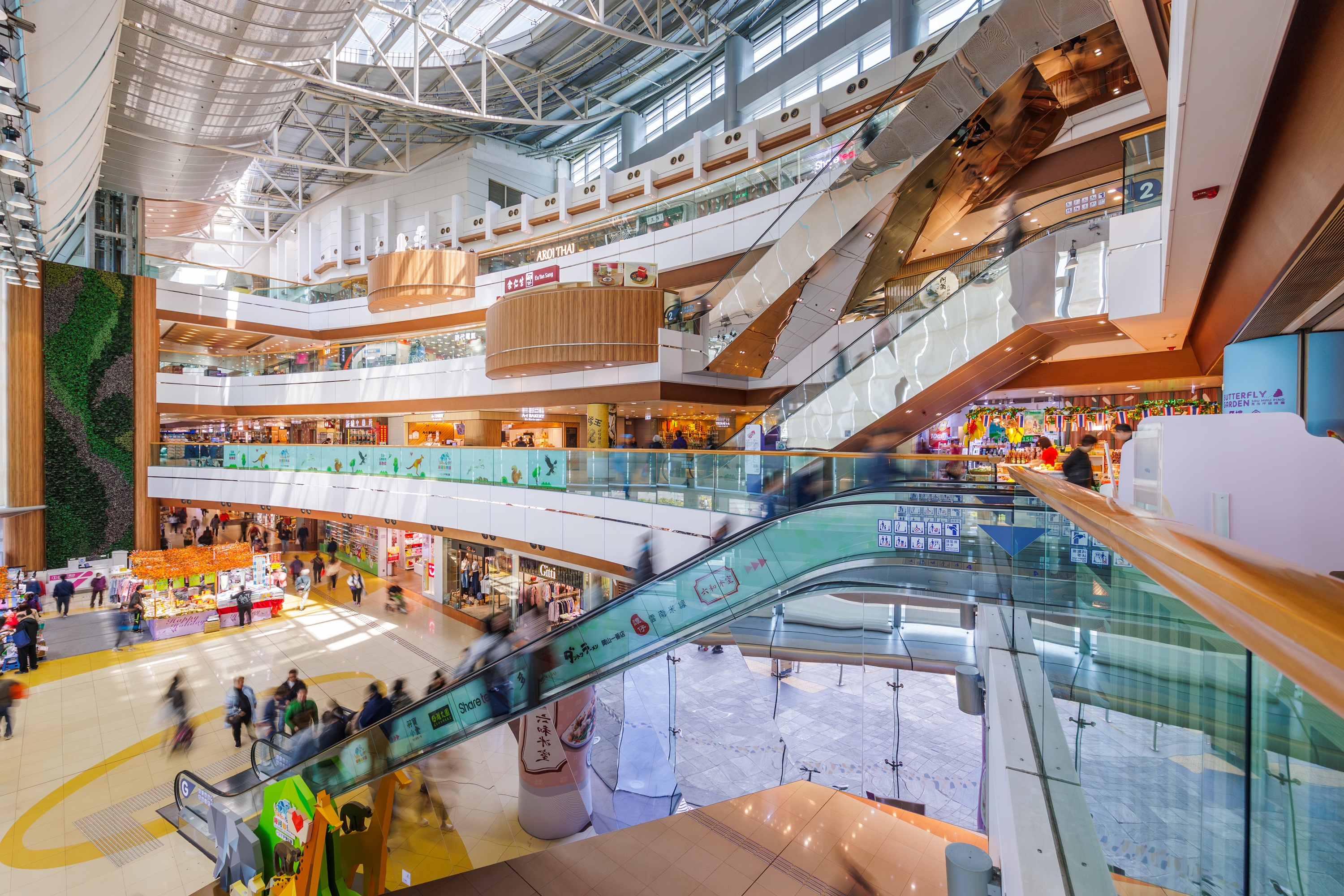
北京通州领展广场

Search documents
一图读懂领展中期业绩:应对市况挑战,领展房托展现韧力
Zheng Quan Shi Bao Wang· 2025-11-20 08:45
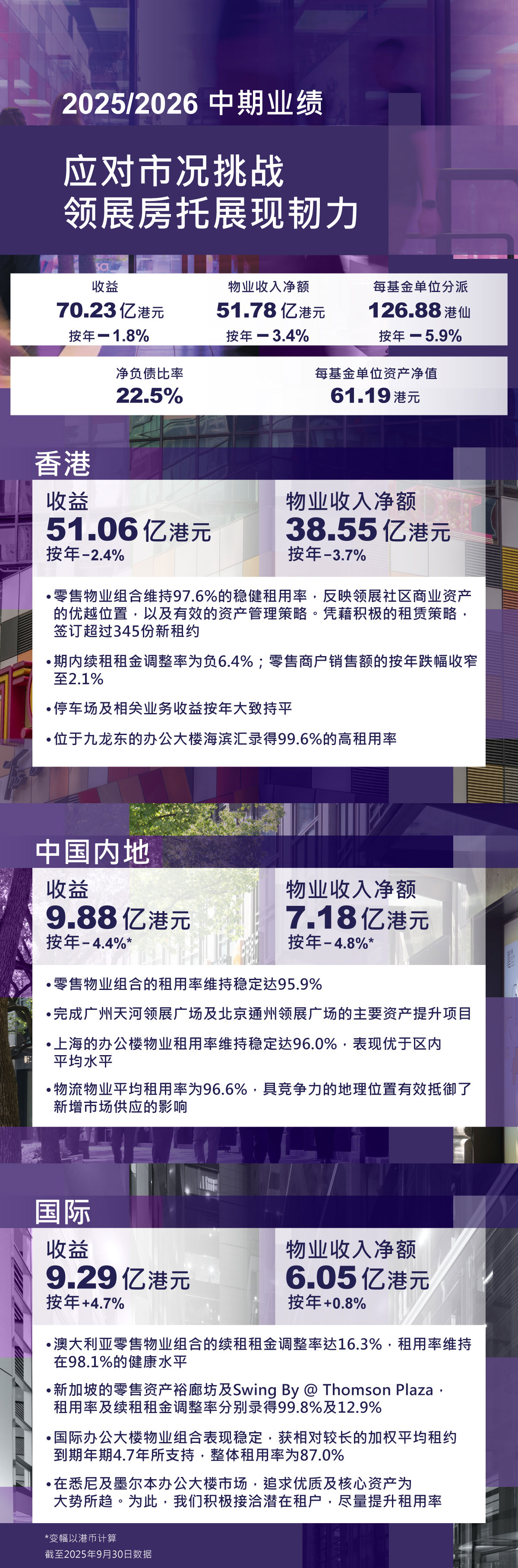
Group 1: Financial Performance - The company reported a revenue of HKD 70.23 billion, reflecting a year-on-year increase of 1.8% [1] - The net property income was HKD 51.78 billion, showing a year-on-year growth of 3.4% [1] - The distribution per fund unit was HKD 1.2688, which is a year-on-year increase of 5.9% [1] - The net debt ratio stands at 22.5% [1] - The net asset value per fund unit is HKD 61.19 [1] Group 2: Property Performance - The retail property portfolio maintained a strong occupancy rate of 97.6%, reflecting the superior location of the community commercial assets and effective asset management strategies [3] - Over 345 new leases were signed during the period, although the rental adjustment rate for renewals was negative at -6.4% [3] - Retail sales for tenants saw a year-on-year decline of 2.1%, but the drop has narrowed [3] Group 3: Regional Performance - The occupancy rate for the office building in Kowloon East, known as Harbourfront, reached 99.6% [4] - In mainland China, the net property income was HKD 1.3 billion, with a year-on-year decline of 4.4% [4] - The retail property portfolio in mainland China maintained a stable occupancy rate of 95.9% [4] - The Australian retail property portfolio experienced a rental adjustment rate of 16.3% for renewals, with an occupancy rate of 98.1% [5][6] Group 4: Asset Management and Development - Major asset enhancement projects were completed at Guangzhou Tianhe Link REIT Plaza and Beijing Tongzhou Link REIT Plaza [7] - The office property occupancy rate in Shanghai remained stable at 96.0%, outperforming the regional average [7] - The average occupancy rate for logistics properties was 96.6%, effectively mitigating the impact of new market supply [7] - In Singapore, the retail assets at Jurong Point and Swing By @ Thomson Plaza recorded occupancy rates of 99.8% and a rental adjustment rate of 12.9% [8] Group 5: Office Market Trends - The international office property portfolio showed stable performance, supported by a relatively long weighted average lease expiry of 4.7 years, with an overall occupancy rate of 87.0% [10] - There is a trend towards pursuing quality and core assets in the office markets of Sydney and Melbourne, with active engagement with potential tenants to enhance occupancy rates [10]

领展:从香港屋邨走出的“亚洲REITs之王”
Di Yi Cai Jing· 2025-11-06 01:03
Core Viewpoint - The transformation of Lok Fu Market represents a significant achievement in Link REIT's (0823.HK) over 100 asset enhancement projects, redefining the market experience in Hong Kong and showcasing the company's commitment to improving community retail spaces [3][6][8]. Group 1: Company Overview - Link REIT has evolved from managing public housing retail properties to becoming the largest REIT in Asia, with a portfolio of 154 assets valued at HKD 226 billion as of March 31, 2025 [6][7]. - The company was established in 2005 as Hong Kong's first REIT, focusing on enhancing operational efficiency and generating stable rental income rather than selling properties [7][8]. - Link REIT's asset portfolio includes various categories such as retail, office, parking, and logistics, with geographical diversification across Hong Kong, mainland China, Singapore, Australia, and the UK [7][8]. Group 2: Asset Enhancement Strategy - Link REIT's asset enhancement strategy involves modernizing older properties to improve their appeal and operational efficiency, with an average investment return rate of 18% across over 100 completed projects [17]. - The company emphasizes creating a "cultural living circle" tailored to the community's demographics and cultural characteristics, transforming shopping centers into more than just retail spaces [9][17]. - The transformation of Lok Fu Market and other properties incorporates innovative design elements and community engagement strategies, enhancing the overall shopping experience [8][9]. Group 3: Expansion and Market Position - Since 2014, Link REIT has expanded its focus from organic growth to external diversification, entering new markets and asset classes, including office and logistics properties [17][18]. - The company has successfully entered the mainland Chinese market, implementing a dual strategy of brand positioning and community engagement to adapt to local consumer preferences [19][24]. - By 2023, Link REIT introduced the "Link 3.0 Strategy," transitioning to a comprehensive asset manager that combines traditional REIT operations with private fund management, aiming for sustainable returns through external capital [18][19].