
华夏基金A500ETF

Search documents
A500指数相关ETF总规模突破3000亿元 A500ETF华泰柏瑞已超500亿元
Xin Hua Cai Jing· 2026-01-13 06:11
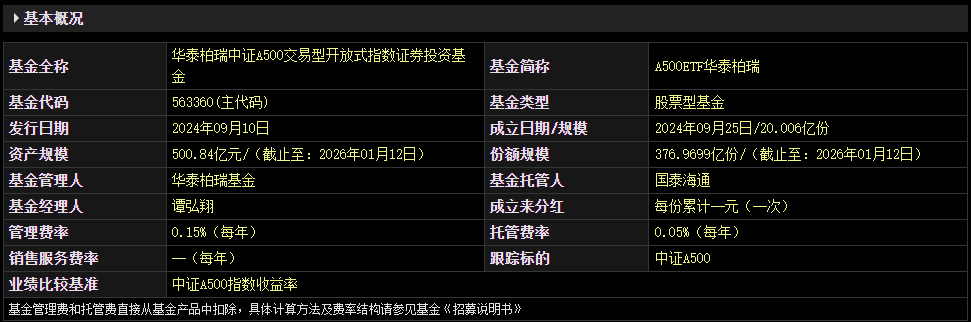
Group 1 - The A-share market has been experiencing a continuous upward trend, with the total scale of ETF products tracking the CSI A500 index surpassing 300 billion yuan [1] - As of January 12, 2026, the A500 ETF managed by Huatai-PB has reached an asset scale of 50.084 billion yuan, making it the first A500 index ETF in the market to exceed 50 billion yuan [2] - The A500 ETF has seen significant growth, with its share scale increasing from 20.006 billion shares at inception to 376.9699 billion shares, representing a nearly 19-fold increase [3] Group 2 - The competitive landscape among leading A500 ETFs is intense, with the Southern A500 ETF ranking second at 47.304 billion yuan, and the Huaxia Fund A500 ETF in third place at 42.333 billion yuan [3] - Other notable A500 ETFs include the Guotai A500 ETF with an asset scale of 38.088 billion yuan and the E Fund A500 ETF with 34.287 billion yuan, ranking fourth and fifth respectively [3]

A500相关ETF总规模突破3000亿 首现单只500亿元产品
Sou Hu Cai Jing· 2026-01-13 04:10
Core Insights - The A500 index ETFs have seen significant growth, with total market size surpassing 300 billion yuan, reaching 300.8 billion yuan [1] - The Huatai-PB A500 ETF has achieved a historic milestone, becoming the first A500 index ETF to exceed 50 billion yuan in size, currently at 50.84 billion yuan [1] - Competition among leading A500 ETFs remains intense, with the Southern A500 ETF at 47.22 billion yuan and the Huaxia A500 ETF at 42.33 billion yuan, ranking second and third respectively [1] Market Overview - The total size of 40 A500-related ETFs in the market has reached 300.8 billion yuan, indicating strong investor interest and net value growth [1] - The top players in the A500 ETF market are actively competing for larger market shares, with several products exceeding 30 billion yuan in size [1]
全球投资新风尚:买中国基金
Zhong Guo Zheng Quan Bao - Zhong Zheng Wang· 2025-09-11 23:28
Group 1 - The core viewpoint of the articles highlights the increasing interest of overseas investors in Chinese public funds, with a focus on the accessibility and low entry barriers these funds provide for global investors to tap into China's growth dividends [1][2][3] - Thai investors are particularly drawn to the Bualuang China A500 passive fund, which links to the Huaxia A500 ETF, allowing them to invest in leading Chinese companies with a minimum investment of only 500 Thai Baht (approximately 110 RMB) [2][3] - The B-CNA500P fund strategically reduces exposure to financial stocks while focusing on high-growth sectors such as technology and consumption, aligning with China's economic transformation from manufacturing to innovation and domestic consumption [3] Group 2 - The launch of the B-CNA500P fund in Thailand is part of a broader trend of Chinese public funds expanding into Southeast Asia, supported by initiatives like the Regional Comprehensive Economic Partnership (RCEP) and the Belt and Road Initiative [4] - Major Chinese asset management firms are establishing comprehensive pathways for market entry in Southeast Asia, including partnerships for launching ETFs and other investment products [4][5] - The collaboration between E Fund and Itaú Asset Management in Brazil resulted in the successful issuance of the Itaú E Fund MSCI China A50 ETF, enhancing connectivity between Chinese and Brazilian capital markets [5][6] Group 3 - Chinese public funds are also exploring opportunities in the Middle East, with firms like Fuqua Hong Kong partnering with local asset managers to launch Chinese equity funds [6][9] - The introduction of various cross-border investment products, such as the Southbound ETF and mutual recognition funds, reflects the industry's commitment to facilitating global asset allocation [10] - The establishment of overseas subsidiaries by Chinese public fund companies has become a crucial strategy for expanding their international presence, with over twenty firms having set up such entities since 2008 [10][11] Group 4 - The public fund industry is actively working to tell the "China story" and help global investors share in the benefits of China's economic development while meeting domestic investors' needs for global asset allocation [11]