华泰柏瑞中证红利低波ETF联接基金A类(007466)

Search documents
创业板新高之下,资金为何抛售红利低波(512890)?机构:回调或是布局良机
Xin Lang Ji Jin· 2025-08-22 04:22
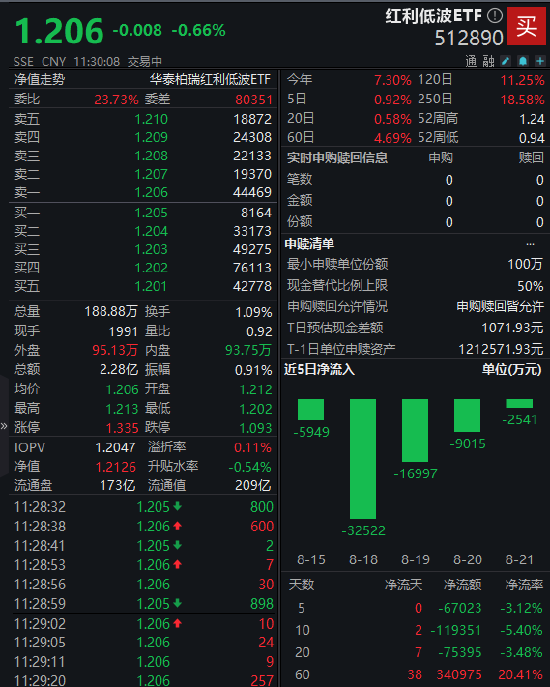
Core Viewpoint - The recent performance of the stock market has led to a short-term outflow of funds from the Dividend Low Volatility ETF (512890), but the long-term investment appeal of this strategy remains strong [1][3][6]. Group 1: Market Performance - On August 22, the three major stock indices rose, with the ChiNext Index reaching a three-year high [1]. - The Dividend Low Volatility ETF (512890) saw a decrease of 0.66%, closing at 1.206 yuan, with a turnover rate of 1.09% and a half-day trading volume of 228 million yuan [1][2]. Group 2: Fund Flow Dynamics - The ETF experienced a short-term net outflow of 670 million yuan over the past five days and 1.19 billion yuan over the past ten days [3]. - Despite the short-term outflows, there has been a net inflow of 3.41 billion yuan over the last 60 trading days, indicating a coexistence of short-term trading funds exiting and long-term investment funds entering [3]. Group 3: Institutional Investment Trends - As of August 19, 2025, insurance capital has made over 29 stake increases this year, marking a four-year high, with a focus on undervalued, high-dividend sectors such as banking, public utilities, and energy [3]. - This trend suggests that professional institutions view high-dividend assets as having long-term investment value, especially in a low-interest-rate environment [3]. Group 4: Historical Performance - The Dividend Low Volatility ETF (512890) has achieved a total return of 142.52% since its inception on December 19, 2018, significantly outperforming its benchmark and ranking 28th among 502 similar products [4]. Group 5: Investment Strategy Recommendations - The ongoing regulatory emphasis on cash dividends and steady inflow of long-term funds have enhanced the allocation value of the Dividend Low Volatility ETF [6]. - For investors with a long-term perspective, the current short-term outflows may present better allocation opportunities, and a systematic investment approach is recommended [6].