
双星鞋

Search documents
鞋王父子的“双星残局”
Zhong Guo Xin Wen Wang· 2026-01-07 07:43
Core Viewpoint - The recent public statement by Wang Hai, founder of Double Star Group, has brought to light a family feud that threatens the company's stability and legacy, highlighting issues of governance and succession within the organization [1][3]. Group 1: Family Feud and Governance Issues - Wang Hai, aged 84, has publicly severed ties with his son Wang Jun and daughter-in-law Xu Ying, citing reasons such as the prohibition of his name in promotions and the removal of his image from branding [3]. - The conflict escalated following a 2022 equity change where Xu Ying's company gained control of Double Star Group, leading to Wang Hai losing effective control despite retaining his title [3][4]. - Wang Hai accused his family of usurping company authority and making decisions without his consent, including relocating the company's headquarters [3][4]. Group 2: Company History and Achievements - Double Star Group, founded in 1921, has a rich history, evolving from a state-owned rubber factory to a prominent player in the shoe industry under Wang Hai's leadership [6][7]. - The company was known for innovative marketing strategies and was the first in the industry to achieve several milestones, including hosting a national press conference and obtaining self-operated import-export rights [6][7]. Group 3: Challenges in Succession and Management - The transition from Wang Hai's leadership to a new generation has been complicated by a lack of structured governance and reliance on family ties for key positions, leading to management inefficiencies [8][9]. - Wang Hai's declaration to establish a "Double Star Brand Succession Committee" aims to shift towards a merit-based succession model, indicating a potential move towards modern corporate governance [9].


与儿子儿媳断绝关系!知名企业创始人突发声明:不能让美国人接班
Nan Fang Du Shi Bao· 2026-01-05 07:24
Core Viewpoint - The internal family conflict within the century-old brand, Double Star Mingren Group, has escalated, with founder Wang Hai officially severing ties with his son Wang Jun and daughter-in-law Xu Ying, citing multiple disputes over succession, company control, and financial issues [1][2][5] Group 1: Family Conflict and Control Issues - Wang Hai's public statement lists 11 core disputes, including the nationality of successors, claiming that Wang Jun and Xu Ying are American citizens, which he believes disqualifies them from inheriting the company [2][5] - The conflict has revealed governance issues within the company, with accusations of "de-founderization" where Wang Jun's faction allegedly removed Wang Hai's image from promotional materials and ceased using trademarks registered under his name [5] - Wang Hai claims that since the conflict became public in April 2025, his salary and social security have been suspended, and he has faced personal financial difficulties, including the alleged misappropriation of his wife's retirement funds [5] Group 2: Shareholding Changes and Governance Crisis - The root of the conflict can be traced back to a shareholding structure change in June 2022, where Xu Ying's company acquired a controlling stake in Double Star Mingren Group, leading to a shift in actual control from Wang Hai to Xu Ying [6][8] - Following the shareholding change, a series of conflicts emerged, including Wang Hai's public accusations of being forced out and the board's decision to remove him as chairman, which he contests as invalid [8] Group 3: Brand Challenges and Market Position - Double Star Mingren Group, founded in 1921, was once the largest shoe manufacturer globally but has faced significant challenges in recent years, including brand aging and declining market share due to competition from brands like Li Ning and Anta [13] - The company has acknowledged internal issues such as outdated systems and management complexities that hinder innovation and adaptability, which are exacerbated by the ongoing family conflict [13] - As of January 5, 2024, the company has not publicly responded to Wang Hai's latest statement, indicating that the management team led by Wang Jun and Xu Ying continues to operate the company [14]
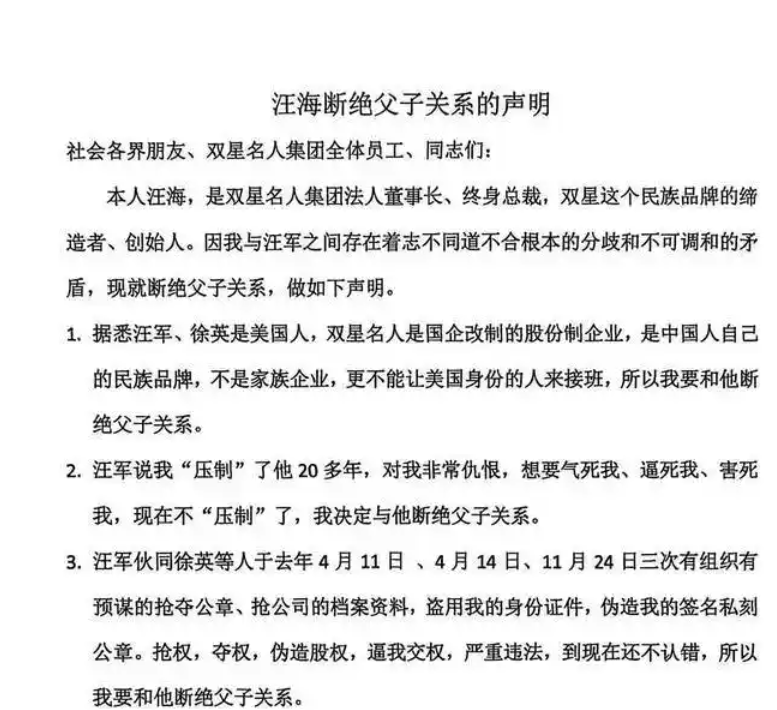
84岁双星创始人声明断绝父子关系 百年“鞋王”何去何从?
Nan Fang Du Shi Bao· 2026-01-05 06:01
Core Viewpoint - The internal family conflict within the century-old brand, Double Star Mingren Group, has escalated, with founder Wang Hai officially severing ties with his son Wang Jun and daughter-in-law Xu Ying, citing multiple disputes over succession, company control, and financial issues [1][2]. Group 1: Key Issues Raised in the Statement - Wang Hai's statement lists 11 core disputes, with the nationality of the successors being a primary concern, as he claims that Wang Jun and Xu Ying hold American citizenship, which he believes disqualifies them from leading a national brand [2]. - The statement accuses Wang Jun's faction of attempting to erase Wang Hai's legacy by prohibiting his mention in company promotions and removing his image from signage, actions seen as a betrayal of the brand's history [5]. - Financial grievances are highlighted, including the suspension of salaries and social security for Wang Hai and his staff, as well as the alleged misappropriation of his wife's pension funds and personal assets [5]. Group 2: Shareholding Changes and Control Issues - The root of the conflict traces back to a significant change in the company's shareholding structure in June 2022, when Xu Ying's company acquired a controlling stake of 56.96%, leading to a shift in actual control from Wang Hai to Xu Ying [6]. - This change set the stage for subsequent conflicts, including public accusations of coercive tactics used by Wang Jun and Xu Ying against Wang Hai, which have led to legal disputes over company governance and control [8]. Group 3: Brand Challenges and Market Position - Double Star Mingren Group, founded in 1921, was once a leader in the shoe manufacturing industry but has faced significant challenges in recent years, including brand aging and declining market share due to competition from brands like Li Ning and Anta [12][13]. - The company has acknowledged internal issues such as outdated systems and management complexities that hinder innovation and adaptability, which are exacerbated by the ongoing family conflict [13]. - Despite the turmoil, the company's operations continue under the leadership of Wang Jun and Xu Ying, indicating a lack of immediate resolution to the internal strife [14].
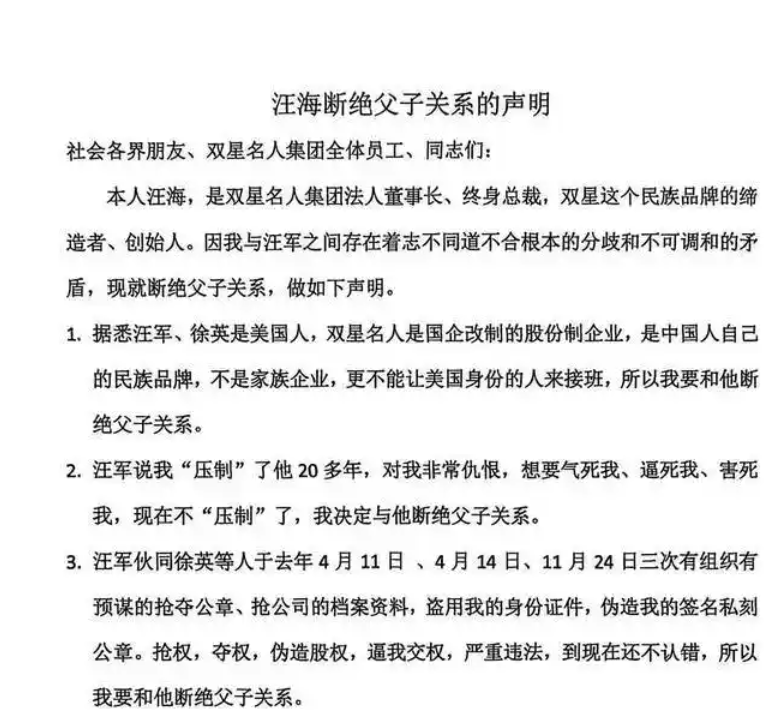
84岁双星创始人声明断绝父子关系,百年“鞋王”何去何从?
Nan Fang Du Shi Bao· 2026-01-05 03:37
Core Viewpoint - The internal family conflict within the century-old brand, Double Star Mingren Group, has escalated, with founder Wang Hai officially severing ties with his son Wang Jun and daughter-in-law Xu Ying, citing multiple disputes over succession, company control, and financial issues [1][4]. Group 1: Key Disputes - Wang Hai's statement lists 11 core disputes, prioritizing the nationality of his son and daughter-in-law, claiming they are American citizens, which he believes disqualifies them from inheriting the company [1]. - The statement accuses Wang Jun's faction of actions aimed at "de-founderization," including prohibiting the mention of Wang Hai in promotions and removing his portrait from the company sign [4]. - Financial grievances are highlighted, with Wang Hai alleging that his salary and social security payments have been halted, and his personal savings have been seized, leading to financial distress [4]. Group 2: Control and Ownership Changes - The root of the conflict traces back to a significant change in the company's shareholding structure in June 2022, when Xu Ying's company acquired a controlling stake of 56.96% in Double Star Mingren Group [5]. - By May 2024, Xu Ying's stake increased to 69.48%, relegating Wang Hai to the position of the second-largest shareholder with only 21.88% [5]. - This shift in control has led to a series of legal disputes, with Wang Hai contesting the legitimacy of board decisions and asserting his rights as the legal chairman [7][8]. Group 3: Brand and Market Position - Double Star Mingren Group, founded in 1921, was once the largest shoe manufacturer globally, but has faced significant challenges in recent years due to increased competition from brands like Li Ning and Anta [11][13]. - The company has struggled with brand aging, lack of product innovation, and declining market share, now primarily targeting lower-end markets and elderly footwear [13]. - Internal recognition of these issues has been noted, with the company acknowledging that outdated systems and management complexities hinder its adaptability and innovation [13].
双星名人控制权争夺白热化,传创始人汪海声明断绝父子关系
Xin Lang Cai Jing· 2026-01-04 11:25
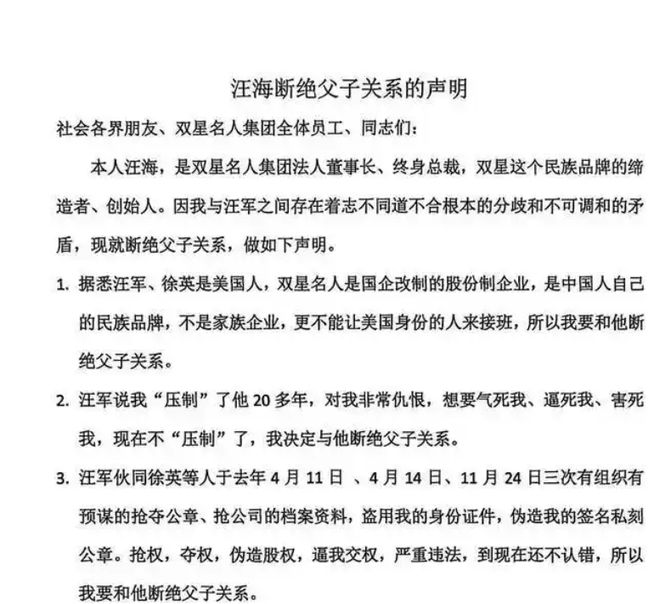
Core Viewpoint - The control dispute within the century-old shoe company, Double Star Celebrity, has escalated, with founder Wang Hai publicly severing ties with his son Wang Jun and daughter-in-law Xu Ying, accusing them of betrayal and power grabs [1][2]. Group 1: Control Dispute - Wang Hai, the 84-year-old founder, announced the termination of his relationship with his son and daughter-in-law, citing multiple instances of them attempting to seize control of the company [1]. - The conflict traces back to a 2022 equity change where Xu Ying gained control of 56.96% of Double Star Celebrity through Qingdao Xingmaida, becoming the largest shareholder [1]. - In December 2025, Xu Ying claimed that the board had removed Wang Hai from his positions, which Wang Hai refuted, stating the board's procedures were illegal and the decisions invalid [2]. Group 2: Company Background and Market Position - Double Star Celebrity Group was established in 1921 and is one of China's earliest shoe manufacturing companies, originally part of the state-owned Qingdao No. 9 Rubber Factory [3]. - The company was separated from Qingdao Double Star Group in 2008, which now focuses on tire manufacturing, while Double Star Celebrity has struggled with market share against emerging brands [3]. - Despite past successes, including annual sales exceeding 30 million pairs in the 1980s and 1990s, the company has faced declining growth and has attempted to revitalize its brand through e-commerce and collaborations [3].