反向过年游

Search documents
马年春节三大主线“点亮”湾区文旅新图景
2 1 Shi Ji Jing Ji Bao Dao· 2026-02-25 09:37
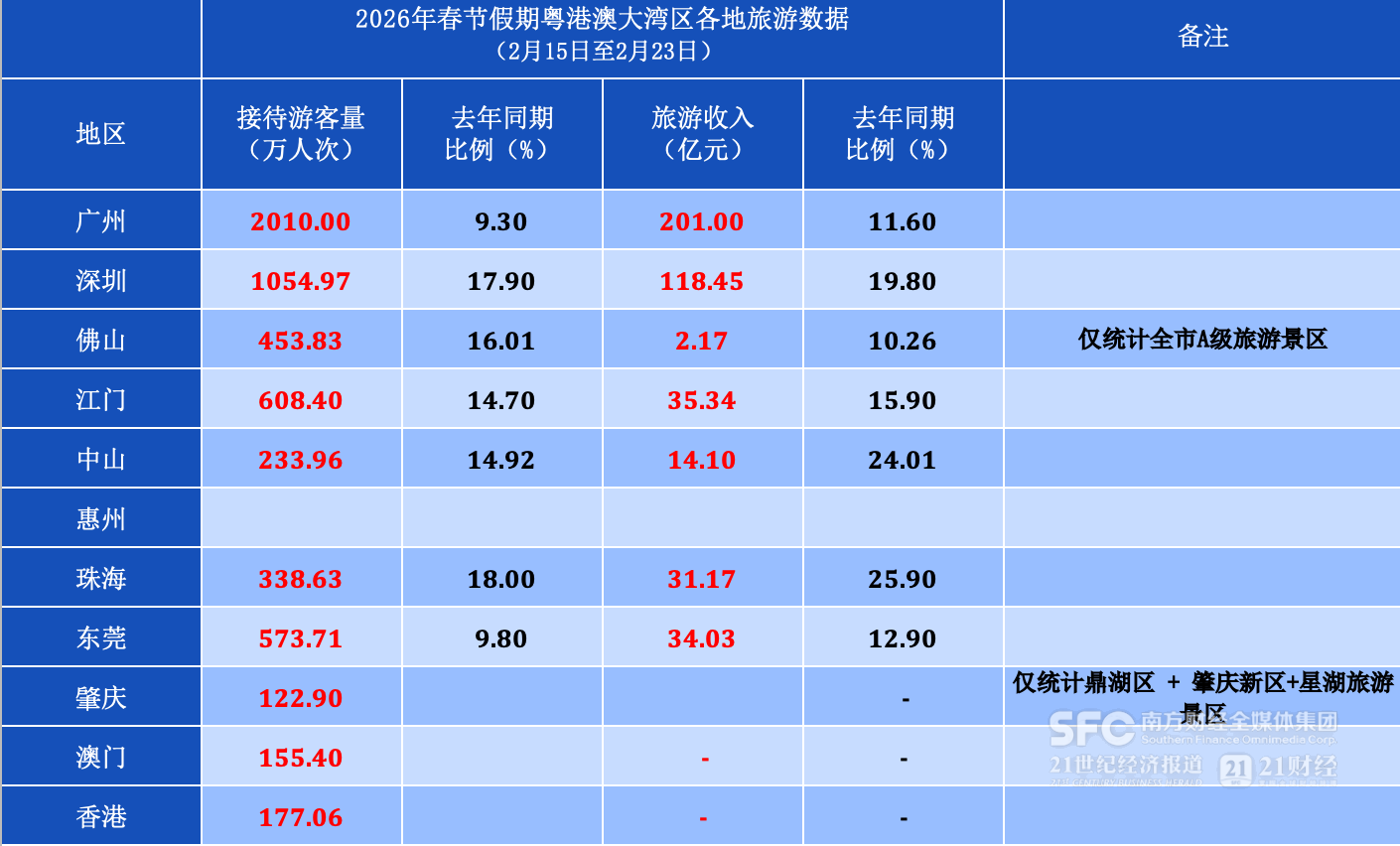
Core Insights - The Guangdong-Hong Kong-Macao Greater Bay Area (GBA) tourism market showed significant growth during the 2026 Lunar New Year holiday, surpassing 2025 levels in both total visitor numbers and tourism revenue [1][2] - Key trends included the rise of intangible cultural heritage (ICH) experiences, cross-border travel, and the increasing popularity of "reverse New Year" celebrations among residents [5][6] Tourism Performance - The GBA received over 57.29 million visitors and generated more than 43.63 billion yuan in tourism revenue during the nine-day holiday [1] - Guangzhou led with 20.10 million visitors and 20.1 billion yuan in revenue, while Shenzhen followed with 10.55 million visitors and 11.84 billion yuan, reflecting year-on-year growth of 17.9% and 19.8% respectively [2] - Zhuhai reported a remarkable 25.9% increase in tourism revenue, reaching 3.12 billion yuan, while other cities like Jiangmen and Dongguan also experienced double-digit growth [2] Cultural Heritage Focus - ICH became a central theme in GBA tourism, with Guangzhou hosting a promotional event featuring over 130 ICH projects and 60 inheritors [3] - The integration of technology, such as AR and VR, enhanced the appeal of traditional cultural displays, attracting younger audiences and increasing visitor numbers in areas like Nansha [3][4] Reverse New Year Trend - The "reverse New Year" trend, where residents invite family members to celebrate in urban areas, gained traction, particularly in Shenzhen, with inbound tourism orders increasing by 31% [5][6] - This trend reflects a shift in family dynamics and tourism patterns, with more workers bringing their families to urban centers for the holiday [6] Cross-Border Travel Dynamics - The Hong Kong-Zhuhai-Macao Bridge recorded significant traffic, with 191,800 vehicle crossings, marking a 16.48% increase [7] - The trend of Hong Kong and Macao residents traveling to the mainland for the New Year is becoming a new norm, facilitated by improved border crossing conditions [8][9] Market Integration and Future Outlook - The transformation of Hong Kong and Macao residents into both a source and destination of tourism highlights the need for integrated tourism strategies across the GBA [10][11] - The development of innovative tourism packages that leverage the unique characteristics of the GBA is essential for attracting a broader audience and enhancing the region's appeal as a cohesive tourism brand [11]