启发式算法

Search documents
马斯克要让Grok全面接管x,彻底剔除人类规则推荐算法
Sou Hu Cai Jing· 2025-10-21 00:03
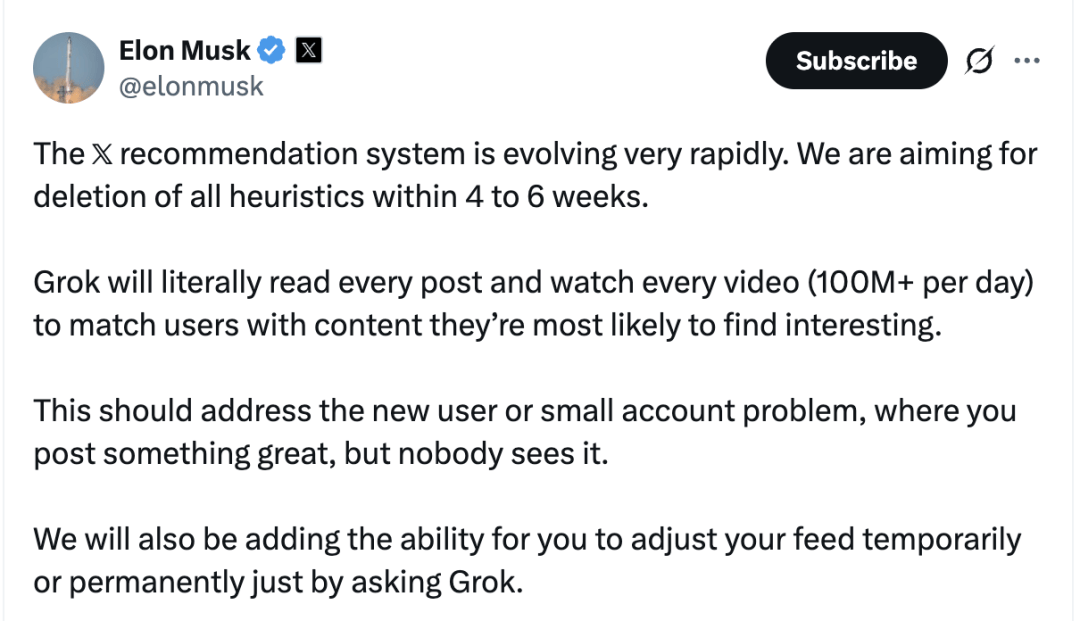
Core Insights - Elon Musk announced that X (formerly Twitter) will completely remove heuristic recommendation algorithms in favor of Grok, an AI that will automatically match user interests by reading and watching all content [1][2] - This update positions Grok as the primary content manager for X, marking it as the first major social platform to abandon heuristic algorithms entirely [2] Group 1: Algorithm Changes - The update aims to enhance visibility for quality content from new accounts, allowing users to customize their information streams more effectively [3][4] - Heuristic algorithms, which rely on human-set rules to determine content quality, have historically favored established accounts, making it difficult for new or smaller accounts to gain exposure [8][9] Group 2: User Reactions - User reactions to the announcement are mixed, with some expressing hope that it will "liberate smaller accounts and break content monopolies," while others worry that the removal of the algorithm may diminish exposure for established accounts [3][4] - Some users prefer a straightforward feed of content from accounts they follow, rather than algorithmically curated recommendations [6] Group 3: Implications of AI Integration - The integration of Grok is seen as a shift towards AI-driven content distribution, raising concerns about the authenticity of online interactions and the prevalence of AI-generated content [9][10] - The "death of the internet" theory, which suggests that most online content is now generated by bots and algorithms, has gained traction in discussions surrounding this update [10]

马斯克要让Grok全面接管x,彻底剔除人类规则推荐算法
量子位· 2025-10-20 23:34
Core Viewpoint - Elon Musk announced that X (formerly Twitter) will completely remove heuristic recommendation algorithms in the coming weeks, allowing Grok to take over and automatically match user interests through reading and viewing all content [1][2]. Group 1: Algorithm Changes - If the plan is realized, X will become the first major social platform to entirely abandon heuristic algorithms [2]. - The update elevates Grok from a summarization tool to the main controller of content on X [3]. - Users will have the ability to request Grok to dynamically adjust content recommendations for a more personalized experience [7]. Group 2: Current Recommendation Mechanism - The recommendation algorithm is not arbitrary; it assesses content similarly to human judgment to determine its potential appeal [6]. - Posts with engaging titles, images, or background information are more likely to be seen, while simple links may receive less exposure [8]. Group 3: User Reactions - The update aims to make high-quality content from new accounts more visible, allowing users to customize their information streams [9]. - Reactions from users vary, with some hoping for a "liberation of small accounts" and others concerned that the removal of algorithms may diminish exposure for established accounts [9]. Group 4: Heuristic Algorithm Explanation - Heuristic algorithms are rules set by human developers to determine which content is "worthy of recommendation" [10]. - These algorithms often favor established accounts, making it difficult for new or smaller accounts to gain visibility, even if they post quality content [13]. Group 5: Future Implications - Grok's AI capabilities allow for personalized content delivery, potentially giving more exposure to smaller accounts [15]. - There is a desire among users for a balance between content from followed accounts and new, creative content [15]. - Musk's initial goal of cleaning up the platform to promote "real conversations" contrasts with the current move to have Grok manage the information flow [16]. Group 6: Broader Context - The rise of AI in content distribution raises concerns about the authenticity of online interactions, with many posts and comments potentially being generated by algorithms [20]. - The "death of the internet" theory suggests that the prevalence of AI-generated content is leading to a decline in genuine human interaction online [18].