
喷水织机

Search documents
泰坦股份高端纺机出海 共建“一带一路”高质量发展
Quan Jing Wang· 2026-01-21 07:45
Core Viewpoint - The 2025 Central Economic Work Conference emphasizes promoting high-quality development of the "Belt and Road" initiative, which presents significant growth opportunities for Titan Holdings (003036.SZ) in the global textile machinery market [1] Group 1: Company Overview - Titan Holdings focuses on the research and manufacturing of high-end textile machinery, with core business areas including high-speed, automated, and intelligent textile machinery [1] - The company has developed a range of products, including spinning and weaving equipment, with several leading products ranking at the top of domestic counterparts [1] - Titan Holdings holds 166 patents and has achieved technology performance close to international advanced levels, successfully replacing imports and expanding into global markets [1] Group 2: Market Opportunities - The "Belt and Road" initiative is driving a gradient transfer of the textile industry from China to Southeast Asia, South Asia, and Central Asia, creating substantial market opportunities for textile machinery exports [2] - Titan Holdings has established a strong presence in "Belt and Road" markets, with overseas sales primarily through direct sales and agency models, focusing on countries like India and Turkey [2] - In the first half of 2025, the company's overseas revenue reached 103 million yuan, a year-on-year increase of 27.86%, demonstrating robust market expansion capabilities [2] Group 3: Competitive Advantage - The company's core competitiveness is supported by its ability to seize opportunities from the "Belt and Road" initiative, utilizing hardware support and software simulation to enhance product precision and reliability [3] - Titan Holdings has established a three-tier technical innovation development system and collaborates closely with research institutions, ensuring product stability and reliability [3] - The ongoing expansion of overseas business helps mitigate market volatility, with a focus on countries less affected by tariff conflicts, thus driving export growth [3] Group 4: Future Outlook - As the "Belt and Road" initiative enters a new stage of high-quality development, key factors such as rule alignment, long-term operations, and comprehensive performance improvement will be crucial for collaborative efforts [3] - Titan Holdings aims to continue its commitment to technological innovation, deepen its market presence along the "Belt and Road," and enhance its product development advantages to sustain overseas business growth [3]
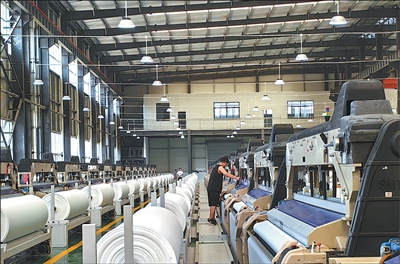
园区厂房闲置,后续盘活了吗?(干部状态新观察·走进一线探作风)
Ren Min Ri Bao· 2025-08-12 22:29
Core Insights - The article highlights the successful revitalization of a 63,000 square meter factory in the Guizhou Bijie High-tech Zone, which was transformed from a vacant facility into a productive textile manufacturing site within four months [1][4]. Group 1: Revitalization Efforts - The Bijie High-tech Zone has 369 enterprises focusing on new energy materials, new equipment manufacturing, and green ecological food and pharmaceuticals [1]. - The factory was previously underutilized due to the struggles of the original tenant, prompting local officials to seek new tenants and improve utilization rates [1][2]. - A shift in strategy from blind recruitment to selective investment was implemented to ensure sustainable growth and stability of incoming businesses [2]. Group 2: Investment and Development - A textile company from Jiangxi was attracted to the area, committing to an investment of 860 million yuan, with the project expected to create a complete industrial chain from fiber to finished clothing [4]. - The establishment of Bijie Hongsheng Textile Technology Co., Ltd. has led to the attraction of 15 additional upstream and downstream enterprises, indicating a positive ripple effect on local industry [4]. Group 3: Challenges and Solutions - The local government faced challenges in attracting businesses that demanded excessive incentives without initial investment, leading to a cautious approach in negotiations [2][4]. - The strategy included identifying and utilizing existing idle factory spaces effectively, with 140,000 square meters of factory space revitalized in the first half of the year [6]. Group 4: Future Plans - The local government aims to achieve 100% utilization of factory spaces, with ongoing efforts to identify and address underutilized facilities [5][7]. - Plans are in place to attract smaller, specialized enterprises to fill remaining vacant spaces, ensuring a diverse industrial ecosystem [5][6].

王台街道:擦亮“中国纺机名镇”金招牌
Da Zhong Ri Bao· 2025-03-31 02:07
Core Insights - The Wangtai Street textile machinery industry has evolved from small workshops in the 1950s to become the largest shuttleless loom production base in China, with over 1,600 textile machinery enterprises [1][2] - The region has established a complete industrial ecosystem and high local matching rate of 75%, producing 150,000 units of water jet looms annually, contributing significantly to the development of the textile machinery sector [1][2] Group 1 - Wangtai Street is recognized as "China's Textile Machinery Town" due to its rich industrial heritage and robust production capabilities [1] - The area is focusing on leading enterprises and industrial parks to drive innovation and upgrade the entire industry chain, including machinery, components, and services [1][2] - A cluster of enterprises has formed, led by established companies like Haijia and Dongjia, supported by key players and small businesses [1][2] Group 2 - Wangtai Street has established the first town-level chamber of commerce in the city and is promoting the formation of a textile machinery industry association [2] - Financial institutions have provided over 1.3 billion yuan in loans to more than 20 enterprises for equipment upgrades and energy-saving renovations [2] - The region has organized participation in over 50 industry exhibitions, resulting in nearly 1.5 billion yuan in intended orders [2] Group 3 - A textile machinery-themed museum has been established, showcasing over 300 exhibits that highlight the development history of the Wangtai textile machinery industry [2] - Plans are in place to create a 100,000 square meter "Vibrant Street" area to enhance the region's reputation as "China's Textile Machinery Town" [2] - Future initiatives will focus on optimizing industrial layout, enhancing service quality, and fostering collaboration with authoritative institutions to drive innovation in the textile machinery sector [2]